

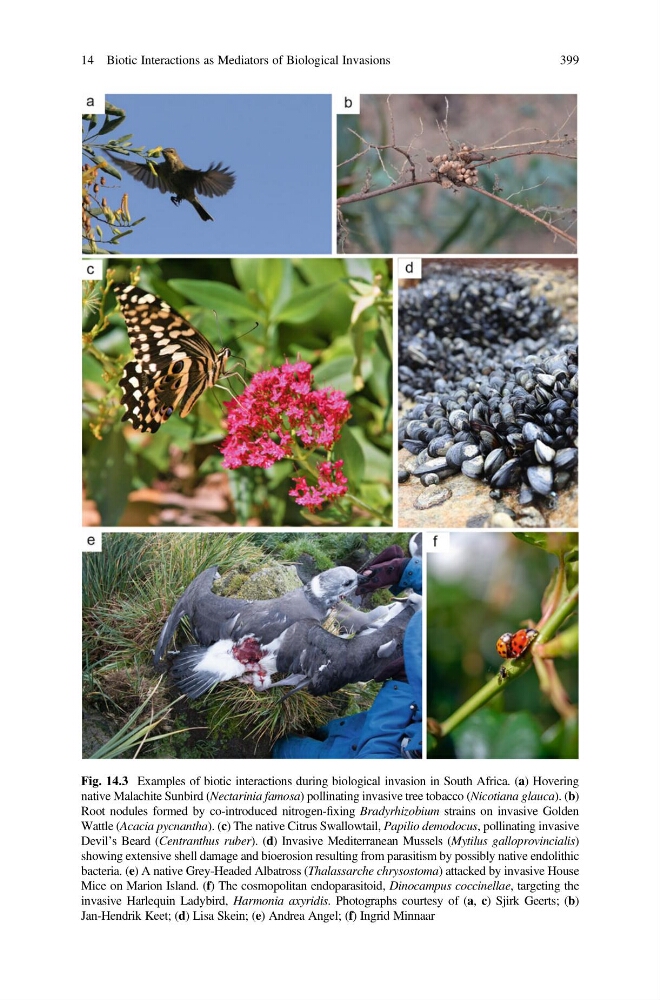
Fig. 14.3 Examples of biotic interactions during biological invasion in South Africa. (a) Hovering
native Malachite Sunbird (Nectarinia famosa) pollinating invasive tree tobacco (Nicotiana glauca). (b)
Root nodules formed by co-introduced nitrogen-fixing Bradyrhizobium strains on invasive Golden
Wattle (Acacia pycnantha). (c) The native Citrus Swallowtail, Papilio demodocus, pollinating invasive
Devil’s Beard (Centranthus ruber). (d) Invasive Mediterranean Mussels (Mytilus galloprovincialis)
showing extensive shell damage and bioerosion resulting from parasitism by possibly native endolithic
bacteria. (e) A native Grey-Headed Albatross (Thalassarche chrysostoma) attacked by invasive House
Mice on Marion Island. (f) The cosmopolitan endoparasitoid, Dinocampus coccinellae, targeting the
invasive Harlequin Ladybird, Harmonia axyridis. Photographs courtesy of (a, c) Sjirk Geerts; (b)
Jan-Hendrik Keet; (d) Lisa Skein; (e) Andrea Angel; (f) Ingrid Minnaar
14 Biotic Interactions as Mediators of Biological Invasions
399
native Malachite Sunbird (Nectarinia famosa) pollinating invasive tree tobacco (Nicotiana glauca). (b)
Root nodules formed by co-introduced nitrogen-fixing Bradyrhizobium strains on invasive Golden
Wattle (Acacia pycnantha). (c) The native Citrus Swallowtail, Papilio demodocus, pollinating invasive
Devil’s Beard (Centranthus ruber). (d) Invasive Mediterranean Mussels (Mytilus galloprovincialis)
showing extensive shell damage and bioerosion resulting from parasitism by possibly native endolithic
bacteria. (e) A native Grey-Headed Albatross (Thalassarche chrysostoma) attacked by invasive House
Mice on Marion Island. (f) The cosmopolitan endoparasitoid, Dinocampus coccinellae, targeting the
invasive Harlequin Ladybird, Harmonia axyridis. Photographs courtesy of (a, c) Sjirk Geerts; (b)
Jan-Hendrik Keet; (d) Lisa Skein; (e) Andrea Angel; (f) Ingrid Minnaar
14 Biotic Interactions as Mediators of Biological Invasions
399