

interact with mutualists that they share a co-evolutionary history with, and vice versa
(Bascompte 2009). Therefore, modularity and/or nestedness of networks are dependent on the prevalence of interaction specialisation within communities.
Following introduction, the reassembly of beneficial mutualistic interactions are
clearly more important for successful establishment and subsequent invasion than
the formation of harmful antagonistic interactions. So how do aliens typically
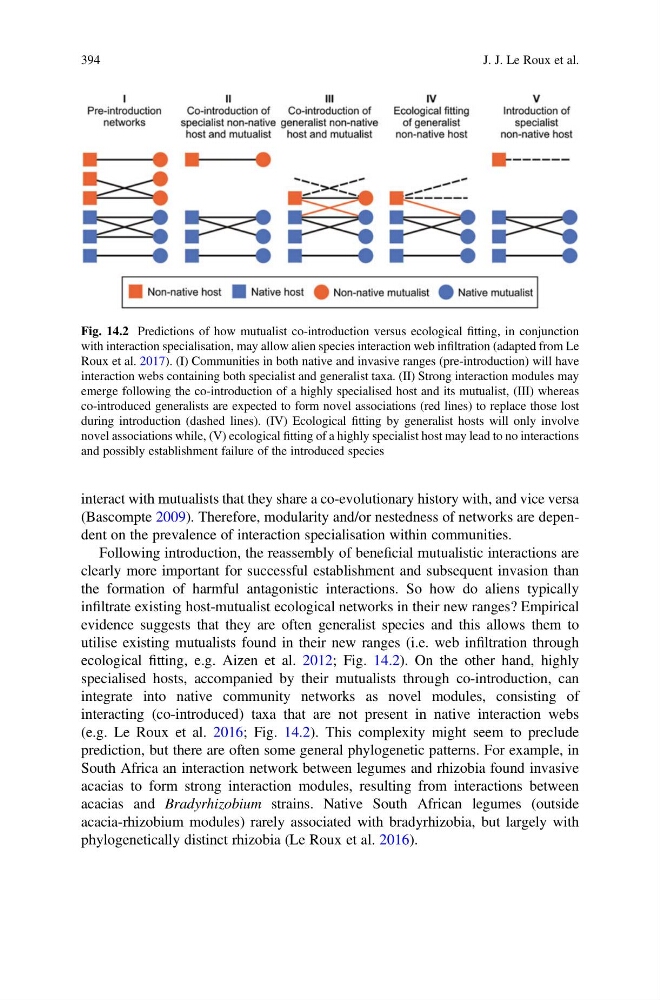
infiltrate existing host-mutualist ecological networks in their new ranges? Empirical
evidence suggests that they are often generalist species and this allows them to
utilise existing mutualists found in their new ranges (i.e. web infiltration through
ecological fitting, e.g. Aizen et al. 2012; Fig. 14.2). On the other hand, highly
specialised hosts, accompanied by their mutualists through co-introduction, can
integrate into native community networks as novel modules, consisting of
interacting (co-introduced) taxa that are not present in native interaction webs
(e.g. Le Roux et al. 2016; Fig. 14.2). This complexity might seem to preclude
prediction, but there are often some general phylogenetic patterns. For example, in
South Africa an interaction network between legumes and rhizobia found invasive
acacias to form strong interaction modules, resulting from interactions between
acacias and Bradyrhizobium strains. Native South African legumes (outside
acacia-rhizobium modules) rarely associated with bradyrhizobia, but largely with
phylogenetically distinct rhizobia (Le Roux et al. 2016).
Fig. 14.2 Predictions of how mutualist co-introduction versus ecological fitting, in conjunction
with interaction specialisation, may allow alien species interaction web infiltration (adapted from Le
Roux et al. 2017). (I) Communities in both native and invasive ranges (pre-introduction) will have
interaction webs containing both specialist and generalist taxa. (II) Strong interaction modules may
emerge following the co-introduction of a highly specialised host and its mutualist, (III) whereas
co-introduced generalists are expected to form novel associations (red lines) to replace those lost
during introduction (dashed lines). (IV) Ecological fitting by generalist hosts will only involve
novel associations while, (V) ecological fitting of a highly specialist host may lead to no interactions
and possibly establishment failure of the introduced species
394
J. J. Le Roux et al.
(Bascompte 2009). Therefore, modularity and/or nestedness of networks are dependent on the prevalence of interaction specialisation within communities.
Following introduction, the reassembly of beneficial mutualistic interactions are
clearly more important for successful establishment and subsequent invasion than
the formation of harmful antagonistic interactions. So how do aliens typically
infiltrate existing host-mutualist ecological networks in their new ranges? Empirical
evidence suggests that they are often generalist species and this allows them to
utilise existing mutualists found in their new ranges (i.e. web infiltration through
ecological fitting, e.g. Aizen et al. 2012; Fig. 14.2). On the other hand, highly
specialised hosts, accompanied by their mutualists through co-introduction, can
integrate into native community networks as novel modules, consisting of
interacting (co-introduced) taxa that are not present in native interaction webs
(e.g. Le Roux et al. 2016; Fig. 14.2). This complexity might seem to preclude
prediction, but there are often some general phylogenetic patterns. For example, in
South Africa an interaction network between legumes and rhizobia found invasive
acacias to form strong interaction modules, resulting from interactions between
acacias and Bradyrhizobium strains. Native South African legumes (outside
acacia-rhizobium modules) rarely associated with bradyrhizobia, but largely with
phylogenetically distinct rhizobia (Le Roux et al. 2016).
Fig. 14.2 Predictions of how mutualist co-introduction versus ecological fitting, in conjunction
with interaction specialisation, may allow alien species interaction web infiltration (adapted from Le
Roux et al. 2017). (I) Communities in both native and invasive ranges (pre-introduction) will have
interaction webs containing both specialist and generalist taxa. (II) Strong interaction modules may
emerge following the co-introduction of a highly specialised host and its mutualist, (III) whereas
co-introduced generalists are expected to form novel associations (red lines) to replace those lost
during introduction (dashed lines). (IV) Ecological fitting by generalist hosts will only involve
novel associations while, (V) ecological fitting of a highly specialist host may lead to no interactions
and possibly establishment failure of the introduced species
394
J. J. Le Roux et al.