

interactions during biological invasions in South Africa, covering a wide range of
taxonomic groups and interaction types. We first discuss the different ways in which
interactions can be reassembled following the introduction of alien species, and how
these depend on the eco-evolutionary experience of the alien species. We then
discuss documented examples of parasitism and mutualism associated with invasions in South Africa and how these relate to various ecological and evolutionary
hypotheses aimed at explaining species invasiveness. Selected examples of how
invasive species impact on native species interactions are provided. A diverse array
of biotic interactions (e.g. pollination, fish and mollusc parasitism, plant-soil mutualistic bacteria, seed dispersal) have been studied for various invasive species in
South Africa. Surprisingly, only a few of these studies explicitly tested any of the
major hypotheses that invoke biotic interactions and are commonly tested in invasion ecology. We argue that many invasions in South Africa are promising candidates for testing hypotheses related to species interactions and invasiveness.
14.1 Introduction
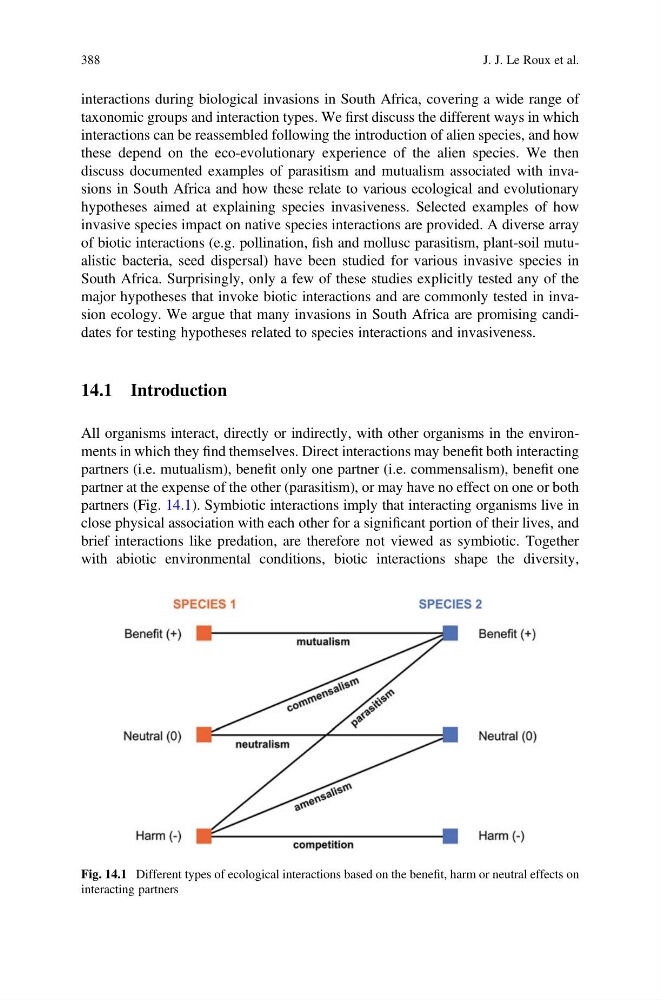
All organisms interact, directly or indirectly, with other organisms in the environments in which they find themselves. Direct interactions may benefit both interacting
partners (i.e. mutualism), benefit only one partner (i.e. commensalism), benefit one
partner at the expense of the other (parasitism), or may have no effect on one or both
partners (Fig. 14.1). Symbiotic interactions imply that interacting organisms live in
close physical association with each other for a significant portion of their lives, and
brief interactions like predation, are therefore not viewed as symbiotic. Together
with abiotic environmental conditions, biotic interactions shape the diversity,
Fig. 14.1 Different types of ecological interactions based on the benefit, harm or neutral effects on
interacting partners
388
J. J. Le Roux et al.
taxonomic groups and interaction types. We first discuss the different ways in which
interactions can be reassembled following the introduction of alien species, and how
these depend on the eco-evolutionary experience of the alien species. We then
discuss documented examples of parasitism and mutualism associated with invasions in South Africa and how these relate to various ecological and evolutionary
hypotheses aimed at explaining species invasiveness. Selected examples of how
invasive species impact on native species interactions are provided. A diverse array
of biotic interactions (e.g. pollination, fish and mollusc parasitism, plant-soil mutualistic bacteria, seed dispersal) have been studied for various invasive species in
South Africa. Surprisingly, only a few of these studies explicitly tested any of the
major hypotheses that invoke biotic interactions and are commonly tested in invasion ecology. We argue that many invasions in South Africa are promising candidates for testing hypotheses related to species interactions and invasiveness.
14.1 Introduction
All organisms interact, directly or indirectly, with other organisms in the environments in which they find themselves. Direct interactions may benefit both interacting
partners (i.e. mutualism), benefit only one partner (i.e. commensalism), benefit one
partner at the expense of the other (parasitism), or may have no effect on one or both
partners (Fig. 14.1). Symbiotic interactions imply that interacting organisms live in
close physical association with each other for a significant portion of their lives, and
brief interactions like predation, are therefore not viewed as symbiotic. Together
with abiotic environmental conditions, biotic interactions shape the diversity,
Fig. 14.1 Different types of ecological interactions based on the benefit, harm or neutral effects on
interacting partners
388
J. J. Le Roux et al.