

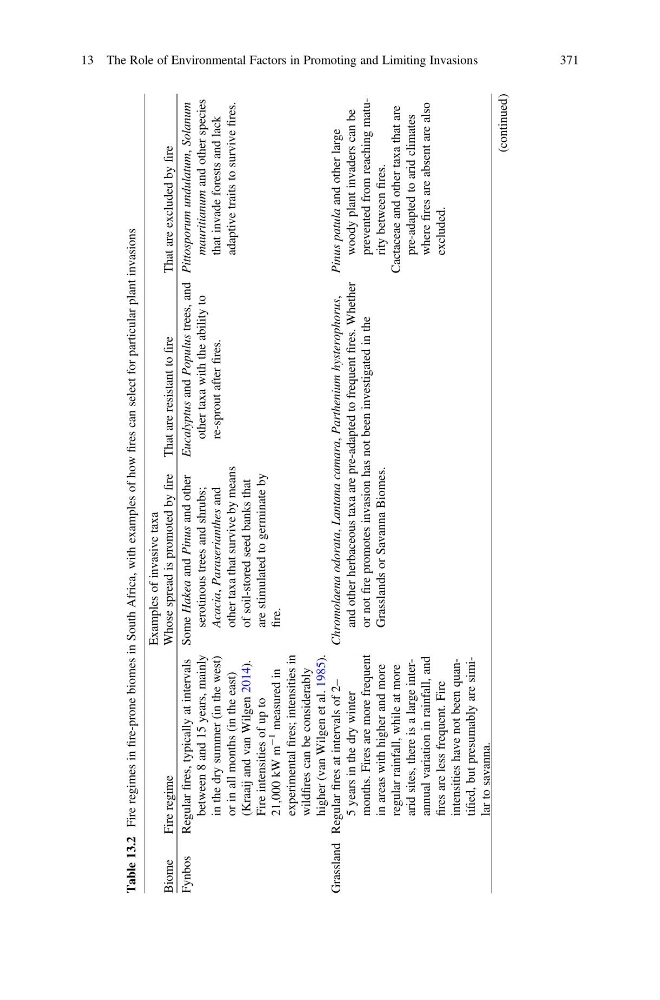
Table 13.2
Fire regimes in
fire-prone biomes in South Africa, with examples of how
fires can select for particular plant invasions
Biome
Fire regime
Examples of invasive taxa
Whose spread is promoted by
fire That are resistant to
fire
That are excluded by
fire
Fynbos
Regular
fires, typically at intervals
between 8 and 15 years, mainly
in the dry summer (in the west)
or in all months (in the east)
(Kraaij and van Wilgen 2014).
Fire intensities of up to
21,000 kW m
À1
measured in
experimental
fires; intensities in
wildfires can be considerably
higher (van Wilgen et al. 1985).
Some Hakea
and Pinus
and other
serotinous trees and shrubs;
Acacia, Paraserianthes
and
other taxa that survive by means
of soil-stored seed banks that
are stimulated to germinate by
fire.
Eucalyptus
and Populus
trees, and
other taxa with the ability to
re-sprout after
fires.
Pittosporum undulatum, Solanum
mauritianum
and other species
that invade forests and lack
adaptive traits to survive
fires.
Grassland Regular
fires at intervals of 2–
5 years in the dry winter
months. Fires are more frequent
in areas with higher and more
regular rainfall, while at more
arid sites, there is a large interannual variation in rainfall, and
fires are less frequent. Fire
intensities have not been quantified, but presumably are similar to savanna.
Chromolaena odorata, Lantana camara, Parthenium hysterophorus,
and other herbaceous taxa are pre-adapted to frequent
fires. Whether
or not
fire promotes invasion has not been investigated in the
Grasslands or Savanna Biomes.
Pinus patula
and other large
woody plant invaders can be
prevented from reaching maturity between
fires.
Cactaceae and other taxa that are
pre-adapted to arid climates
where
fires are absent are also
excluded.
(continued)
13 The Role of Environmental Factors in Promoting and Limiting Invasions
371
Fire regimes in
fire-prone biomes in South Africa, with examples of how
fires can select for particular plant invasions
Biome
Fire regime
Examples of invasive taxa
Whose spread is promoted by
fire That are resistant to
fire
That are excluded by
fire
Fynbos
Regular
fires, typically at intervals
between 8 and 15 years, mainly
in the dry summer (in the west)
or in all months (in the east)
(Kraaij and van Wilgen 2014).
Fire intensities of up to
21,000 kW m
À1
measured in
experimental
fires; intensities in
wildfires can be considerably
higher (van Wilgen et al. 1985).
Some Hakea
and Pinus
and other
serotinous trees and shrubs;
Acacia, Paraserianthes
and
other taxa that survive by means
of soil-stored seed banks that
are stimulated to germinate by
fire.
Eucalyptus
and Populus
trees, and
other taxa with the ability to
re-sprout after
fires.
Pittosporum undulatum, Solanum
mauritianum
and other species
that invade forests and lack
adaptive traits to survive
fires.
Grassland Regular
fires at intervals of 2–
5 years in the dry winter
months. Fires are more frequent
in areas with higher and more
regular rainfall, while at more
arid sites, there is a large interannual variation in rainfall, and
fires are less frequent. Fire
intensities have not been quantified, but presumably are similar to savanna.
Chromolaena odorata, Lantana camara, Parthenium hysterophorus,
and other herbaceous taxa are pre-adapted to frequent
fires. Whether
or not
fire promotes invasion has not been investigated in the
Grasslands or Savanna Biomes.
Pinus patula
and other large
woody plant invaders can be
prevented from reaching maturity between
fires.
Cactaceae and other taxa that are
pre-adapted to arid climates
where
fires are absent are also
excluded.
(continued)
13 The Role of Environmental Factors in Promoting and Limiting Invasions
371