

Box 11.3 The Polyphagous Shot Hole Borer and Fusarium Dieback
in South Africa
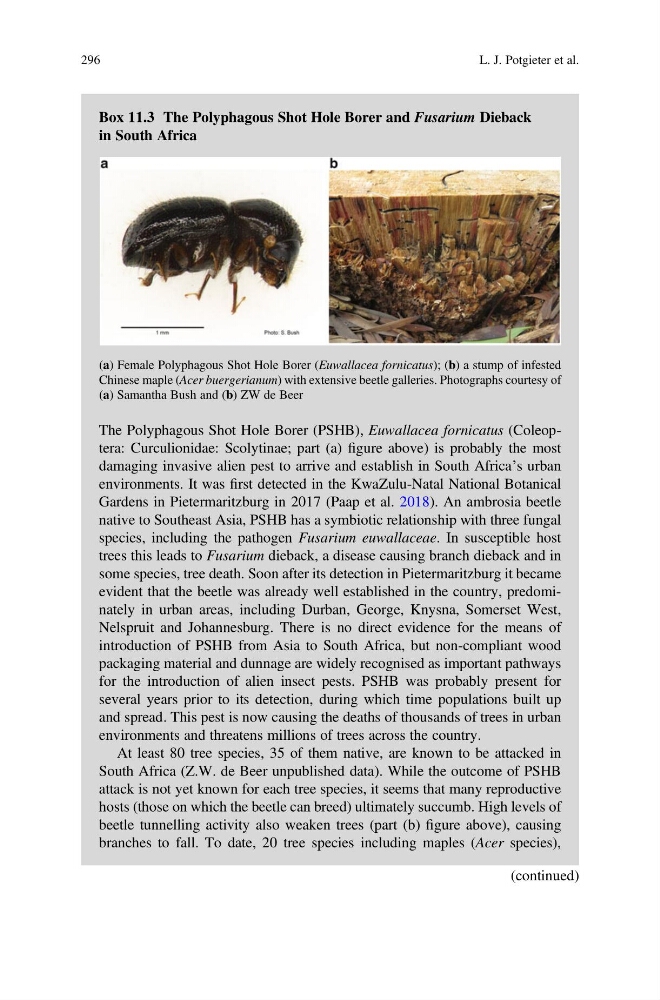
(a) Female Polyphagous Shot Hole Borer (Euwallacea fornicatus); (b) a stump of infested
Chinese maple (Acer buergerianum) with extensive beetle galleries. Photographs courtesy of
(a) Samantha Bush and (b) ZW de Beer
The Polyphagous Shot Hole Borer (PSHB), Euwallacea fornicatus (Coleoptera: Curculionidae: Scolytinae; part (a) figure above) is probably the most
damaging invasive alien pest to arrive and establish in South Africa’s urban
environments. It was first detected in the KwaZulu-Natal National Botanical
Gardens in Pietermaritzburg in 2017 (Paap et al. 2018). An ambrosia beetle
native to Southeast Asia, PSHB has a symbiotic relationship with three fungal
species, including the pathogen Fusarium euwallaceae. In susceptible host
trees this leads to Fusarium dieback, a disease causing branch dieback and in
some species, tree death. Soon after its detection in Pietermaritzburg it became
evident that the beetle was already well established in the country, predominately in urban areas, including Durban, George, Knysna, Somerset West,
Nelspruit and Johannesburg. There is no direct evidence for the means of
introduction of PSHB from Asia to South Africa, but non-compliant wood
packaging material and dunnage are widely recognised as important pathways
for the introduction of alien insect pests. PSHB was probably present for
several years prior to its detection, during which time populations built up
and spread. This pest is now causing the deaths of thousands of trees in urban
environments and threatens millions of trees across the country.
At least 80 tree species, 35 of them native, are known to be attacked in
South Africa (Z.W. de Beer unpublished data). While the outcome of PSHB
attack is not yet known for each tree species, it seems that many reproductive
hosts (those on which the beetle can breed) ultimately succumb. High levels of
beetle tunnelling activity also weaken trees (part (b) figure above), causing
branches to fall. To date, 20 tree species including maples (Acer species),
(continued)
296
L. J. Potgieter et al.
in South Africa
(a) Female Polyphagous Shot Hole Borer (Euwallacea fornicatus); (b) a stump of infested
Chinese maple (Acer buergerianum) with extensive beetle galleries. Photographs courtesy of
(a) Samantha Bush and (b) ZW de Beer
The Polyphagous Shot Hole Borer (PSHB), Euwallacea fornicatus (Coleoptera: Curculionidae: Scolytinae; part (a) figure above) is probably the most
damaging invasive alien pest to arrive and establish in South Africa’s urban
environments. It was first detected in the KwaZulu-Natal National Botanical
Gardens in Pietermaritzburg in 2017 (Paap et al. 2018). An ambrosia beetle
native to Southeast Asia, PSHB has a symbiotic relationship with three fungal
species, including the pathogen Fusarium euwallaceae. In susceptible host
trees this leads to Fusarium dieback, a disease causing branch dieback and in
some species, tree death. Soon after its detection in Pietermaritzburg it became
evident that the beetle was already well established in the country, predominately in urban areas, including Durban, George, Knysna, Somerset West,
Nelspruit and Johannesburg. There is no direct evidence for the means of
introduction of PSHB from Asia to South Africa, but non-compliant wood
packaging material and dunnage are widely recognised as important pathways
for the introduction of alien insect pests. PSHB was probably present for
several years prior to its detection, during which time populations built up
and spread. This pest is now causing the deaths of thousands of trees in urban
environments and threatens millions of trees across the country.
At least 80 tree species, 35 of them native, are known to be attacked in
South Africa (Z.W. de Beer unpublished data). While the outcome of PSHB
attack is not yet known for each tree species, it seems that many reproductive
hosts (those on which the beetle can breed) ultimately succumb. High levels of
beetle tunnelling activity also weaken trees (part (b) figure above), causing
branches to fall. To date, 20 tree species including maples (Acer species),
(continued)
296
L. J. Potgieter et al.