

Box 11.1 (continued)
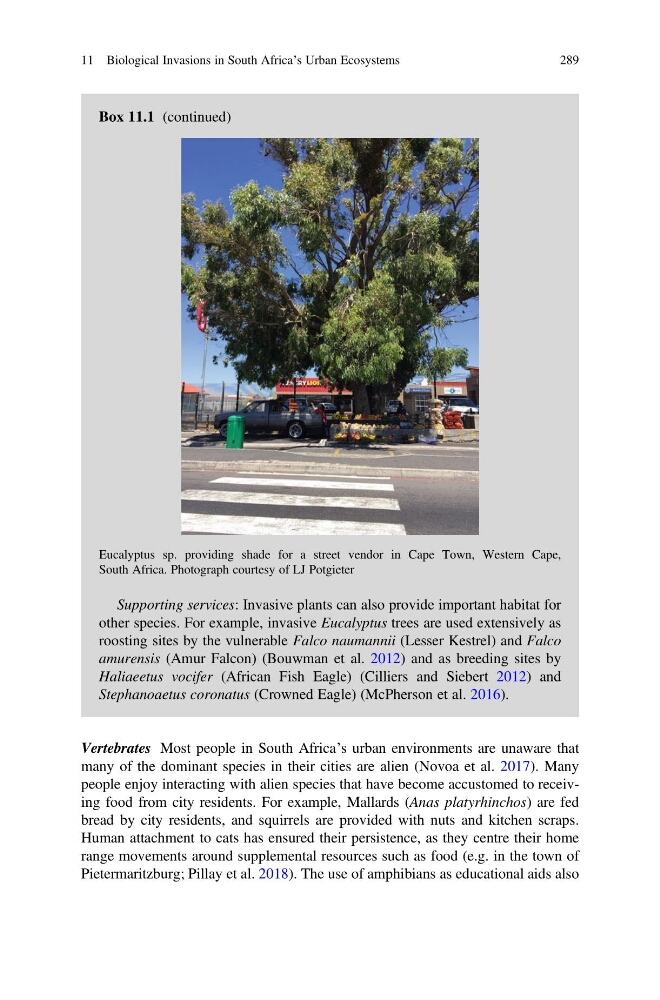
Eucalyptus sp. providing shade for a street vendor in Cape Town, Western Cape,
South Africa. Photograph courtesy of LJ Potgieter
Supporting services: Invasive plants can also provide important habitat for
other species. For example, invasive Eucalyptus trees are used extensively as
roosting sites by the vulnerable Falco naumannii (Lesser Kestrel) and Falco
amurensis (Amur Falcon) (Bouwman et al. 2012) and as breeding sites by
Haliaeetus vocifer (African Fish Eagle) (Cilliers and Siebert 2012) and
Stephanoaetus coronatus (Crowned Eagle) (McPherson et al. 2016).
Vertebrates Most people in South Africa’s urban environments are unaware that
many of the dominant species in their cities are alien (Novoa et al. 2017). Many
people enjoy interacting with alien species that have become accustomed to receiving food from city residents. For example, Mallards (Anas platyrhinchos) are fed
bread by city residents, and squirrels are provided with nuts and kitchen scraps.
Human attachment to cats has ensured their persistence, as they centre their home
range movements around supplemental resources such as food (e.g. in the town of
Pietermaritzburg; Pillay et al. 2018). The use of amphibians as educational aids also
11 Biological Invasions in South Africa’s Urban Ecosystems
289
Eucalyptus sp. providing shade for a street vendor in Cape Town, Western Cape,
South Africa. Photograph courtesy of LJ Potgieter
Supporting services: Invasive plants can also provide important habitat for
other species. For example, invasive Eucalyptus trees are used extensively as
roosting sites by the vulnerable Falco naumannii (Lesser Kestrel) and Falco
amurensis (Amur Falcon) (Bouwman et al. 2012) and as breeding sites by
Haliaeetus vocifer (African Fish Eagle) (Cilliers and Siebert 2012) and
Stephanoaetus coronatus (Crowned Eagle) (McPherson et al. 2016).
Vertebrates Most people in South Africa’s urban environments are unaware that
many of the dominant species in their cities are alien (Novoa et al. 2017). Many
people enjoy interacting with alien species that have become accustomed to receiving food from city residents. For example, Mallards (Anas platyrhinchos) are fed
bread by city residents, and squirrels are provided with nuts and kitchen scraps.
Human attachment to cats has ensured their persistence, as they centre their home
range movements around supplemental resources such as food (e.g. in the town of
Pietermaritzburg; Pillay et al. 2018). The use of amphibians as educational aids also
11 Biological Invasions in South Africa’s Urban Ecosystems
289