

Box 11.1 (continued)
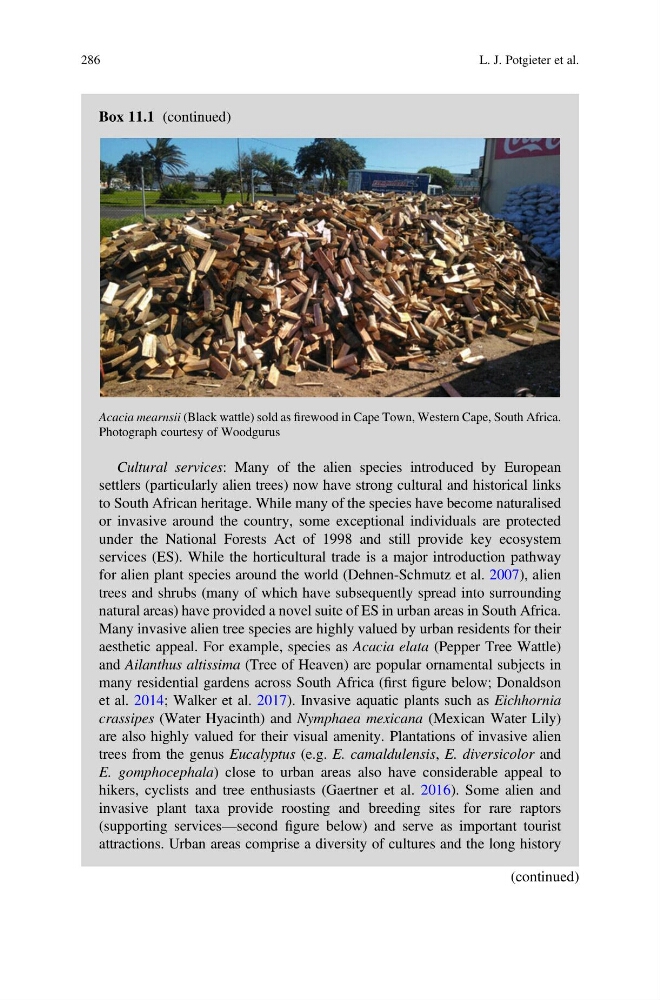
Acacia mearnsii (Black wattle) sold as firewood in Cape Town, Western Cape, South Africa.
Photograph courtesy of Woodgurus
Cultural services: Many of the alien species introduced by European
settlers (particularly alien trees) now have strong cultural and historical links
to South African heritage. While many of the species have become naturalised
or invasive around the country, some exceptional individuals are protected
under the National Forests Act of 1998 and still provide key ecosystem
services (ES). While the horticultural trade is a major introduction pathway
for alien plant species around the world (Dehnen-Schmutz et al. 2007), alien
trees and shrubs (many of which have subsequently spread into surrounding
natural areas) have provided a novel suite of ES in urban areas in South Africa.
Many invasive alien tree species are highly valued by urban residents for their
aesthetic appeal. For example, species as Acacia elata (Pepper Tree Wattle)
and Ailanthus altissima (Tree of Heaven) are popular ornamental subjects in
many residential gardens across South Africa (first figure below; Donaldson
et al. 2014; Walker et al. 2017). Invasive aquatic plants such as Eichhornia
crassipes (Water Hyacinth) and Nymphaea mexicana (Mexican Water Lily)
are also highly valued for their visual amenity. Plantations of invasive alien
trees from the genus Eucalyptus (e.g. E. camaldulensis, E. diversicolor and
E. gomphocephala) close to urban areas also have considerable appeal to
hikers, cyclists and tree enthusiasts (Gaertner et al. 2016). Some alien and
invasive plant taxa provide roosting and breeding sites for rare raptors
(supporting services—second figure below) and serve as important tourist
attractions. Urban areas comprise a diversity of cultures and the long history
(continued)
286
L. J. Potgieter et al.
Acacia mearnsii (Black wattle) sold as firewood in Cape Town, Western Cape, South Africa.
Photograph courtesy of Woodgurus
Cultural services: Many of the alien species introduced by European
settlers (particularly alien trees) now have strong cultural and historical links
to South African heritage. While many of the species have become naturalised
or invasive around the country, some exceptional individuals are protected
under the National Forests Act of 1998 and still provide key ecosystem
services (ES). While the horticultural trade is a major introduction pathway
for alien plant species around the world (Dehnen-Schmutz et al. 2007), alien
trees and shrubs (many of which have subsequently spread into surrounding
natural areas) have provided a novel suite of ES in urban areas in South Africa.
Many invasive alien tree species are highly valued by urban residents for their
aesthetic appeal. For example, species as Acacia elata (Pepper Tree Wattle)
and Ailanthus altissima (Tree of Heaven) are popular ornamental subjects in
many residential gardens across South Africa (first figure below; Donaldson
et al. 2014; Walker et al. 2017). Invasive aquatic plants such as Eichhornia
crassipes (Water Hyacinth) and Nymphaea mexicana (Mexican Water Lily)
are also highly valued for their visual amenity. Plantations of invasive alien
trees from the genus Eucalyptus (e.g. E. camaldulensis, E. diversicolor and
E. gomphocephala) close to urban areas also have considerable appeal to
hikers, cyclists and tree enthusiasts (Gaertner et al. 2016). Some alien and
invasive plant taxa provide roosting and breeding sites for rare raptors
(supporting services—second figure below) and serve as important tourist
attractions. Urban areas comprise a diversity of cultures and the long history
(continued)
286
L. J. Potgieter et al.