

Fig. 11.1
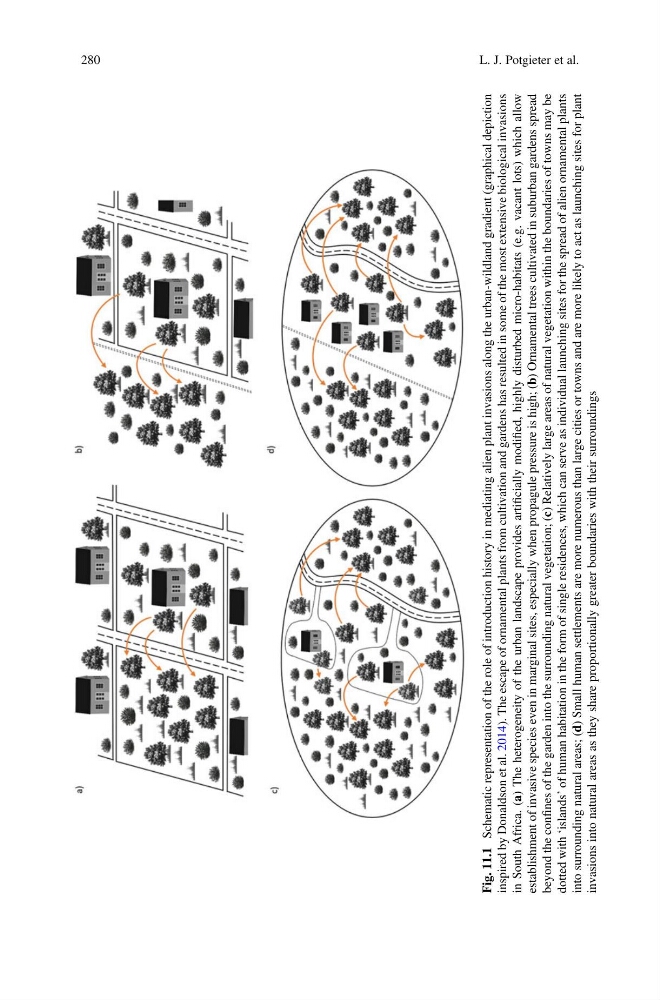
Schematic representation of the role of introduction history in mediating alien plant invasions along the urban-wildland gradient (graphical depiction
inspired by Donaldson et al. 2014). The escape of ornamental plants from cultivation and gardens has resulted in some of the most extensive biological invasions
in South Africa. (a) The heterogeneity of the urban landscape provides artificially modified, highly disturbed micro-habitats (e.g. vacant lots) which allow
establishment of invasive species even in marginal sites, especially when propagule pressure is high; (b) Ornamental trees cultivated in suburban gardens spread
beyond the confines of the garden into the surrounding natural vegetation; (c) Relatively large areas of natural vegetation within the boundaries of towns may be
dotted with
‘islands’ of human habitation in the form of single residences, which can serve as individual launching sites for the spread of alien ornamental plants
into surrounding natural areas; (d) Small human settlements are more numerous than large cities or towns and are more likely to act as launching sites for plant
invasions into natural areas as they share proportionally greater boundaries with their surroundings
280
L. J. Potgieter et al.
Schematic representation of the role of introduction history in mediating alien plant invasions along the urban-wildland gradient (graphical depiction
inspired by Donaldson et al. 2014). The escape of ornamental plants from cultivation and gardens has resulted in some of the most extensive biological invasions
in South Africa. (a) The heterogeneity of the urban landscape provides artificially modified, highly disturbed micro-habitats (e.g. vacant lots) which allow
establishment of invasive species even in marginal sites, especially when propagule pressure is high; (b) Ornamental trees cultivated in suburban gardens spread
beyond the confines of the garden into the surrounding natural vegetation; (c) Relatively large areas of natural vegetation within the boundaries of towns may be
dotted with
‘islands’ of human habitation in the form of single residences, which can serve as individual launching sites for the spread of alien ornamental plants
into surrounding natural areas; (d) Small human settlements are more numerous than large cities or towns and are more likely to act as launching sites for plant
invasions into natural areas as they share proportionally greater boundaries with their surroundings
280
L. J. Potgieter et al.