

10.2.3 Rinderpest
Perhaps the most dramatic example of an invasive animal disease was rinderpest.
This virus, which expanded its reach to affect the globe, is now distinguished as the
second infectious disease to be globally eradicated (the first being smallpox, see
below) (World Organisation for Animal Health 2011; Roeder 2011; Roeder et al.
2013). It is a classic example of an introduced disease with devastating consequences. However, due to rapid transmission through a susceptible population
with near 100% fatality, it did not become endemic in South Africa. It was known
in Roman times as a pestilence of cattle and other ruminants (Barrett and Rossiter
1999). It is caused by a morbillivirus, and its precursor most likely gave rise also to
the human disease, measles (Haas and Barrett 1996; Pearce-Duvet 2006). Introduced
from Asia in the mid 1800s, rinderpest killed hundreds of millions of cattle in Europe
(Roeder 2011), making it a dreaded disease. It causes erosions in the gastro-intestinal
tract, resulting in severe diarrhoea and death from dehydration (Rossiter 1995).
Rinderpest was detected for the first time in South Africa in the Groot Marico
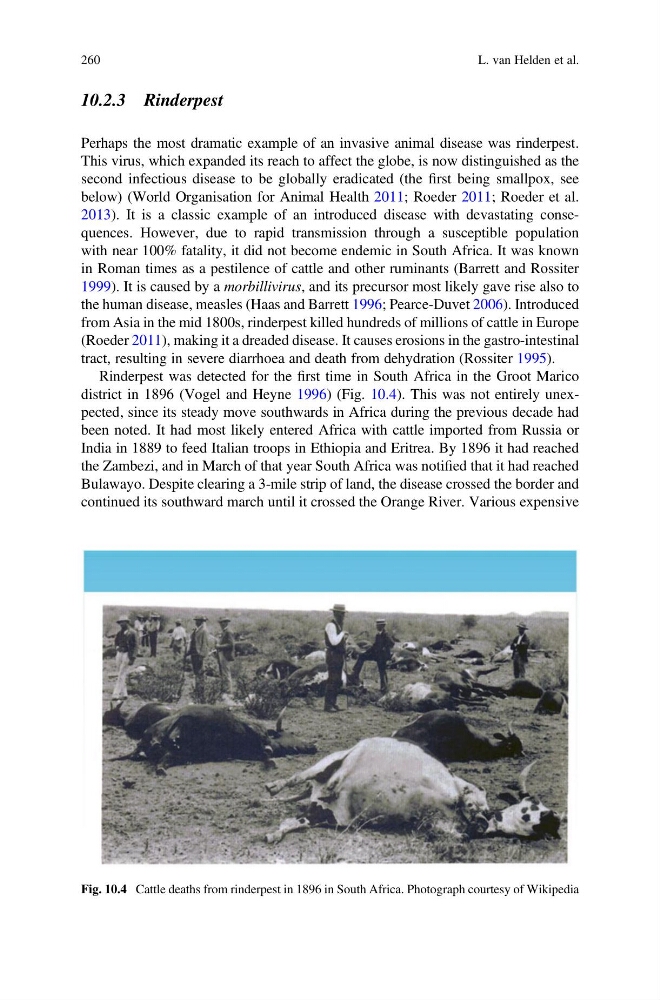
district in 1896 (Vogel and Heyne 1996) (Fig. 10.4). This was not entirely unexpected, since its steady move southwards in Africa during the previous decade had
been noted. It had most likely entered Africa with cattle imported from Russia or
India in 1889 to feed Italian troops in Ethiopia and Eritrea. By 1896 it had reached
the Zambezi, and in March of that year South Africa was notified that it had reached
Bulawayo. Despite clearing a 3-mile strip of land, the disease crossed the border and
continued its southward march until it crossed the Orange River. Various expensive
Fig. 10.4 Cattle deaths from rinderpest in 1896 in South Africa. Photograph courtesy of Wikipedia
260
L. van Helden et al.
Perhaps the most dramatic example of an invasive animal disease was rinderpest.
This virus, which expanded its reach to affect the globe, is now distinguished as the
second infectious disease to be globally eradicated (the first being smallpox, see
below) (World Organisation for Animal Health 2011; Roeder 2011; Roeder et al.
2013). It is a classic example of an introduced disease with devastating consequences. However, due to rapid transmission through a susceptible population
with near 100% fatality, it did not become endemic in South Africa. It was known
in Roman times as a pestilence of cattle and other ruminants (Barrett and Rossiter
1999). It is caused by a morbillivirus, and its precursor most likely gave rise also to
the human disease, measles (Haas and Barrett 1996; Pearce-Duvet 2006). Introduced
from Asia in the mid 1800s, rinderpest killed hundreds of millions of cattle in Europe
(Roeder 2011), making it a dreaded disease. It causes erosions in the gastro-intestinal
tract, resulting in severe diarrhoea and death from dehydration (Rossiter 1995).
Rinderpest was detected for the first time in South Africa in the Groot Marico
district in 1896 (Vogel and Heyne 1996) (Fig. 10.4). This was not entirely unexpected, since its steady move southwards in Africa during the previous decade had
been noted. It had most likely entered Africa with cattle imported from Russia or
India in 1889 to feed Italian troops in Ethiopia and Eritrea. By 1896 it had reached
the Zambezi, and in March of that year South Africa was notified that it had reached
Bulawayo. Despite clearing a 3-mile strip of land, the disease crossed the border and
continued its southward march until it crossed the Orange River. Various expensive
Fig. 10.4 Cattle deaths from rinderpest in 1896 in South Africa. Photograph courtesy of Wikipedia
260
L. van Helden et al.