

disease has become endemic in South Africa, the observed pattern has been that of a
large initial outbreak, followed by a period of several years in which little disease is
observed. Once the susceptible population is restored in that area to a density that
facilitates disease transmission, secondary outbreaks of the disease are seen with this
cycle repeating every few years (Swanepoel 1995).
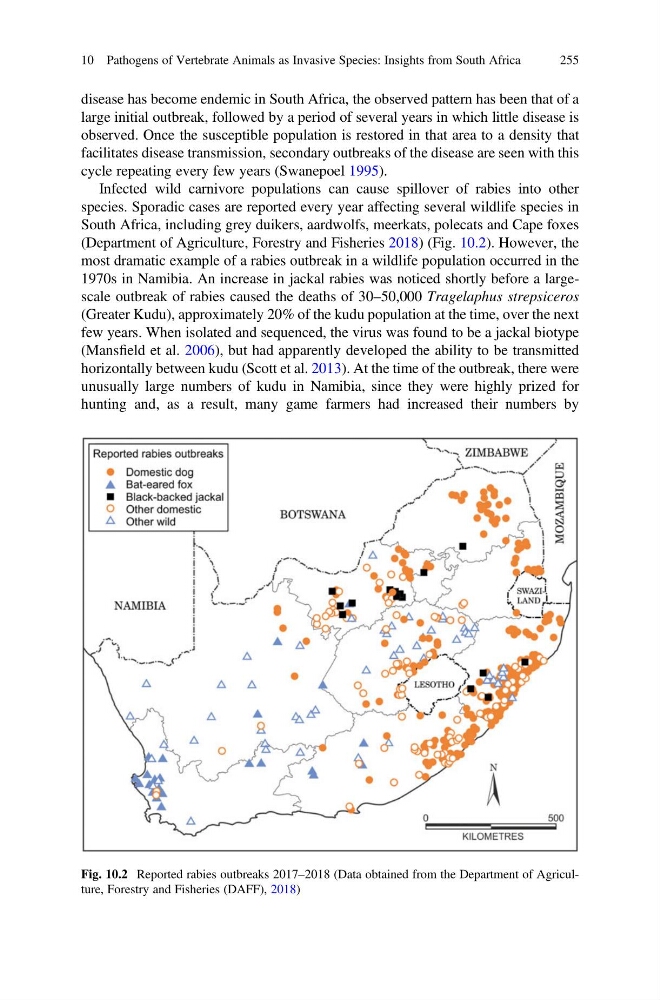
Infected wild carnivore populations can cause spillover of rabies into other
species. Sporadic cases are reported every year affecting several wildlife species in
South Africa, including grey duikers, aardwolfs, meerkats, polecats and Cape foxes
(Department of Agriculture, Forestry and Fisheries 2018) (Fig. 10.2). However, the
most dramatic example of a rabies outbreak in a wildlife population occurred in the
1970s in Namibia. An increase in jackal rabies was noticed shortly before a largescale outbreak of rabies caused the deaths of 30–50,000 Tragelaphus strepsiceros
(Greater Kudu), approximately 20% of the kudu population at the time, over the next
few years. When isolated and sequenced, the virus was found to be a jackal biotype
(Mansfield et al. 2006), but had apparently developed the ability to be transmitted
horizontally between kudu (Scott et al. 2013). At the time of the outbreak, there were
unusually large numbers of kudu in Namibia, since they were highly prized for
hunting and, as a result, many game farmers had increased their numbers by
Fig. 10.2 Reported rabies outbreaks 2017–2018 (Data obtained from the Department of Agriculture, Forestry and Fisheries (DAFF), 2018)
10 Pathogens of Vertebrate Animals as Invasive Species: Insights from South Africa
255
large initial outbreak, followed by a period of several years in which little disease is
observed. Once the susceptible population is restored in that area to a density that
facilitates disease transmission, secondary outbreaks of the disease are seen with this
cycle repeating every few years (Swanepoel 1995).
Infected wild carnivore populations can cause spillover of rabies into other
species. Sporadic cases are reported every year affecting several wildlife species in
South Africa, including grey duikers, aardwolfs, meerkats, polecats and Cape foxes
(Department of Agriculture, Forestry and Fisheries 2018) (Fig. 10.2). However, the
most dramatic example of a rabies outbreak in a wildlife population occurred in the
1970s in Namibia. An increase in jackal rabies was noticed shortly before a largescale outbreak of rabies caused the deaths of 30–50,000 Tragelaphus strepsiceros
(Greater Kudu), approximately 20% of the kudu population at the time, over the next
few years. When isolated and sequenced, the virus was found to be a jackal biotype
(Mansfield et al. 2006), but had apparently developed the ability to be transmitted
horizontally between kudu (Scott et al. 2013). At the time of the outbreak, there were
unusually large numbers of kudu in Namibia, since they were highly prized for
hunting and, as a result, many game farmers had increased their numbers by
Fig. 10.2 Reported rabies outbreaks 2017–2018 (Data obtained from the Department of Agriculture, Forestry and Fisheries (DAFF), 2018)
10 Pathogens of Vertebrate Animals as Invasive Species: Insights from South Africa
255