

disease seemed to be absent in dogs in South Africa (Swanepoel 1995). We believe
currently that this is due to a rabies biotype adapted to the Yellow Mongoose
(Cynictis penicillata) that has existed in South Africa since before written history.
Mongoose rabies was confirmed after years of anecdotal evidence when two children
were bitten by a Yellow Mongoose in 1928 and subsequently died of rabies
(Herzenberg 1928). Rabies was thereafter confirmed to be endemic in most of the
country, excluding the areas where Yellow Mongooses were not present. The virus is
maintained in the mongoose population, and occasionally affects other species of
animals that come into contact with a rabid mongoose, but has not shown itself
capable of establishing and maintaining itself in populations of other species
(Swanepoel 1995).
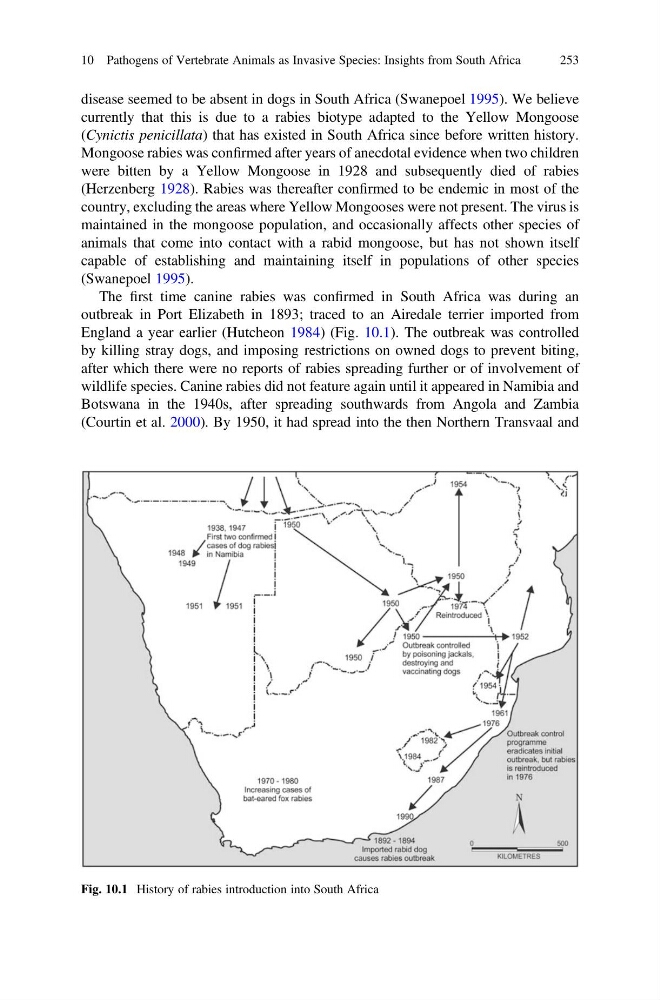
The first time canine rabies was confirmed in South Africa was during an
outbreak in Port Elizabeth in 1893; traced to an Airedale terrier imported from
England a year earlier (Hutcheon 1984) (Fig. 10.1). The outbreak was controlled
by killing stray dogs, and imposing restrictions on owned dogs to prevent biting,
after which there were no reports of rabies spreading further or of involvement of
wildlife species. Canine rabies did not feature again until it appeared in Namibia and
Botswana in the 1940s, after spreading southwards from Angola and Zambia
(Courtin et al. 2000). By 1950, it had spread into the then Northern Transvaal and
Fig. 10.1 History of rabies introduction into South Africa
10 Pathogens of Vertebrate Animals as Invasive Species: Insights from South Africa
253
currently that this is due to a rabies biotype adapted to the Yellow Mongoose
(Cynictis penicillata) that has existed in South Africa since before written history.
Mongoose rabies was confirmed after years of anecdotal evidence when two children
were bitten by a Yellow Mongoose in 1928 and subsequently died of rabies
(Herzenberg 1928). Rabies was thereafter confirmed to be endemic in most of the
country, excluding the areas where Yellow Mongooses were not present. The virus is
maintained in the mongoose population, and occasionally affects other species of
animals that come into contact with a rabid mongoose, but has not shown itself
capable of establishing and maintaining itself in populations of other species
(Swanepoel 1995).
The first time canine rabies was confirmed in South Africa was during an
outbreak in Port Elizabeth in 1893; traced to an Airedale terrier imported from
England a year earlier (Hutcheon 1984) (Fig. 10.1). The outbreak was controlled
by killing stray dogs, and imposing restrictions on owned dogs to prevent biting,
after which there were no reports of rabies spreading further or of involvement of
wildlife species. Canine rabies did not feature again until it appeared in Namibia and
Botswana in the 1940s, after spreading southwards from Angola and Zambia
(Courtin et al. 2000). By 1950, it had spread into the then Northern Transvaal and
Fig. 10.1 History of rabies introduction into South Africa
10 Pathogens of Vertebrate Animals as Invasive Species: Insights from South Africa
253