

size of this limpet has declined as the maximum size that individuals can reach is
now limited by the size of the mussel shell upon which they settle (Griffiths et al.
1992). While Scutellastra argenvillei has also been impacted by the
M. galloprovincialis invasion, the impact of the alien mussel on this limpet is
moderated by wave action (Steffani and Branch 2003). At high levels of wave action
the mussel has displaced the limpet, but at moderate wave exposures the limpet
persists and retains dominance of open rock. Maybe one of the most notable effects
of this invasive mussel has been its positive impact on the African Black Oystercatcher Haematopus moquini. Before the mussel invasion, the oystercatcher fed
predominantly on limpets and the native ribbed mussel Aulacomya atra, but following
invasion the birds were presented with an abundant new food source (Branch and
Steffani 2004). This resulted in increased breeding success and ultimately increased
population size of H. moquini along the west coast (Coleman and Hockey 2008). It is
notable that M. galloprovincialis is nearly free of internal parasites in South Africa,
unlike the endemic Perna perna, which has a 15–70% incidence of infection, slowing
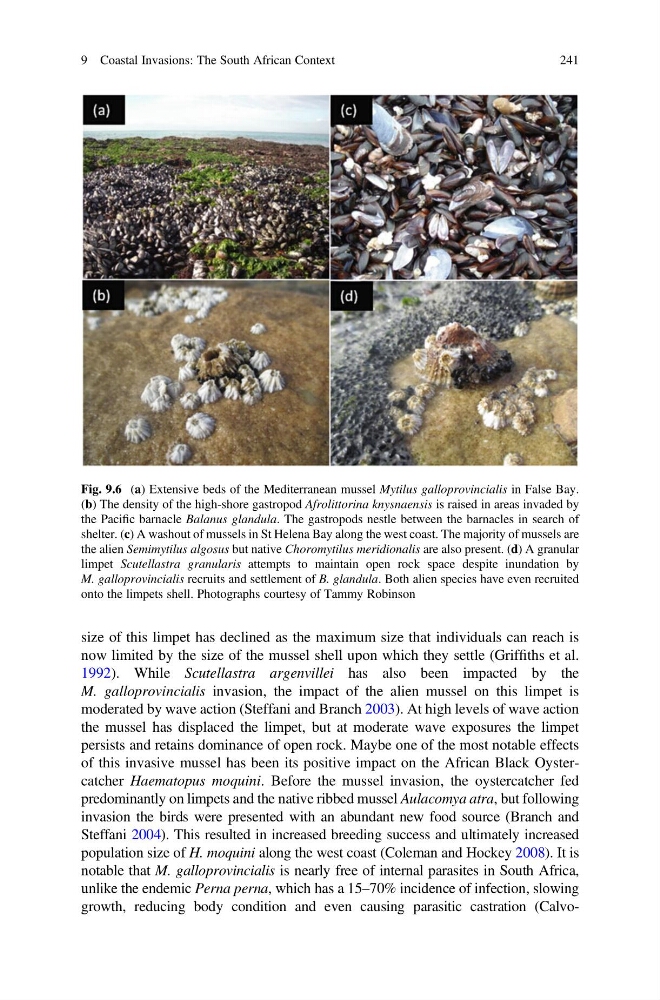
growth, reducing body condition and even causing parasitic castration (CalvoFig. 9.6 (a) Extensive beds of the Mediterranean mussel Mytilus galloprovincialis in False Bay.
(b) The density of the high-shore gastropod Afrolittorina knysnaensis is raised in areas invaded by
the Pacific barnacle Balanus glandula. The gastropods nestle between the barnacles in search of
shelter. (c) A washout of mussels in St Helena Bay along the west coast. The majority of mussels are
the alien Semimytilus algosus but native Choromytilus meridionalis are also present. (d) A granular
limpet Scutellastra granularis attempts to maintain open rock space despite inundation by
M. galloprovincialis recruits and settlement of B. glandula. Both alien species have even recruited
onto the limpets shell. Photographs courtesy of Tammy Robinson
9 Coastal Invasions: The South African Context
241
now limited by the size of the mussel shell upon which they settle (Griffiths et al.
1992). While Scutellastra argenvillei has also been impacted by the
M. galloprovincialis invasion, the impact of the alien mussel on this limpet is
moderated by wave action (Steffani and Branch 2003). At high levels of wave action
the mussel has displaced the limpet, but at moderate wave exposures the limpet
persists and retains dominance of open rock. Maybe one of the most notable effects
of this invasive mussel has been its positive impact on the African Black Oystercatcher Haematopus moquini. Before the mussel invasion, the oystercatcher fed
predominantly on limpets and the native ribbed mussel Aulacomya atra, but following
invasion the birds were presented with an abundant new food source (Branch and
Steffani 2004). This resulted in increased breeding success and ultimately increased
population size of H. moquini along the west coast (Coleman and Hockey 2008). It is
notable that M. galloprovincialis is nearly free of internal parasites in South Africa,
unlike the endemic Perna perna, which has a 15–70% incidence of infection, slowing
growth, reducing body condition and even causing parasitic castration (CalvoFig. 9.6 (a) Extensive beds of the Mediterranean mussel Mytilus galloprovincialis in False Bay.
(b) The density of the high-shore gastropod Afrolittorina knysnaensis is raised in areas invaded by
the Pacific barnacle Balanus glandula. The gastropods nestle between the barnacles in search of
shelter. (c) A washout of mussels in St Helena Bay along the west coast. The majority of mussels are
the alien Semimytilus algosus but native Choromytilus meridionalis are also present. (d) A granular
limpet Scutellastra granularis attempts to maintain open rock space despite inundation by
M. galloprovincialis recruits and settlement of B. glandula. Both alien species have even recruited
onto the limpets shell. Photographs courtesy of Tammy Robinson
9 Coastal Invasions: The South African Context
241