

becoming a sentinel for research and conservation (most recently) (de Villiers and
Cooper 2008), the probability of introducing new invasive alien species to the
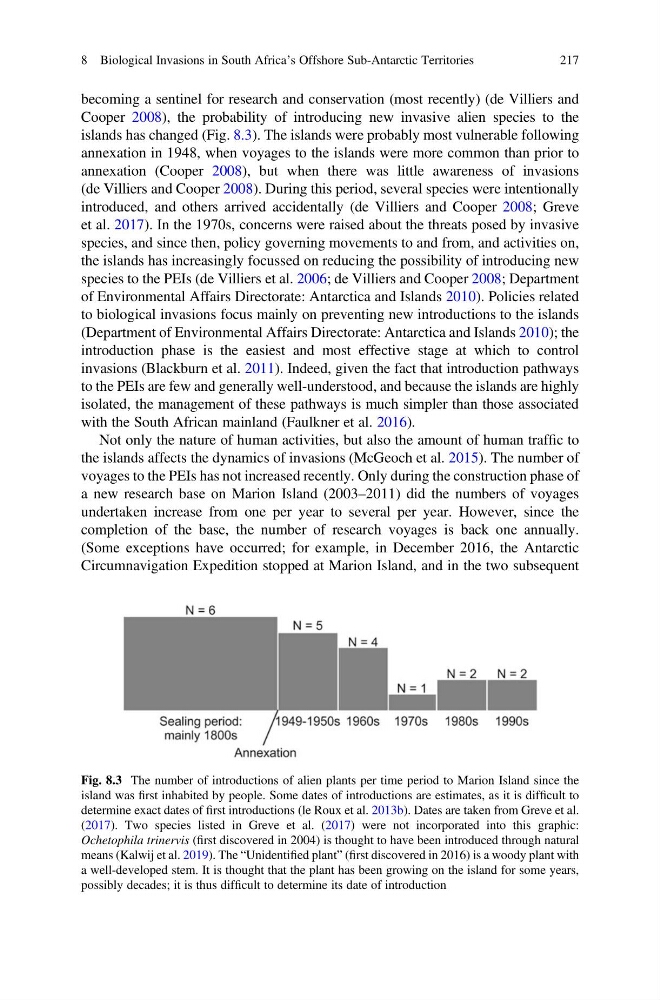
islands has changed (Fig. 8.3). The islands were probably most vulnerable following
annexation in 1948, when voyages to the islands were more common than prior to
annexation (Cooper 2008), but when there was little awareness of invasions
(de Villiers and Cooper 2008). During this period, several species were intentionally
introduced, and others arrived accidentally (de Villiers and Cooper 2008; Greve
et al. 2017). In the 1970s, concerns were raised about the threats posed by invasive
species, and since then, policy governing movements to and from, and activities on,
the islands has increasingly focussed on reducing the possibility of introducing new
species to the PEIs (de Villiers et al. 2006; de Villiers and Cooper 2008; Department
of Environmental Affairs Directorate: Antarctica and Islands 2010). Policies related
to biological invasions focus mainly on preventing new introductions to the islands
(Department of Environmental Affairs Directorate: Antarctica and Islands 2010); the
introduction phase is the easiest and most effective stage at which to control
invasions (Blackburn et al. 2011). Indeed, given the fact that introduction pathways
to the PEIs are few and generally well-understood, and because the islands are highly
isolated, the management of these pathways is much simpler than those associated
with the South African mainland (Faulkner et al. 2016).
Not only the nature of human activities, but also the amount of human traffic to
the islands affects the dynamics of invasions (McGeoch et al. 2015). The number of
voyages to the PEIs has not increased recently. Only during the construction phase of
a new research base on Marion Island (2003–2011) did the numbers of voyages
undertaken increase from one per year to several per year. However, since the
completion of the base, the number of research voyages is back one annually.
(Some exceptions have occurred; for example, in December 2016, the Antarctic
Circumnavigation Expedition stopped at Marion Island, and in the two subsequent
Fig. 8.3 The number of introductions of alien plants per time period to Marion Island since the
island was first inhabited by people. Some dates of introductions are estimates, as it is difficult to
determine exact dates of first introductions (le Roux et al. 2013b). Dates are taken from Greve et al.
(2017). Two species listed in Greve et al. (2017) were not incorporated into this graphic:
Ochetophila trinervis (first discovered in 2004) is thought to have been introduced through natural
means (Kalwij et al. 2019). The “Unidentified plant” (first discovered in 2016) is a woody plant with
a well-developed stem. It is thought that the plant has been growing on the island for some years,
possibly decades; it is thus difficult to determine its date of introduction
8 Biological Invasions in South Africa’s Offshore Sub-Antarctic Territories
217
Cooper 2008), the probability of introducing new invasive alien species to the
islands has changed (Fig. 8.3). The islands were probably most vulnerable following
annexation in 1948, when voyages to the islands were more common than prior to
annexation (Cooper 2008), but when there was little awareness of invasions
(de Villiers and Cooper 2008). During this period, several species were intentionally
introduced, and others arrived accidentally (de Villiers and Cooper 2008; Greve
et al. 2017). In the 1970s, concerns were raised about the threats posed by invasive
species, and since then, policy governing movements to and from, and activities on,
the islands has increasingly focussed on reducing the possibility of introducing new
species to the PEIs (de Villiers et al. 2006; de Villiers and Cooper 2008; Department
of Environmental Affairs Directorate: Antarctica and Islands 2010). Policies related
to biological invasions focus mainly on preventing new introductions to the islands
(Department of Environmental Affairs Directorate: Antarctica and Islands 2010); the
introduction phase is the easiest and most effective stage at which to control
invasions (Blackburn et al. 2011). Indeed, given the fact that introduction pathways
to the PEIs are few and generally well-understood, and because the islands are highly
isolated, the management of these pathways is much simpler than those associated
with the South African mainland (Faulkner et al. 2016).
Not only the nature of human activities, but also the amount of human traffic to
the islands affects the dynamics of invasions (McGeoch et al. 2015). The number of
voyages to the PEIs has not increased recently. Only during the construction phase of
a new research base on Marion Island (2003–2011) did the numbers of voyages
undertaken increase from one per year to several per year. However, since the
completion of the base, the number of research voyages is back one annually.
(Some exceptions have occurred; for example, in December 2016, the Antarctic
Circumnavigation Expedition stopped at Marion Island, and in the two subsequent
Fig. 8.3 The number of introductions of alien plants per time period to Marion Island since the
island was first inhabited by people. Some dates of introductions are estimates, as it is difficult to
determine exact dates of first introductions (le Roux et al. 2013b). Dates are taken from Greve et al.
(2017). Two species listed in Greve et al. (2017) were not incorporated into this graphic:
Ochetophila trinervis (first discovered in 2004) is thought to have been introduced through natural
means (Kalwij et al. 2019). The “Unidentified plant” (first discovered in 2016) is a woody plant with
a well-developed stem. It is thought that the plant has been growing on the island for some years,
possibly decades; it is thus difficult to determine its date of introduction
8 Biological Invasions in South Africa’s Offshore Sub-Antarctic Territories
217