

Box 7.6 The Argentine Ant: Disrupting Natural and Agricultural
Ecosystems
The Argentine Ant (Linepithema humile) is an aggressive invasive ant that was
introduced to South Africa from South America in about 1898. In natural
fynbos habitats, native ants play an important role in the dispersal and burying
of seeds for germination (Slingsby and Bond 1984; Christian 2001), but as
Argentine ants often displace native ants, and are not effective seed dispersers,
invasion of natural habitats by this species can have detrimental effects on
fynbos diversity and ultimately ecosystem function (Bond and Slingsby 1984;
Rodriguez-Cabal et al. 2009). In agricultural habitats, Argentine ants also form
mutualistic associations with harmful plant pests, such as mealybugs, aphids
and scale insect, and protect them from their predators and parasites, resulting
in heavier pest infestations and crop losses (figure below).
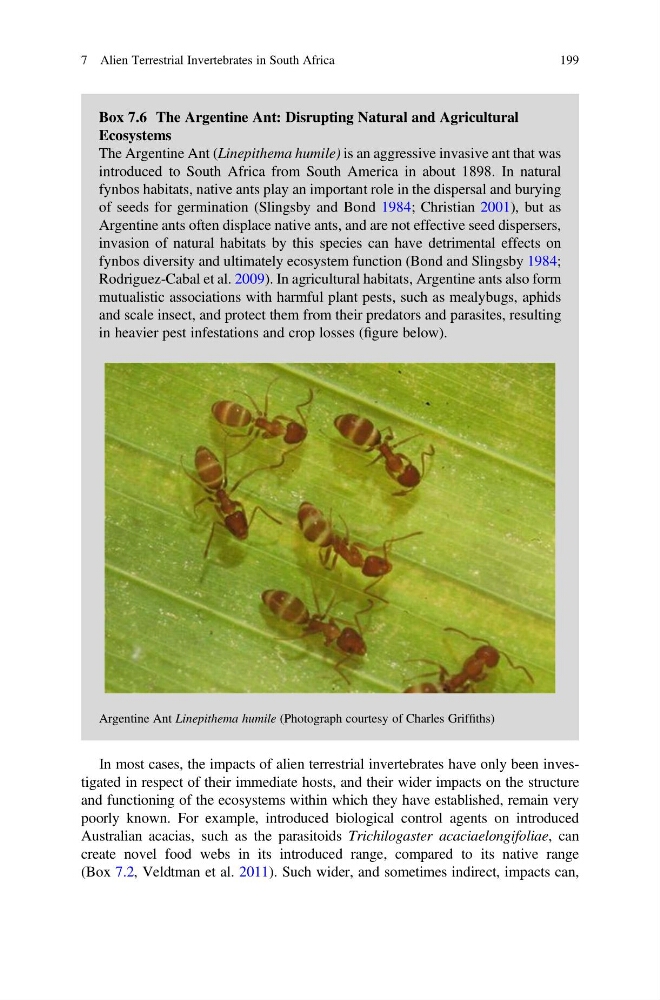
Argentine Ant Linepithema humile (Photograph courtesy of Charles Griffiths)
In most cases, the impacts of alien terrestrial invertebrates have only been investigated in respect of their immediate hosts, and their wider impacts on the structure
and functioning of the ecosystems within which they have established, remain very
poorly known. For example, introduced biological control agents on introduced
Australian acacias, such as the parasitoids Trichilogaster acaciaelongifoliae, can
create novel food webs in its introduced range, compared to its native range
(Box 7.2, Veldtman et al. 2011). Such wider, and sometimes indirect, impacts can,
7 Alien Terrestrial Invertebrates in South Africa
199
Ecosystems
The Argentine Ant (Linepithema humile) is an aggressive invasive ant that was
introduced to South Africa from South America in about 1898. In natural
fynbos habitats, native ants play an important role in the dispersal and burying
of seeds for germination (Slingsby and Bond 1984; Christian 2001), but as
Argentine ants often displace native ants, and are not effective seed dispersers,
invasion of natural habitats by this species can have detrimental effects on
fynbos diversity and ultimately ecosystem function (Bond and Slingsby 1984;
Rodriguez-Cabal et al. 2009). In agricultural habitats, Argentine ants also form
mutualistic associations with harmful plant pests, such as mealybugs, aphids
and scale insect, and protect them from their predators and parasites, resulting
in heavier pest infestations and crop losses (figure below).
Argentine Ant Linepithema humile (Photograph courtesy of Charles Griffiths)
In most cases, the impacts of alien terrestrial invertebrates have only been investigated in respect of their immediate hosts, and their wider impacts on the structure
and functioning of the ecosystems within which they have established, remain very
poorly known. For example, introduced biological control agents on introduced
Australian acacias, such as the parasitoids Trichilogaster acaciaelongifoliae, can
create novel food webs in its introduced range, compared to its native range
(Box 7.2, Veldtman et al. 2011). Such wider, and sometimes indirect, impacts can,
7 Alien Terrestrial Invertebrates in South Africa
199