

species). Most of the invasive arachnids are mites (24 species), many of which are
important agricultural pests, followed by spiders (16 species), which instead occur in
and around human dwellings (Picker and Griffiths 2011). Amongst the terrestrial
molluscs, invasive species from 10 families are present in South Africa (Herbert
2010), while the family Pyralidae (snout moths), which includes many economically
important pests, are dominant amongst the terrestrial Lepidoptera (8 out of
25 species).
The high number of invasive earthworm taxa (38 species) is of concern, given the
negative impacts of invasive earthworms on native communities elsewhere (Hendrix
et al. 2008; Ferlian et al. 2018). Alien earthworms are commonly used as bait for
fishing and in the vermicomposting trade, and this facilitates their translocation to
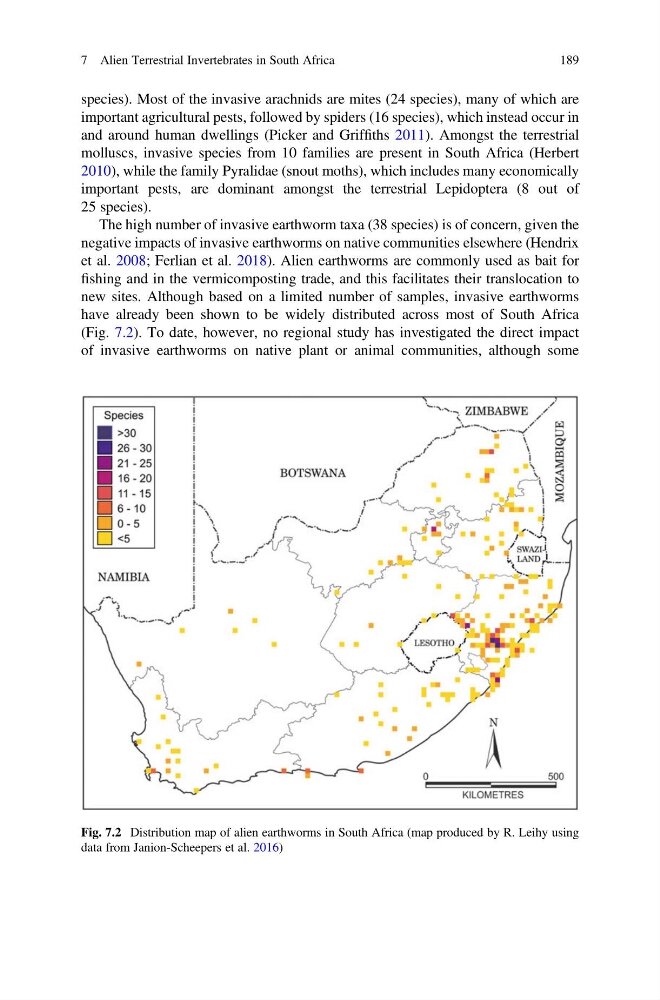
new sites. Although based on a limited number of samples, invasive earthworms
have already been shown to be widely distributed across most of South Africa
(Fig. 7.2). To date, however, no regional study has investigated the direct impact
of invasive earthworms on native plant or animal communities, although some
Fig. 7.2 Distribution map of alien earthworms in South Africa (map produced by R. Leihy using
data from Janion-Scheepers et al. 2016)
7 Alien Terrestrial Invertebrates in South Africa
189
important agricultural pests, followed by spiders (16 species), which instead occur in
and around human dwellings (Picker and Griffiths 2011). Amongst the terrestrial
molluscs, invasive species from 10 families are present in South Africa (Herbert
2010), while the family Pyralidae (snout moths), which includes many economically
important pests, are dominant amongst the terrestrial Lepidoptera (8 out of
25 species).
The high number of invasive earthworm taxa (38 species) is of concern, given the
negative impacts of invasive earthworms on native communities elsewhere (Hendrix
et al. 2008; Ferlian et al. 2018). Alien earthworms are commonly used as bait for
fishing and in the vermicomposting trade, and this facilitates their translocation to
new sites. Although based on a limited number of samples, invasive earthworms
have already been shown to be widely distributed across most of South Africa
(Fig. 7.2). To date, however, no regional study has investigated the direct impact
of invasive earthworms on native plant or animal communities, although some
Fig. 7.2 Distribution map of alien earthworms in South Africa (map produced by R. Leihy using
data from Janion-Scheepers et al. 2016)
7 Alien Terrestrial Invertebrates in South Africa
189