

South Africa, and other parts of the developing world (Goss and Cumming 2013),
which may see a rise in invasive species. Similarly, the rising demand for reptiles as
pets, and the rising numbers of (especially) snakes (with the threat of hybridisation to
native pythons) found, suggests that we will soon see newly-established populations
of alien species from the pet trade.
Lastly, we emphasise here the need for consideration of domestic exotics with
formal lists of invasive species. NEM:BA is exemplary in its flexibility to formally
list species that are native in some parts of the geopolitical area of South Africa, but
invasive in other parts, as invasive. This has provided important legislative power to
help to control invasions (see Chap. 23).
Acknowledgements A great many people helped to supply literature as well as giving insights
into their current studies. We would like to particularly thank members of the CAPE IAA WG,
Chris Chimimba, Sarah Davies, Rob Simmonds, Louise Stafford and Chris Wilke. Special thanks
go to Charles Griffiths, Julie Lockwood and Rob Crystal-Ornelas whose comments considerably
improved this chapter.
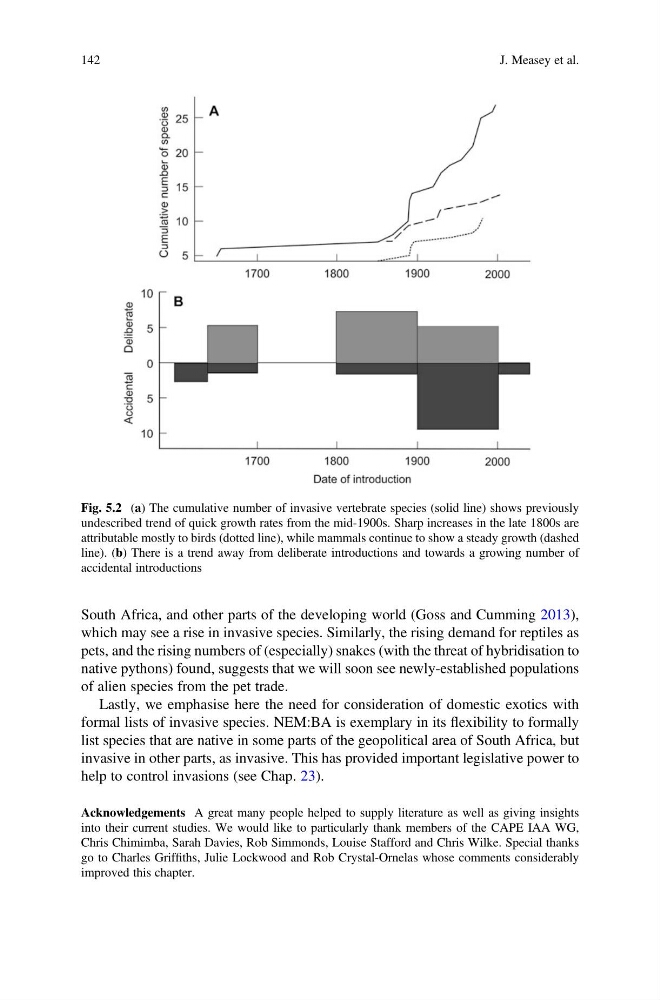
Fig. 5.2 (a) The cumulative number of invasive vertebrate species (solid line) shows previously
undescribed trend of quick growth rates from the mid-1900s. Sharp increases in the late 1800s are
attributable mostly to birds (dotted line), while mammals continue to show a steady growth (dashed
line). (b) There is a trend away from deliberate introductions and towards a growing number of
accidental introductions
142
J. Measey et al.
which may see a rise in invasive species. Similarly, the rising demand for reptiles as
pets, and the rising numbers of (especially) snakes (with the threat of hybridisation to
native pythons) found, suggests that we will soon see newly-established populations
of alien species from the pet trade.
Lastly, we emphasise here the need for consideration of domestic exotics with
formal lists of invasive species. NEM:BA is exemplary in its flexibility to formally
list species that are native in some parts of the geopolitical area of South Africa, but
invasive in other parts, as invasive. This has provided important legislative power to
help to control invasions (see Chap. 23).
Acknowledgements A great many people helped to supply literature as well as giving insights
into their current studies. We would like to particularly thank members of the CAPE IAA WG,
Chris Chimimba, Sarah Davies, Rob Simmonds, Louise Stafford and Chris Wilke. Special thanks
go to Charles Griffiths, Julie Lockwood and Rob Crystal-Ornelas whose comments considerably
improved this chapter.
Fig. 5.2 (a) The cumulative number of invasive vertebrate species (solid line) shows previously
undescribed trend of quick growth rates from the mid-1900s. Sharp increases in the late 1800s are
attributable mostly to birds (dotted line), while mammals continue to show a steady growth (dashed
line). (b) There is a trend away from deliberate introductions and towards a growing number of
accidental introductions
142
J. Measey et al.