

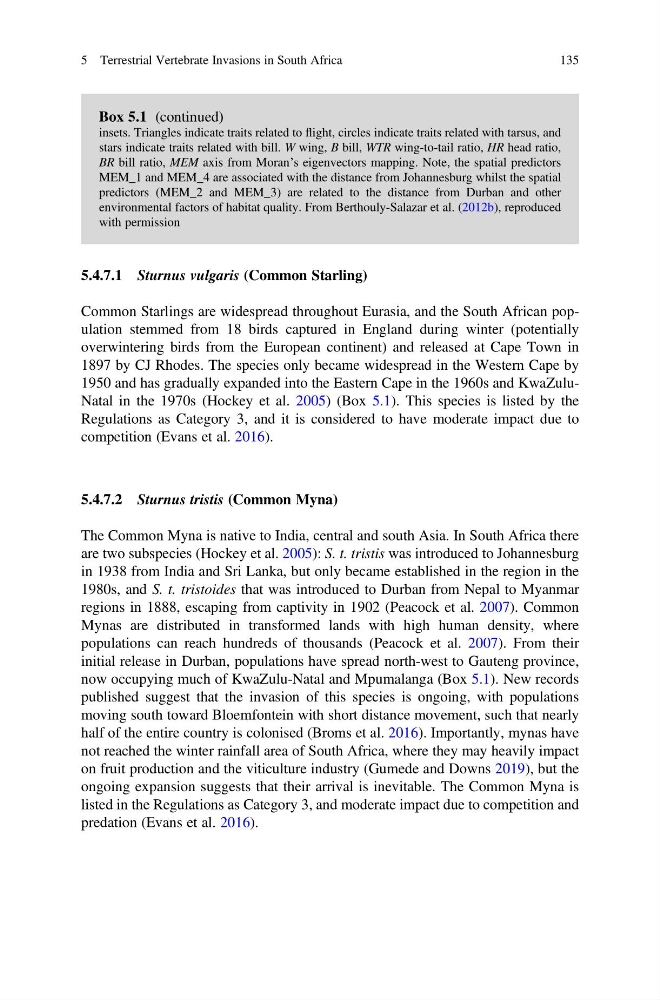
Box 5.1 (continued)
insets. Triangles indicate traits related to flight, circles indicate traits related with tarsus, and
stars indicate traits related with bill. W wing, B bill, WTR wing-to-tail ratio, HR head ratio,
BR bill ratio, MEM axis from Moran’s eigenvectors mapping. Note, the spatial predictors
MEM_1 and MEM_4 are associated with the distance from Johannesburg whilst the spatial
predictors (MEM_2 and MEM_3) are related to the distance from Durban and other
environmental factors of habitat quality. From Berthouly-Salazar et al. (2012b), reproduced
with permission
5.4.7.1 Sturnus vulgaris (Common Starling)
Common Starlings are widespread throughout Eurasia, and the South African population stemmed from 18 birds captured in England during winter (potentially
overwintering birds from the European continent) and released at Cape Town in
1897 by CJ Rhodes. The species only became widespread in the Western Cape by
1950 and has gradually expanded into the Eastern Cape in the 1960s and KwaZuluNatal in the 1970s (Hockey et al. 2005) (Box 5.1). This species is listed by the
Regulations as Category 3, and it is considered to have moderate impact due to
competition (Evans et al. 2016).
5.4.7.2 Sturnus tristis (Common Myna)
The Common Myna is native to India, central and south Asia. In South Africa there
are two subspecies (Hockey et al. 2005): S. t. tristis was introduced to Johannesburg
in 1938 from India and Sri Lanka, but only became established in the region in the
1980s, and S. t. tristoides that was introduced to Durban from Nepal to Myanmar
regions in 1888, escaping from captivity in 1902 (Peacock et al. 2007). Common
Mynas are distributed in transformed lands with high human density, where
populations can reach hundreds of thousands (Peacock et al. 2007). From their
initial release in Durban, populations have spread north-west to Gauteng province,
now occupying much of KwaZulu-Natal and Mpumalanga (Box 5.1). New records
published suggest that the invasion of this species is ongoing, with populations
moving south toward Bloemfontein with short distance movement, such that nearly
half of the entire country is colonised (Broms et al. 2016). Importantly, mynas have
not reached the winter rainfall area of South Africa, where they may heavily impact
on fruit production and the viticulture industry (Gumede and Downs 2019), but the
ongoing expansion suggests that their arrival is inevitable. The Common Myna is
listed in the Regulations as Category 3, and moderate impact due to competition and
predation (Evans et al. 2016).
5 Terrestrial Vertebrate Invasions in South Africa
135
insets. Triangles indicate traits related to flight, circles indicate traits related with tarsus, and
stars indicate traits related with bill. W wing, B bill, WTR wing-to-tail ratio, HR head ratio,
BR bill ratio, MEM axis from Moran’s eigenvectors mapping. Note, the spatial predictors
MEM_1 and MEM_4 are associated with the distance from Johannesburg whilst the spatial
predictors (MEM_2 and MEM_3) are related to the distance from Durban and other
environmental factors of habitat quality. From Berthouly-Salazar et al. (2012b), reproduced
with permission
5.4.7.1 Sturnus vulgaris (Common Starling)
Common Starlings are widespread throughout Eurasia, and the South African population stemmed from 18 birds captured in England during winter (potentially
overwintering birds from the European continent) and released at Cape Town in
1897 by CJ Rhodes. The species only became widespread in the Western Cape by
1950 and has gradually expanded into the Eastern Cape in the 1960s and KwaZuluNatal in the 1970s (Hockey et al. 2005) (Box 5.1). This species is listed by the
Regulations as Category 3, and it is considered to have moderate impact due to
competition (Evans et al. 2016).
5.4.7.2 Sturnus tristis (Common Myna)
The Common Myna is native to India, central and south Asia. In South Africa there
are two subspecies (Hockey et al. 2005): S. t. tristis was introduced to Johannesburg
in 1938 from India and Sri Lanka, but only became established in the region in the
1980s, and S. t. tristoides that was introduced to Durban from Nepal to Myanmar
regions in 1888, escaping from captivity in 1902 (Peacock et al. 2007). Common
Mynas are distributed in transformed lands with high human density, where
populations can reach hundreds of thousands (Peacock et al. 2007). From their
initial release in Durban, populations have spread north-west to Gauteng province,
now occupying much of KwaZulu-Natal and Mpumalanga (Box 5.1). New records
published suggest that the invasion of this species is ongoing, with populations
moving south toward Bloemfontein with short distance movement, such that nearly
half of the entire country is colonised (Broms et al. 2016). Importantly, mynas have
not reached the winter rainfall area of South Africa, where they may heavily impact
on fruit production and the viticulture industry (Gumede and Downs 2019), but the
ongoing expansion suggests that their arrival is inevitable. The Common Myna is
listed in the Regulations as Category 3, and moderate impact due to competition and
predation (Evans et al. 2016).
5 Terrestrial Vertebrate Invasions in South Africa
135