

4.6 Control
A number of management options are available for the control of invasive macrophytes, but their success often depends on the use of integrated strategies. Here we
review briefly the various options available.
Small invasions of aquatic macrophytes may be removed manually by hand, or
mechanically using specialised harvesters, but this is labour-intensive and requires
frequent follow-up treatments because not all plants are removed, allowing the
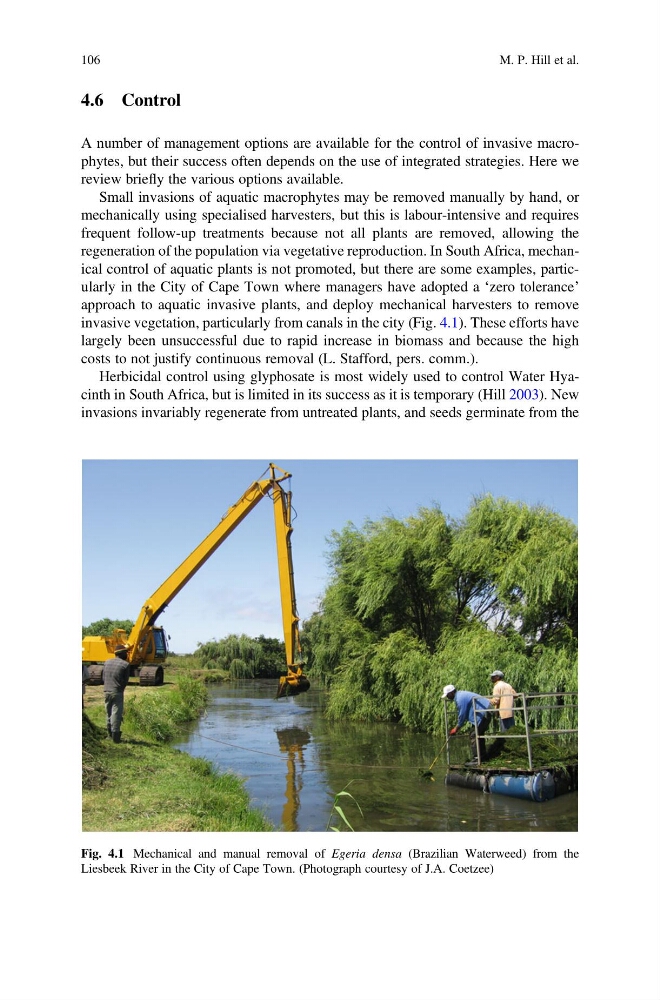
regeneration of the population via vegetative reproduction. In South Africa, mechanical control of aquatic plants is not promoted, but there are some examples, particularly in the City of Cape Town where managers have adopted a ‘zero tolerance’
approach to aquatic invasive plants, and deploy mechanical harvesters to remove
invasive vegetation, particularly from canals in the city (Fig. 4.1). These efforts have
largely been unsuccessful due to rapid increase in biomass and because the high
costs to not justify continuous removal (L. Stafford, pers. comm.).
Herbicidal control using glyphosate is most widely used to control Water Hyacinth in South Africa, but is limited in its success as it is temporary (Hill 2003). New
invasions invariably regenerate from untreated plants, and seeds germinate from the
Fig. 4.1 Mechanical and manual removal of Egeria densa (Brazilian Waterweed) from the
Liesbeek River in the City of Cape Town. (Photograph courtesy of J.A. Coetzee)
106
M. P. Hill et al.
A number of management options are available for the control of invasive macrophytes, but their success often depends on the use of integrated strategies. Here we
review briefly the various options available.
Small invasions of aquatic macrophytes may be removed manually by hand, or
mechanically using specialised harvesters, but this is labour-intensive and requires
frequent follow-up treatments because not all plants are removed, allowing the
regeneration of the population via vegetative reproduction. In South Africa, mechanical control of aquatic plants is not promoted, but there are some examples, particularly in the City of Cape Town where managers have adopted a ‘zero tolerance’
approach to aquatic invasive plants, and deploy mechanical harvesters to remove
invasive vegetation, particularly from canals in the city (Fig. 4.1). These efforts have
largely been unsuccessful due to rapid increase in biomass and because the high
costs to not justify continuous removal (L. Stafford, pers. comm.).
Herbicidal control using glyphosate is most widely used to control Water Hyacinth in South Africa, but is limited in its success as it is temporary (Hill 2003). New
invasions invariably regenerate from untreated plants, and seeds germinate from the
Fig. 4.1 Mechanical and manual removal of Egeria densa (Brazilian Waterweed) from the
Liesbeek River in the City of Cape Town. (Photograph courtesy of J.A. Coetzee)
106
M. P. Hill et al.