

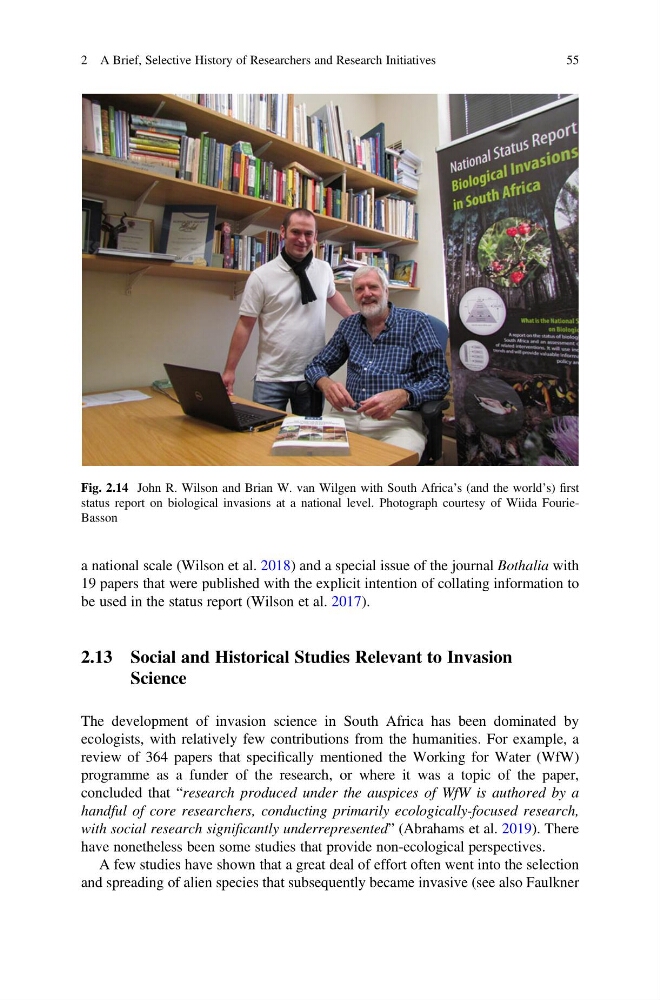
a national scale (Wilson et al. 2018) and a special issue of the journal Bothalia with
19 papers that were published with the explicit intention of collating information to
be used in the status report (Wilson et al. 2017).
2.13 Social and Historical Studies Relevant to Invasion
Science
The development of invasion science in South Africa has been dominated by
ecologists, with relatively few contributions from the humanities. For example, a
review of 364 papers that specifically mentioned the Working for Water (WfW)
programme as a funder of the research, or where it was a topic of the paper,
concluded that “research produced under the auspices of WfW is authored by a
handful of core researchers, conducting primarily ecologically-focused research,
with social research significantly underrepresented” (Abrahams et al. 2019). There
have nonetheless been some studies that provide non-ecological perspectives.
A few studies have shown that a great deal of effort often went into the selection
and spreading of alien species that subsequently became invasive (see also Faulkner
Fig. 2.14 John R. Wilson and Brian W. van Wilgen with South Africa’s (and the world’s) first
status report on biological invasions at a national level. Photograph courtesy of Wiida FourieBasson
2 A Brief, Selective History of Researchers and Research Initiatives
55
19 papers that were published with the explicit intention of collating information to
be used in the status report (Wilson et al. 2017).
2.13 Social and Historical Studies Relevant to Invasion
Science
The development of invasion science in South Africa has been dominated by
ecologists, with relatively few contributions from the humanities. For example, a
review of 364 papers that specifically mentioned the Working for Water (WfW)
programme as a funder of the research, or where it was a topic of the paper,
concluded that “research produced under the auspices of WfW is authored by a
handful of core researchers, conducting primarily ecologically-focused research,
with social research significantly underrepresented” (Abrahams et al. 2019). There
have nonetheless been some studies that provide non-ecological perspectives.
A few studies have shown that a great deal of effort often went into the selection
and spreading of alien species that subsequently became invasive (see also Faulkner
Fig. 2.14 John R. Wilson and Brian W. van Wilgen with South Africa’s (and the world’s) first
status report on biological invasions at a national level. Photograph courtesy of Wiida FourieBasson
2 A Brief, Selective History of Researchers and Research Initiatives
55