

2.2.1 Biological Control Research at the Plant Protection
Research Institute
Dr David Paul Annecke (1928–1981) is widely regarded as the founder of invasive
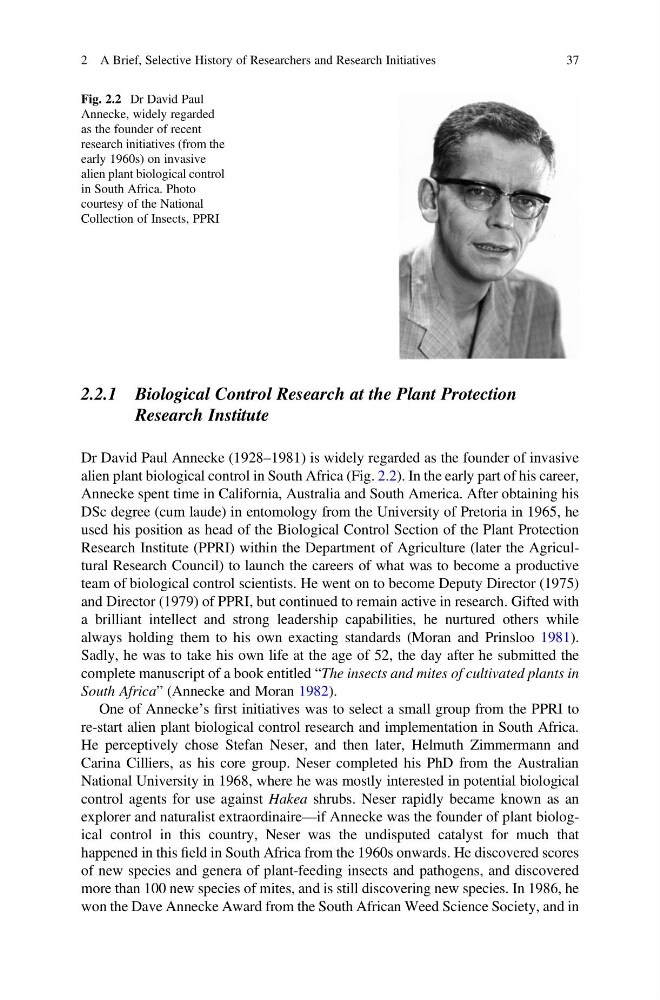
alien plant biological control in South Africa (Fig. 2.2). In the early part of his career,
Annecke spent time in California, Australia and South America. After obtaining his
DSc degree (cum laude) in entomology from the University of Pretoria in 1965, he
used his position as head of the Biological Control Section of the Plant Protection
Research Institute (PPRI) within the Department of Agriculture (later the Agricultural Research Council) to launch the careers of what was to become a productive
team of biological control scientists. He went on to become Deputy Director (1975)
and Director (1979) of PPRI, but continued to remain active in research. Gifted with
a brilliant intellect and strong leadership capabilities, he nurtured others while
always holding them to his own exacting standards (Moran and Prinsloo 1981).
Sadly, he was to take his own life at the age of 52, the day after he submitted the
complete manuscript of a book entitled “The insects and mites of cultivated plants in
South Africa” (Annecke and Moran 1982).
One of Annecke’s first initiatives was to select a small group from the PPRI to
re-start alien plant biological control research and implementation in South Africa.
He perceptively chose Stefan Neser, and then later, Helmuth Zimmermann and
Carina Cilliers, as his core group. Neser completed his PhD from the Australian
National University in 1968, where he was mostly interested in potential biological
control agents for use against Hakea shrubs. Neser rapidly became known as an
explorer and naturalist extraordinaire—if Annecke was the founder of plant biological control in this country, Neser was the undisputed catalyst for much that
happened in this field in South Africa from the 1960s onwards. He discovered scores
of new species and genera of plant-feeding insects and pathogens, and discovered
more than 100 new species of mites, and is still discovering new species. In 1986, he
won the Dave Annecke Award from the South African Weed Science Society, and in
Fig. 2.2 Dr David Paul
Annecke, widely regarded
as the founder of recent
research initiatives (from the
early 1960s) on invasive
alien plant biological control
in South Africa. Photo
courtesy of the National
Collection of Insects, PPRI
2 A Brief, Selective History of Researchers and Research Initiatives
37
Research Institute
Dr David Paul Annecke (1928–1981) is widely regarded as the founder of invasive
alien plant biological control in South Africa (Fig. 2.2). In the early part of his career,
Annecke spent time in California, Australia and South America. After obtaining his
DSc degree (cum laude) in entomology from the University of Pretoria in 1965, he
used his position as head of the Biological Control Section of the Plant Protection
Research Institute (PPRI) within the Department of Agriculture (later the Agricultural Research Council) to launch the careers of what was to become a productive
team of biological control scientists. He went on to become Deputy Director (1975)
and Director (1979) of PPRI, but continued to remain active in research. Gifted with
a brilliant intellect and strong leadership capabilities, he nurtured others while
always holding them to his own exacting standards (Moran and Prinsloo 1981).
Sadly, he was to take his own life at the age of 52, the day after he submitted the
complete manuscript of a book entitled “The insects and mites of cultivated plants in
South Africa” (Annecke and Moran 1982).
One of Annecke’s first initiatives was to select a small group from the PPRI to
re-start alien plant biological control research and implementation in South Africa.
He perceptively chose Stefan Neser, and then later, Helmuth Zimmermann and
Carina Cilliers, as his core group. Neser completed his PhD from the Australian
National University in 1968, where he was mostly interested in potential biological
control agents for use against Hakea shrubs. Neser rapidly became known as an
explorer and naturalist extraordinaire—if Annecke was the founder of plant biological control in this country, Neser was the undisputed catalyst for much that
happened in this field in South Africa from the 1960s onwards. He discovered scores
of new species and genera of plant-feeding insects and pathogens, and discovered
more than 100 new species of mites, and is still discovering new species. In 1986, he
won the Dave Annecke Award from the South African Weed Science Society, and in
Fig. 2.2 Dr David Paul
Annecke, widely regarded
as the founder of recent
research initiatives (from the
early 1960s) on invasive
alien plant biological control
in South Africa. Photo
courtesy of the National
Collection of Insects, PPRI
2 A Brief, Selective History of Researchers and Research Initiatives
37