

2.1 Introduction
There have not been any formal studies that address the development of invasion
science in South Africa, but in 1982 Moran and Moran (1982) published a bibliography of historical publications about invasive alien plants in natural and seminatural environments in this country. Their search covered the period from 1830 up
to and including 1982 and had a focus on publications dealing with the ecology and
biology of alien plant species; references to taxonomic papers and to agricultural
weeds or native plants were not included. The bibliography lists 457 publications,
one dating back to 1858 (implying that there were no publications in this field in
South Africa between 1830 and 1858); the 1858 paper was simply a list that included
some alien plants in the Cape Town botanical garden (McGibbon 1858). Bolus
(1886) made passing reference to potentially invasive plants in his lists of
South African flora, but it seems that the first research- or ecology-based report on
an invasive plant species in South Africa was that by Fischer (1888) who dealt with
Opuntia ficus-indica (Mission Prickly Pear) and cochineal insects (Dactylopiidae).
This was followed by a spate of papers over the next 50 years that were overwhelmingly dominated by reports that addressed the problem of O. ficus-indica, and then
later dealt also with Opuntia aurantiaca (Jointed Cactus).
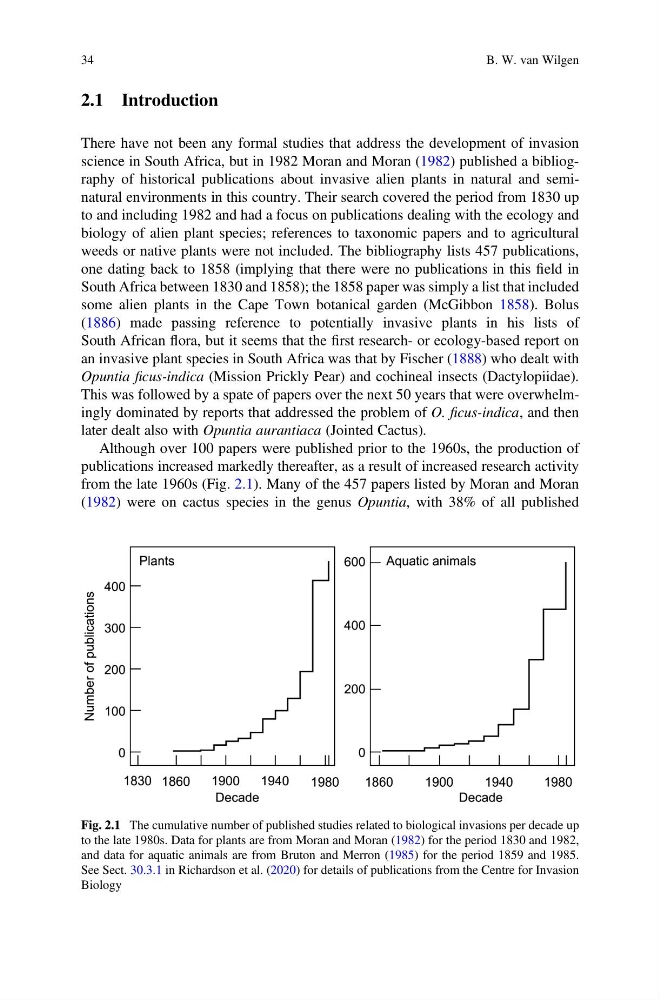
Although over 100 papers were published prior to the 1960s, the production of
publications increased markedly thereafter, as a result of increased research activity
from the late 1960s (Fig. 2.1). Many of the 457 papers listed by Moran and Moran
(1982) were on cactus species in the genus Opuntia, with 38% of all published
Fig. 2.1 The cumulative number of published studies related to biological invasions per decade up
to the late 1980s. Data for plants are from Moran and Moran (1982) for the period 1830 and 1982,
and data for aquatic animals are from Bruton and Merron (1985) for the period 1859 and 1985.
See Sect. 30.3.1 in Richardson et al. (2020) for details of publications from the Centre for Invasion
Biology
34
B. W. van Wilgen
There have not been any formal studies that address the development of invasion
science in South Africa, but in 1982 Moran and Moran (1982) published a bibliography of historical publications about invasive alien plants in natural and seminatural environments in this country. Their search covered the period from 1830 up
to and including 1982 and had a focus on publications dealing with the ecology and
biology of alien plant species; references to taxonomic papers and to agricultural
weeds or native plants were not included. The bibliography lists 457 publications,
one dating back to 1858 (implying that there were no publications in this field in
South Africa between 1830 and 1858); the 1858 paper was simply a list that included
some alien plants in the Cape Town botanical garden (McGibbon 1858). Bolus
(1886) made passing reference to potentially invasive plants in his lists of
South African flora, but it seems that the first research- or ecology-based report on
an invasive plant species in South Africa was that by Fischer (1888) who dealt with
Opuntia ficus-indica (Mission Prickly Pear) and cochineal insects (Dactylopiidae).
This was followed by a spate of papers over the next 50 years that were overwhelmingly dominated by reports that addressed the problem of O. ficus-indica, and then
later dealt also with Opuntia aurantiaca (Jointed Cactus).
Although over 100 papers were published prior to the 1960s, the production of
publications increased markedly thereafter, as a result of increased research activity
from the late 1960s (Fig. 2.1). Many of the 457 papers listed by Moran and Moran
(1982) were on cactus species in the genus Opuntia, with 38% of all published
Fig. 2.1 The cumulative number of published studies related to biological invasions per decade up
to the late 1980s. Data for plants are from Moran and Moran (1982) for the period 1830 and 1982,
and data for aquatic animals are from Bruton and Merron (1985) for the period 1859 and 1985.
See Sect. 30.3.1 in Richardson et al. (2020) for details of publications from the Centre for Invasion
Biology
34
B. W. van Wilgen