

80
4 Rotation of the Polyatomic Molecule
4.2 Classical Kinetic Energy of the Rigid Rotor
We will use two Cartesian coordinate systems to describe free rotation under no
external potential:
1. Space-fixed, XYZ, origin O, the “observer’s” axis system. This axis system is
used to describe the position of the center of mass of the molecule.
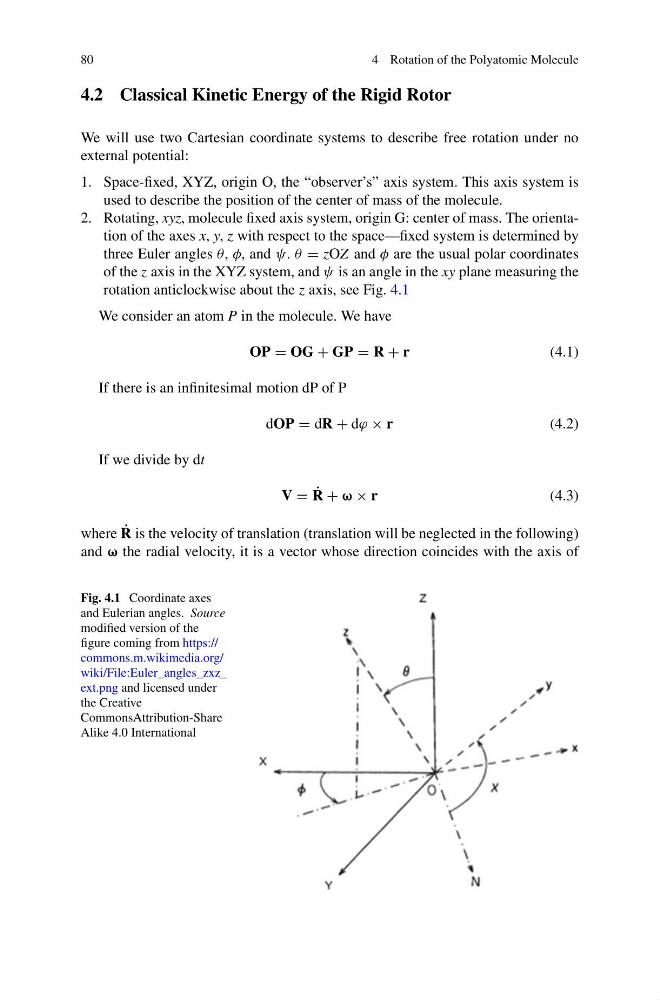
2. Rotating, xyz, molecule fixed axis system, origin G: center of mass. The orientation of the axes x, y, z with respect to the space—fixed system is determined by
three Euler angles θ, φ, and ψ. θ = zOZ and φ are the usual polar coordinates
of the z axis in the XYZ system, and ψ is an angle in the xy plane measuring the
rotation anticlockwise about the z axis, see Fig. 4.1
We consider an atom P in the molecule. We have
OP = OG + GP = R + r
(4.1)
If there is an infinitesimal motion dP of P
dOP = dR + dϕ × r
(4.2)
If we divide by dt
V = ˙
R + ω × r
(4.3)
where ˙
R is the velocity of translation (translation will be neglected in the following)
and ω the radial velocity, it is a vector whose direction coincides with the axis of
Fig. 4.1 Coordinate axes
and Eulerian angles. Source
modified version of the
figure coming from https://
commons.m.wikimedia.org/
wiki/File:Euler_angles_zxz_
ext.png and licensed under
the Creative
CommonsAttribution-Share
Alike 4.0 International
4 Rotation of the Polyatomic Molecule
4.2 Classical Kinetic Energy of the Rigid Rotor
We will use two Cartesian coordinate systems to describe free rotation under no
external potential:
1. Space-fixed, XYZ, origin O, the “observer’s” axis system. This axis system is
used to describe the position of the center of mass of the molecule.
2. Rotating, xyz, molecule fixed axis system, origin G: center of mass. The orientation of the axes x, y, z with respect to the space—fixed system is determined by
three Euler angles θ, φ, and ψ. θ = zOZ and φ are the usual polar coordinates
of the z axis in the XYZ system, and ψ is an angle in the xy plane measuring the
rotation anticlockwise about the z axis, see Fig. 4.1
We consider an atom P in the molecule. We have
OP = OG + GP = R + r
(4.1)
If there is an infinitesimal motion dP of P
dOP = dR + dϕ × r
(4.2)
If we divide by dt
V = ˙
R + ω × r
(4.3)
where ˙
R is the velocity of translation (translation will be neglected in the following)
and ω the radial velocity, it is a vector whose direction coincides with the axis of
Fig. 4.1 Coordinate axes
and Eulerian angles. Source
modified version of the
figure coming from https://
commons.m.wikimedia.org/
wiki/File:Euler_angles_zxz_
ext.png and licensed under
the Creative
CommonsAttribution-Share
Alike 4.0 International