

74
3 Diatomic Molecules
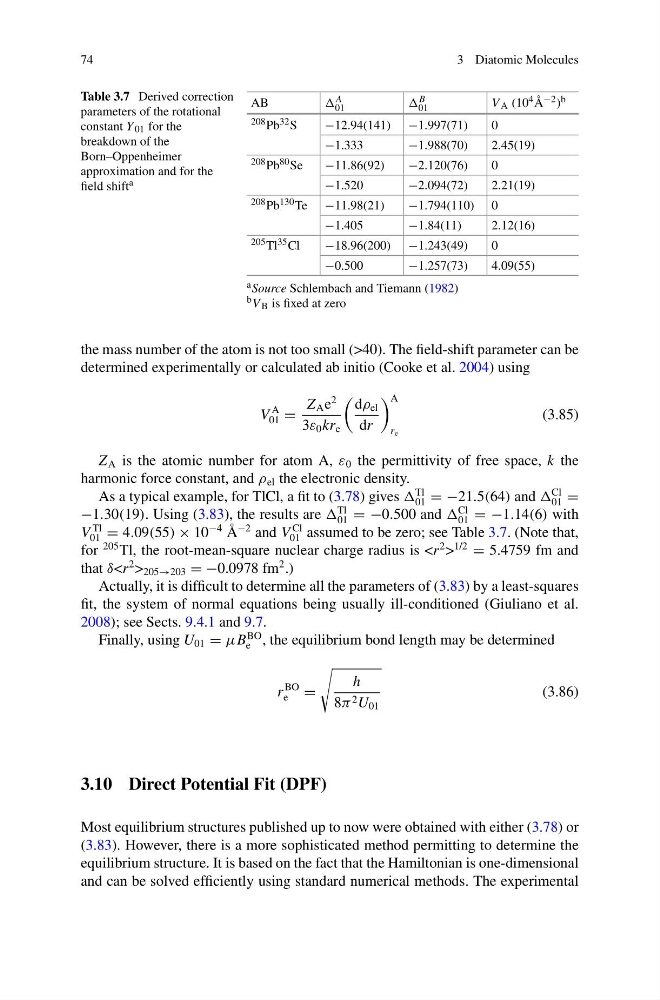
Table 3.7 Derived correction
parameters of the rotational
constant Y 01 for the
breakdown of the
Born–Oppenheimer
approximation and for the
field shift a
AB
A
01
B
01
V A (10 4 Å −2 ) b
208 Pb 32 S
−12.94(141) −1.997(71)
0
−1.333
−1.988(70)
2.45(19)
208 Pb 80 Se
−11.86(92)
−2.120(76)
0
−1.520
−2.094(72)
2.21(19)
208 Pb 130 Te −11.98(21)
−1.794(110) 0
−1.405
−1.84(11)
2.12(16)
205 Tl 35 Cl
−18.96(200) −1.243(49)
0
−0.500
−1.257(73)
4.09(55)
a Source Schlembach and Tiemann (1982)
b V B is fixed at zero
the mass number of the atom is not too small (>40). The field-shift parameter can be
determined experimentally or calculated ab initio (Cooke et al. 2004) using
V
A
01 =
Z A e
2
3ε 0 kr e
dρ el
dr
A
r e
(3.85)
Z A is the atomic number for atom A, ε 0 the permittivity of free space, k the
harmonic force constant, and ρ el the electronic density.
As a typical example, for TlCl, a fit to (3.78) gives
Tl
01 = −21.5(64) and
Cl
01 =
−1.30(19). Using (3.83), the results are
Tl
01 = −0.500 and
Cl
01 = −1.14(6) with
V
Tl
01 = 4.09(55) × 10
−4 Å
−2 and V
Cl
01 assumed to be zero; see Table 3.7. (Note that,
for
205 Tl, the root-mean-square nuclear charge radius is
1/2
= 5.4759 fm and
that δ
2 .)
Actually, it is difficult to determine all the parameters of (3.83) by a least-squares
fit, the system of normal equations being usually ill-conditioned (Giuliano et al.
2008); see Sects. 9.4.1 and 9.7.
Finally, using U 01 = μB
BO
e , the equilibrium bond length may be determined
r
BO
e
=
h
8π 2 U 01
(3.86)
3.10 Direct Potential Fit (DPF)
Most equilibrium structures published up to now were obtained with either (3.78) or
(3.83). However, there is a more sophisticated method permitting to determine the
equilibrium structure. It is based on the fact that the Hamiltonian is one-dimensional
and can be solved efficiently using standard numerical methods. The experimental
3 Diatomic Molecules
Table 3.7 Derived correction
parameters of the rotational
constant Y 01 for the
breakdown of the
Born–Oppenheimer
approximation and for the
field shift a
AB
A
01
B
01
V A (10 4 Å −2 ) b
208 Pb 32 S
−12.94(141) −1.997(71)
0
−1.333
−1.988(70)
2.45(19)
208 Pb 80 Se
−11.86(92)
−2.120(76)
0
−1.520
−2.094(72)
2.21(19)
208 Pb 130 Te −11.98(21)
−1.794(110) 0
−1.405
−1.84(11)
2.12(16)
205 Tl 35 Cl
−18.96(200) −1.243(49)
0
−0.500
−1.257(73)
4.09(55)
a Source Schlembach and Tiemann (1982)
b V B is fixed at zero
the mass number of the atom is not too small (>40). The field-shift parameter can be
determined experimentally or calculated ab initio (Cooke et al. 2004) using
V
A
01 =
Z A e
2
3ε 0 kr e
dρ el
dr
A
r e
(3.85)
Z A is the atomic number for atom A, ε 0 the permittivity of free space, k the
harmonic force constant, and ρ el the electronic density.
As a typical example, for TlCl, a fit to (3.78) gives
Tl
01 = −21.5(64) and
Cl
01 =
−1.30(19). Using (3.83), the results are
Tl
01 = −0.500 and
Cl
01 = −1.14(6) with
V
Tl
01 = 4.09(55) × 10
−4 Å
−2 and V
Cl
01 assumed to be zero; see Table 3.7. (Note that,
for
205 Tl, the root-mean-square nuclear charge radius is
1/2
= 5.4759 fm and
that δ
2 .)
Actually, it is difficult to determine all the parameters of (3.83) by a least-squares
fit, the system of normal equations being usually ill-conditioned (Giuliano et al.
2008); see Sects. 9.4.1 and 9.7.
Finally, using U 01 = μB
BO
e , the equilibrium bond length may be determined
r
BO
e
=
h
8π 2 U 01
(3.86)
3.10 Direct Potential Fit (DPF)
Most equilibrium structures published up to now were obtained with either (3.78) or
(3.83). However, there is a more sophisticated method permitting to determine the
equilibrium structure. It is based on the fact that the Hamiltonian is one-dimensional
and can be solved efficiently using standard numerical methods. The experimental