

60
3 Diatomic Molecules
H =
P
2
2I
(3.19)
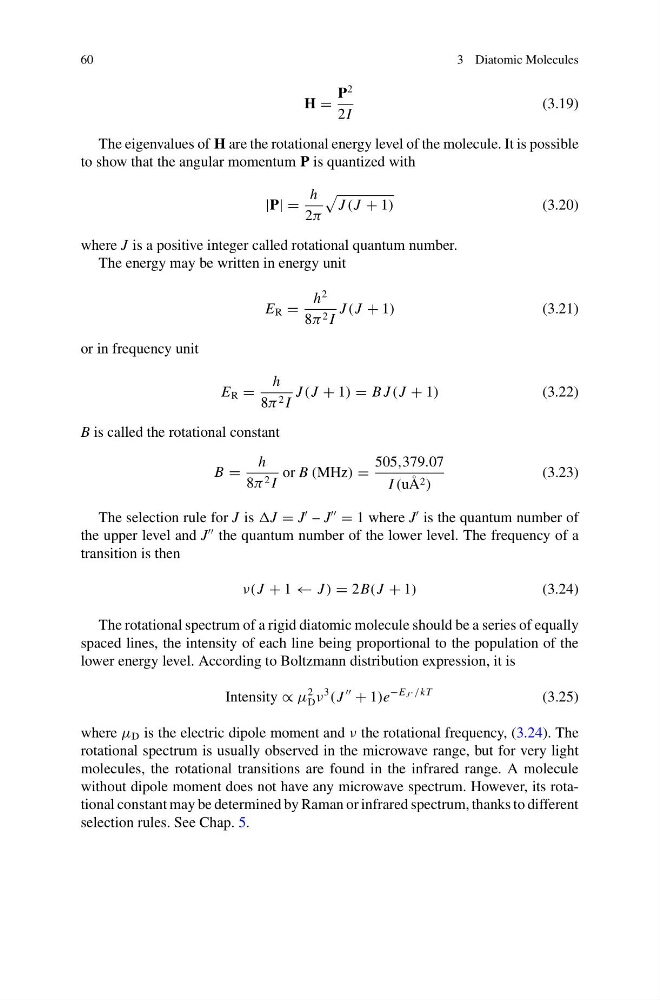
The eigenvalues of H are the rotational energy level of the molecule. It is possible
to show that the angular momentum P is quantized with
|P| =
h
2π
J (J + 1)
(3.20)
where J is a positive integer called rotational quantum number.
The energy may be written in energy unit
E R =
h
2
8π 2 I
J (J + 1)
(3.21)
or in frequency unit
E R =
h
8π 2 I
J (J + 1) = B J (J + 1)
(3.22)
B is called the rotational constant
B =
h
8π 2 I
or B (MHz) =
505,379.07
I (uÅ 2 )
(3.23)
The selection rule for J is J = J
– J
= 1 where J
is the quantum number of
the upper level and J
the quantum number of the lower level. The frequency of a
transition is then
ν(J + 1 ← J ) = 2B(J + 1)
(3.24)
The rotational spectrum of a rigid diatomic molecule should be a series of equally
spaced lines, the intensity of each line being proportional to the population of the
lower energy level. According to Boltzmann distribution expression, it is
Intensity ∝ μ
2
D ν
3
(J
+ 1)e
−E J " /kT
(3.25)
where μ D is the electric dipole moment and ν the rotational frequency, (3.24). The
rotational spectrum is usually observed in the microwave range, but for very light
molecules, the rotational transitions are found in the infrared range. A molecule
without dipole moment does not have any microwave spectrum. However, its rotational constant may be determined by Raman or infrared spectrum, thanks to different
selection rules. See Chap. 5.
3 Diatomic Molecules
H =
P
2
2I
(3.19)
The eigenvalues of H are the rotational energy level of the molecule. It is possible
to show that the angular momentum P is quantized with
|P| =
h
2π
J (J + 1)
(3.20)
where J is a positive integer called rotational quantum number.
The energy may be written in energy unit
E R =
h
2
8π 2 I
J (J + 1)
(3.21)
or in frequency unit
E R =
h
8π 2 I
J (J + 1) = B J (J + 1)
(3.22)
B is called the rotational constant
B =
h
8π 2 I
or B (MHz) =
505,379.07
I (uÅ 2 )
(3.23)
The selection rule for J is J = J
– J
= 1 where J
is the quantum number of
the upper level and J
the quantum number of the lower level. The frequency of a
transition is then
ν(J + 1 ← J ) = 2B(J + 1)
(3.24)
The rotational spectrum of a rigid diatomic molecule should be a series of equally
spaced lines, the intensity of each line being proportional to the population of the
lower energy level. According to Boltzmann distribution expression, it is
Intensity ∝ μ
2
D ν
3
(J
+ 1)e
−E J " /kT
(3.25)
where μ D is the electric dipole moment and ν the rotational frequency, (3.24). The
rotational spectrum is usually observed in the microwave range, but for very light
molecules, the rotational transitions are found in the infrared range. A molecule
without dipole moment does not have any microwave spectrum. However, its rotational constant may be determined by Raman or infrared spectrum, thanks to different
selection rules. See Chap. 5.