

2.19 Appendices
45
E NR =
p
2
2m
+ U
(2.59)
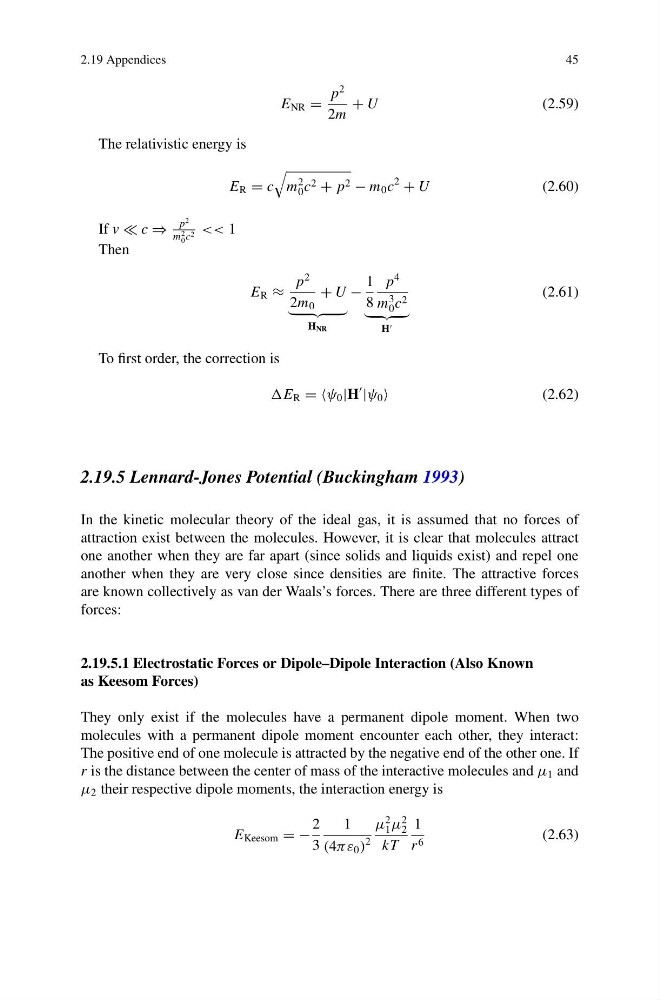
The relativistic energy is
E R = c
m
2
0 c 2 + p 2 − m 0 c
2
+ U
(2.60)
If v c ⇒
p
2
m
2
0 c 2 << 1
Then
E R ≈
p
2
2m 0
+ U
H NR
−
1
8
p
4
m
3
0 c 2
H
(2.61)
To first order, the correction is
E R = ψ 0 |H
|ψ 0
(2.62)
2.19.5 Lennard-Jones Potential (Buckingham 1993)
In the kinetic molecular theory of the ideal gas, it is assumed that no forces of
attraction exist between the molecules. However, it is clear that molecules attract
one another when they are far apart (since solids and liquids exist) and repel one
another when they are very close since densities are finite. The attractive forces
are known collectively as van der Waals’s forces. There are three different types of
forces:
2.19.5.1 Electrostatic Forces or Dipole–Dipole Interaction (Also Known
as Keesom Forces)
They only exist if the molecules have a permanent dipole moment. When two
molecules with a permanent dipole moment encounter each other, they interact:
The positive end of one molecule is attracted by the negative end of the other one. If
r is the distance between the center of mass of the interactive molecules and μ 1 and
μ 2 their respective dipole moments, the interaction energy is
E Keesom = −
2
3
1
(4πε 0 )
2
μ
2
1 μ
2
2
kT
1
r 6
(2.63)
45
E NR =
p
2
2m
+ U
(2.59)
The relativistic energy is
E R = c
m
2
0 c 2 + p 2 − m 0 c
2
+ U
(2.60)
If v c ⇒
p
2
m
2
0 c 2 << 1
Then
E R ≈
p
2
2m 0
+ U
H NR
−
1
8
p
4
m
3
0 c 2
H
(2.61)
To first order, the correction is
E R = ψ 0 |H
|ψ 0
(2.62)
2.19.5 Lennard-Jones Potential (Buckingham 1993)
In the kinetic molecular theory of the ideal gas, it is assumed that no forces of
attraction exist between the molecules. However, it is clear that molecules attract
one another when they are far apart (since solids and liquids exist) and repel one
another when they are very close since densities are finite. The attractive forces
are known collectively as van der Waals’s forces. There are three different types of
forces:
2.19.5.1 Electrostatic Forces or Dipole–Dipole Interaction (Also Known
as Keesom Forces)
They only exist if the molecules have a permanent dipole moment. When two
molecules with a permanent dipole moment encounter each other, they interact:
The positive end of one molecule is attracted by the negative end of the other one. If
r is the distance between the center of mass of the interactive molecules and μ 1 and
μ 2 their respective dipole moments, the interaction energy is
E Keesom = −
2
3
1
(4πε 0 )
2
μ
2
1 μ
2
2
kT
1
r 6
(2.63)