

2.13 Density Functional Theory (DFT)
33
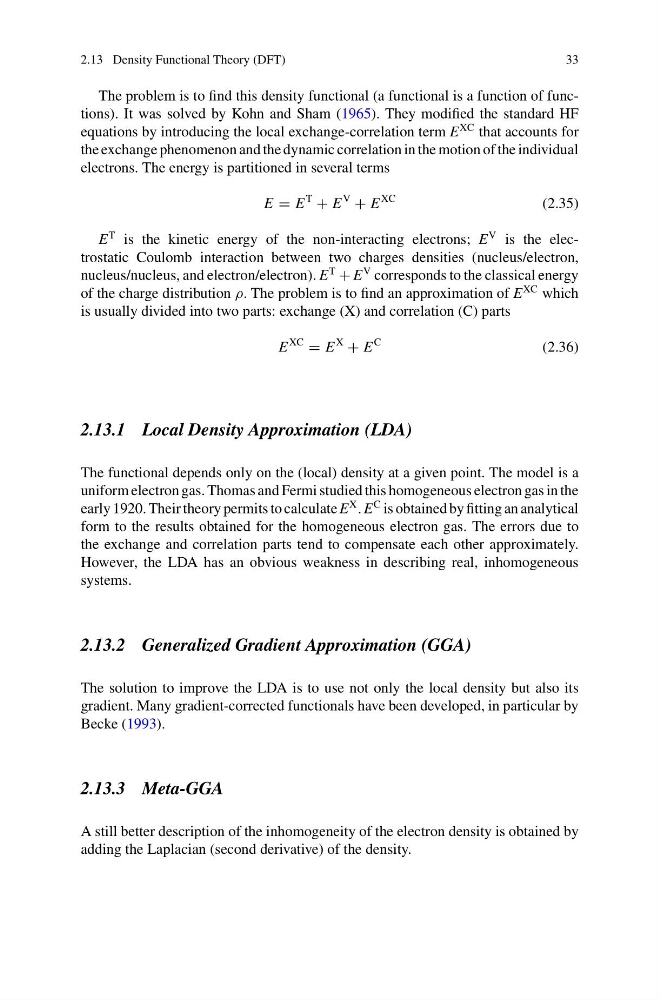
The problem is to find this density functional (a functional is a function of functions). It was solved by Kohn and Sham (1965). They modified the standard HF
equations by introducing the local exchange-correlation term E
XC that accounts for
the exchange phenomenon and the dynamic correlation in the motion of the individual
electrons. The energy is partitioned in several terms
E = E
T
+ E
V
+ E
XC
(2.35)
E
T is the kinetic energy of the non-interacting electrons; E
V is the electrostatic Coulomb interaction between two charges densities (nucleus/electron,
nucleus/nucleus, and electron/electron). E
T
+ E
V corresponds to the classical energy
of the charge distribution ρ. The problem is to find an approximation of E
XC which
is usually divided into two parts: exchange (X) and correlation (C) parts
E
XC
= E
X
+ E
C
(2.36)
2.13.1 Local Density Approximation (LDA)
The functional depends only on the (local) density at a given point. The model is a
uniform electron gas. Thomas and Fermi studied this homogeneous electron gas in the
early 1920. Their theory permits to calculate E
X . E
C is obtained by fitting an analytical
form to the results obtained for the homogeneous electron gas. The errors due to
the exchange and correlation parts tend to compensate each other approximately.
However, the LDA has an obvious weakness in describing real, inhomogeneous
systems.
2.13.2 Generalized Gradient Approximation (GGA)
The solution to improve the LDA is to use not only the local density but also its
gradient. Many gradient-corrected functionals have been developed, in particular by
Becke (1993).
2.13.3 Meta-GGA
A still better description of the inhomogeneity of the electron density is obtained by
adding the Laplacian (second derivative) of the density.
33
The problem is to find this density functional (a functional is a function of functions). It was solved by Kohn and Sham (1965). They modified the standard HF
equations by introducing the local exchange-correlation term E
XC that accounts for
the exchange phenomenon and the dynamic correlation in the motion of the individual
electrons. The energy is partitioned in several terms
E = E
T
+ E
V
+ E
XC
(2.35)
E
T is the kinetic energy of the non-interacting electrons; E
V is the electrostatic Coulomb interaction between two charges densities (nucleus/electron,
nucleus/nucleus, and electron/electron). E
T
+ E
V corresponds to the classical energy
of the charge distribution ρ. The problem is to find an approximation of E
XC which
is usually divided into two parts: exchange (X) and correlation (C) parts
E
XC
= E
X
+ E
C
(2.36)
2.13.1 Local Density Approximation (LDA)
The functional depends only on the (local) density at a given point. The model is a
uniform electron gas. Thomas and Fermi studied this homogeneous electron gas in the
early 1920. Their theory permits to calculate E
X . E
C is obtained by fitting an analytical
form to the results obtained for the homogeneous electron gas. The errors due to
the exchange and correlation parts tend to compensate each other approximately.
However, the LDA has an obvious weakness in describing real, inhomogeneous
systems.
2.13.2 Generalized Gradient Approximation (GGA)
The solution to improve the LDA is to use not only the local density but also its
gradient. Many gradient-corrected functionals have been developed, in particular by
Becke (1993).
2.13.3 Meta-GGA
A still better description of the inhomogeneity of the electron density is obtained by
adding the Laplacian (second derivative) of the density.