

2.12 Lower Level Ab Initio Methods
31
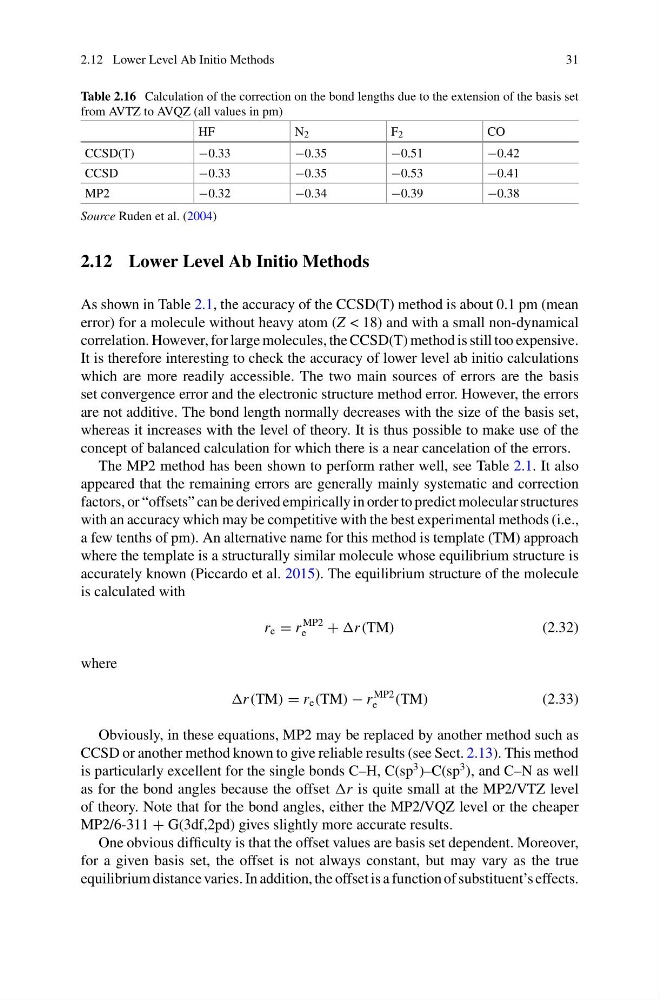
Table 2.16 Calculation of the correction on the bond lengths due to the extension of the basis set
from AVTZ to AVQZ (all values in pm)
HF
N 2
F 2
CO
CCSD(T)
−0.33
−0.35
−0.51
−0.42
CCSD
−0.33
−0.35
−0.53
−0.41
MP2
−0.32
−0.34
−0.39
−0.38
Source Ruden et al. (2004)
2.12 Lower Level Ab Initio Methods
As shown in Table 2.1, the accuracy of the CCSD(T) method is about 0.1 pm (mean
error) for a molecule without heavy atom (Z < 18) and with a small non-dynamical
correlation. However, for large molecules, the CCSD(T) method is still too expensive.
It is therefore interesting to check the accuracy of lower level ab initio calculations
which are more readily accessible. The two main sources of errors are the basis
set convergence error and the electronic structure method error. However, the errors
are not additive. The bond length normally decreases with the size of the basis set,
whereas it increases with the level of theory. It is thus possible to make use of the
concept of balanced calculation for which there is a near cancelation of the errors.
The MP2 method has been shown to perform rather well, see Table 2.1. It also
appeared that the remaining errors are generally mainly systematic and correction
factors, or “offsets” can be derived empirically in order to predict molecular structures
with an accuracy which may be competitive with the best experimental methods (i.e.,
a few tenths of pm). An alternative name for this method is template (TM) approach
where the template is a structurally similar molecule whose equilibrium structure is
accurately known (Piccardo et al. 2015). The equilibrium structure of the molecule
is calculated with
r e = r
MP2
e
+ r (TM)
(2.32)
where
r (TM) = r e (TM) − r
MP2
e
(TM)
(2.33)
Obviously, in these equations, MP2 may be replaced by another method such as
CCSD or another method known to give reliable results (see Sect. 2.13). This method
is particularly excellent for the single bonds C–H, C(sp
3 )–C(sp
3 ), and C–N as well
as for the bond angles because the offset r is quite small at the MP2/VTZ level
of theory. Note that for the bond angles, either the MP2/VQZ level or the cheaper
MP2/6-311 + G(3df,2pd) gives slightly more accurate results.
One obvious difficulty is that the offset values are basis set dependent. Moreover,
for a given basis set, the offset is not always constant, but may vary as the true
equilibrium distance varies. In addition, the offset is a function of substituent’s effects.
31
Table 2.16 Calculation of the correction on the bond lengths due to the extension of the basis set
from AVTZ to AVQZ (all values in pm)
HF
N 2
F 2
CO
CCSD(T)
−0.33
−0.35
−0.51
−0.42
CCSD
−0.33
−0.35
−0.53
−0.41
MP2
−0.32
−0.34
−0.39
−0.38
Source Ruden et al. (2004)
2.12 Lower Level Ab Initio Methods
As shown in Table 2.1, the accuracy of the CCSD(T) method is about 0.1 pm (mean
error) for a molecule without heavy atom (Z < 18) and with a small non-dynamical
correlation. However, for large molecules, the CCSD(T) method is still too expensive.
It is therefore interesting to check the accuracy of lower level ab initio calculations
which are more readily accessible. The two main sources of errors are the basis
set convergence error and the electronic structure method error. However, the errors
are not additive. The bond length normally decreases with the size of the basis set,
whereas it increases with the level of theory. It is thus possible to make use of the
concept of balanced calculation for which there is a near cancelation of the errors.
The MP2 method has been shown to perform rather well, see Table 2.1. It also
appeared that the remaining errors are generally mainly systematic and correction
factors, or “offsets” can be derived empirically in order to predict molecular structures
with an accuracy which may be competitive with the best experimental methods (i.e.,
a few tenths of pm). An alternative name for this method is template (TM) approach
where the template is a structurally similar molecule whose equilibrium structure is
accurately known (Piccardo et al. 2015). The equilibrium structure of the molecule
is calculated with
r e = r
MP2
e
+ r (TM)
(2.32)
where
r (TM) = r e (TM) − r
MP2
e
(TM)
(2.33)
Obviously, in these equations, MP2 may be replaced by another method such as
CCSD or another method known to give reliable results (see Sect. 2.13). This method
is particularly excellent for the single bonds C–H, C(sp
3 )–C(sp
3 ), and C–N as well
as for the bond angles because the offset r is quite small at the MP2/VTZ level
of theory. Note that for the bond angles, either the MP2/VQZ level or the cheaper
MP2/6-311 + G(3df,2pd) gives slightly more accurate results.
One obvious difficulty is that the offset values are basis set dependent. Moreover,
for a given basis set, the offset is not always constant, but may vary as the true
equilibrium distance varies. In addition, the offset is a function of substituent’s effects.