

12
2 Computational Methods
¨
χ
∗
i (r 1 )χ j (r 1 )
1
r 12
χ
∗
k (r 2 )χ l (r 2 )dτ 1 dτ 2
(2.12)
For practical reasons, the χ k functions are Gaussian-type atomic orbitals (GTOs).
χ
GTO
α,abc (x, y, z) = N x
a y
b z
c e
−αr
2
(2.13)
a, b, c again control the angular momentum, and α controls the width of the orbital
The main advantage of the GTOs is that the product of two GTOs is still a GTO.
Therefore, a two-center integral of the type (2.12) can be reduced to a one-center
integral; see Appendix 2.19.3. However, the GTOs have a wrong behavior at the
nucleus where they should have a cusp because the potential energy of the electron
and the nucleus becomes infinite as the distance becomes zero: in other words, the
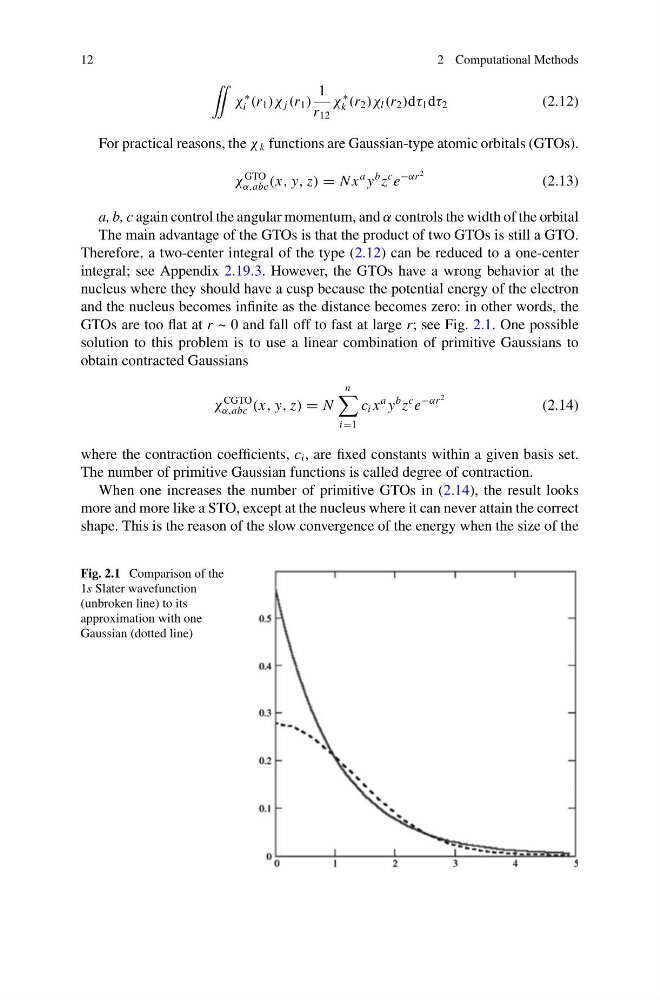
GTOs are too flat at r ~ 0 and fall off to fast at large r; see Fig. 2.1. One possible
solution to this problem is to use a linear combination of primitive Gaussians to
obtain contracted Gaussians
χ
CGTO
α,abc (x, y, z) = N
n
i=1
c i x
a y
b z
c e
−αr
2
(2.14)
where the contraction coefficients, c i , are fixed constants within a given basis set.
The number of primitive Gaussian functions is called degree of contraction.
When one increases the number of primitive GTOs in (2.14), the result looks
more and more like a STO, except at the nucleus where it can never attain the correct
shape. This is the reason of the slow convergence of the energy when the size of the
Fig. 2.1 Comparison of the
1s Slater wavefunction
(unbroken line) to its
approximation with one
Gaussian (dotted line)
2 Computational Methods
¨
χ
∗
i (r 1 )χ j (r 1 )
1
r 12
χ
∗
k (r 2 )χ l (r 2 )dτ 1 dτ 2
(2.12)
For practical reasons, the χ k functions are Gaussian-type atomic orbitals (GTOs).
χ
GTO
α,abc (x, y, z) = N x
a y
b z
c e
−αr
2
(2.13)
a, b, c again control the angular momentum, and α controls the width of the orbital
The main advantage of the GTOs is that the product of two GTOs is still a GTO.
Therefore, a two-center integral of the type (2.12) can be reduced to a one-center
integral; see Appendix 2.19.3. However, the GTOs have a wrong behavior at the
nucleus where they should have a cusp because the potential energy of the electron
and the nucleus becomes infinite as the distance becomes zero: in other words, the
GTOs are too flat at r ~ 0 and fall off to fast at large r; see Fig. 2.1. One possible
solution to this problem is to use a linear combination of primitive Gaussians to
obtain contracted Gaussians
χ
CGTO
α,abc (x, y, z) = N
n
i=1
c i x
a y
b z
c e
−αr
2
(2.14)
where the contraction coefficients, c i , are fixed constants within a given basis set.
The number of primitive Gaussian functions is called degree of contraction.
When one increases the number of primitive GTOs in (2.14), the result looks
more and more like a STO, except at the nucleus where it can never attain the correct
shape. This is the reason of the slow convergence of the energy when the size of the
Fig. 2.1 Comparison of the
1s Slater wavefunction
(unbroken line) to its
approximation with one
Gaussian (dotted line)