

10
2 Computational Methods
E
bo is isotopically invariant. In other words, all the isotopologues of a same molecule
have the same PES and the same equilibrium structure.
It can be shown that the BO approximation can be trusted when the PESs
corresponding to the different electronic states are well separated:
E
BO
0 E
BO
1 E
BO
2 · · ·
(2.4)
It is generally a good approximation in the vicinity of the equilibrium position,
except for a few molecules. For instance, the first two excited electronic states of
NO 3 are close to the ground state and all three levels interact via vibronic coupling
(Deev et al. 2005).
The PES and the equilibrium structure can be calculated by ab initio methods.
This will be discussed in Sects. 2.6 and 2.10 together with the relativistic effects,
Sect. 2.8, and the correction to the BO approximation, Sect. 2.9.
2.4 Hartee–Fock (HF) Method
The electronic Hamiltonian is still too complicated to be solved exactly (except in a
few special cases). Neglecting V nn (which is a constant term), it may be written in
atomic units
H e =
n
i=1
h i +
n
i=1
n
j>i
1
r i j
(2.5)
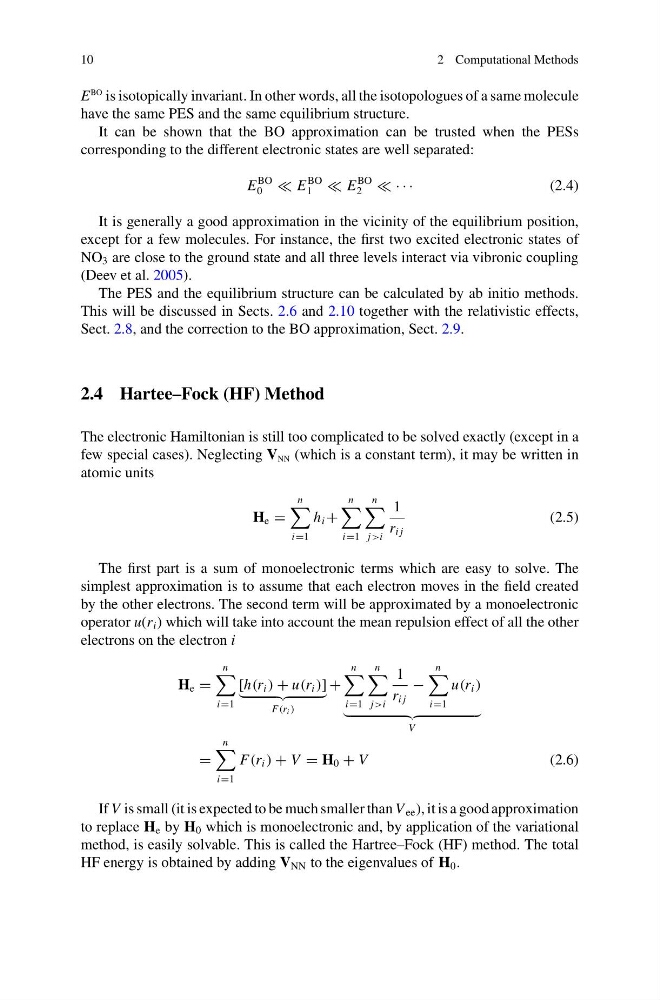
The first part is a sum of monoelectronic terms which are easy to solve. The
simplest approximation is to assume that each electron moves in the field created
by the other electrons. The second term will be approximated by a monoelectronic
operator u(r i ) which will take into account the mean repulsion effect of all the other
electrons on the electron i
H e =
n
i=1
[h(r i ) + u(r i )]
F(r i )
+
n
i=1
n
j>i
1
r i j
−
n
i=1
u(r i )
V
=
n
i=1
F(r i ) + V = H 0 + V
(2.6)
If V is small (it is expected to be much smaller than V ee ), it is a good approximation
to replace H e by H 0 which is monoelectronic and, by application of the variational
method, is easily solvable. This is called the Hartree–Fock (HF) method. The total
HF energy is obtained by adding V NN to the eigenvalues of H 0 .
2 Computational Methods
E
bo is isotopically invariant. In other words, all the isotopologues of a same molecule
have the same PES and the same equilibrium structure.
It can be shown that the BO approximation can be trusted when the PESs
corresponding to the different electronic states are well separated:
E
BO
0 E
BO
1 E
BO
2 · · ·
(2.4)
It is generally a good approximation in the vicinity of the equilibrium position,
except for a few molecules. For instance, the first two excited electronic states of
NO 3 are close to the ground state and all three levels interact via vibronic coupling
(Deev et al. 2005).
The PES and the equilibrium structure can be calculated by ab initio methods.
This will be discussed in Sects. 2.6 and 2.10 together with the relativistic effects,
Sect. 2.8, and the correction to the BO approximation, Sect. 2.9.
2.4 Hartee–Fock (HF) Method
The electronic Hamiltonian is still too complicated to be solved exactly (except in a
few special cases). Neglecting V nn (which is a constant term), it may be written in
atomic units
H e =
n
i=1
h i +
n
i=1
n
j>i
1
r i j
(2.5)
The first part is a sum of monoelectronic terms which are easy to solve. The
simplest approximation is to assume that each electron moves in the field created
by the other electrons. The second term will be approximated by a monoelectronic
operator u(r i ) which will take into account the mean repulsion effect of all the other
electrons on the electron i
H e =
n
i=1
[h(r i ) + u(r i )]
F(r i )
+
n
i=1
n
j>i
1
r i j
−
n
i=1
u(r i )
V
=
n
i=1
F(r i ) + V = H 0 + V
(2.6)
If V is small (it is expected to be much smaller than V ee ), it is a good approximation
to replace H e by H 0 which is monoelectronic and, by application of the variational
method, is easily solvable. This is called the Hartree–Fock (HF) method. The total
HF energy is obtained by adding V NN to the eigenvalues of H 0 .