

8
2 Computational Methods
methods are easy to understand and to apply and are still useful for very large
molecules. Their natural extension are the combined quantum/classical (QM/MM)
methods where the interesting part of the system is treated quantum mechanically
while the effects of the surrounding are taken into account by molecular mechanics.
2.2 Molecular Hamiltonian (Bunker and Jensen 1998)
A molecule is a collection of nuclei and electrons held together by certain forces
and obeying the laws of quantum mechanics. The dominant forces are the Coulomb
electrostatic forces. Gravitational forces are also present but a simple calculation
shows that they are completely negligible compared to the electrostatic forces, see
Appendix 2.19.1. For open shell molecules or when heavy nuclei are present, the
electron spin magnetic moment may interact with other magnetic moments (generated by the orbital motion of the electrons or of the nuclei, or magnetic moments of the
other electrons). These interactions are much smaller and will be neglected in order
to simplify the presentation. When they are not negligible, they can be taken into
account without difficulty.
1 What is left is the Coulomb Hamiltonian. To write it, it is
assumed that the nuclei are punctual masses and the relativistic effects are negligible.
The first approximation is a very good one, see Appendix 2.19.2, and will be further
discussed in Sect. 3.9.3. The second approximation is also a good one. However,
when heavy nuclei are present, relativistic effects become important and should be
taken into account when a structure is calculated ab initio. This approximation will
be further discussed in Sect. 2.8. With these approximations, the Hamiltonian of a
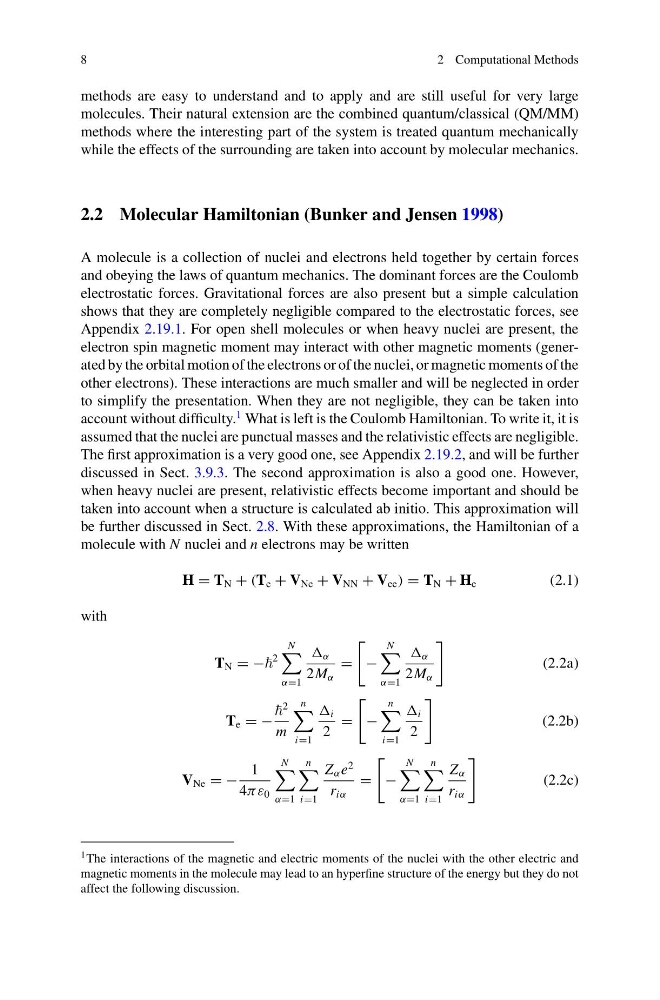
molecule with N nuclei and n electrons may be written
H = T N + (T e + V Ne + V NN + V ee ) = T N + H e
(2.1)
with
T N = −
2
N
α=1
α
2M α
=
−
N
α=1
α
2M α
(2.2a)
T e = −
2
m
n
i=1
i
2
=
−
n
i=1
i
2
(2.2b)
V Ne = −
1
4πε 0
N
α=1
n
i=1
Z α e
2
r iα
=
−
N
α=1
n
i=1
Z α
r iα
(2.2c)
1 The interactions of the magnetic and electric moments of the nuclei with the other electric and
magnetic moments in the molecule may lead to an hyperfine structure of the energy but they do not
affect the following discussion.
2 Computational Methods
methods are easy to understand and to apply and are still useful for very large
molecules. Their natural extension are the combined quantum/classical (QM/MM)
methods where the interesting part of the system is treated quantum mechanically
while the effects of the surrounding are taken into account by molecular mechanics.
2.2 Molecular Hamiltonian (Bunker and Jensen 1998)
A molecule is a collection of nuclei and electrons held together by certain forces
and obeying the laws of quantum mechanics. The dominant forces are the Coulomb
electrostatic forces. Gravitational forces are also present but a simple calculation
shows that they are completely negligible compared to the electrostatic forces, see
Appendix 2.19.1. For open shell molecules or when heavy nuclei are present, the
electron spin magnetic moment may interact with other magnetic moments (generated by the orbital motion of the electrons or of the nuclei, or magnetic moments of the
other electrons). These interactions are much smaller and will be neglected in order
to simplify the presentation. When they are not negligible, they can be taken into
account without difficulty.
1 What is left is the Coulomb Hamiltonian. To write it, it is
assumed that the nuclei are punctual masses and the relativistic effects are negligible.
The first approximation is a very good one, see Appendix 2.19.2, and will be further
discussed in Sect. 3.9.3. The second approximation is also a good one. However,
when heavy nuclei are present, relativistic effects become important and should be
taken into account when a structure is calculated ab initio. This approximation will
be further discussed in Sect. 2.8. With these approximations, the Hamiltonian of a
molecule with N nuclei and n electrons may be written
H = T N + (T e + V Ne + V NN + V ee ) = T N + H e
(2.1)
with
T N = −
2
N
α=1
α
2M α
=
−
N
α=1
α
2M α
(2.2a)
T e = −
2
m
n
i=1
i
2
=
−
n
i=1
i
2
(2.2b)
V Ne = −
1
4πε 0
N
α=1
n
i=1
Z α e
2
r iα
=
−
N
α=1
n
i=1
Z α
r iα
(2.2c)
1 The interactions of the magnetic and electric moments of the nuclei with the other electric and
magnetic moments in the molecule may lead to an hyperfine structure of the energy but they do not
affect the following discussion.