

220
8 Models of Chemical Bonding and “Empirical” Methods
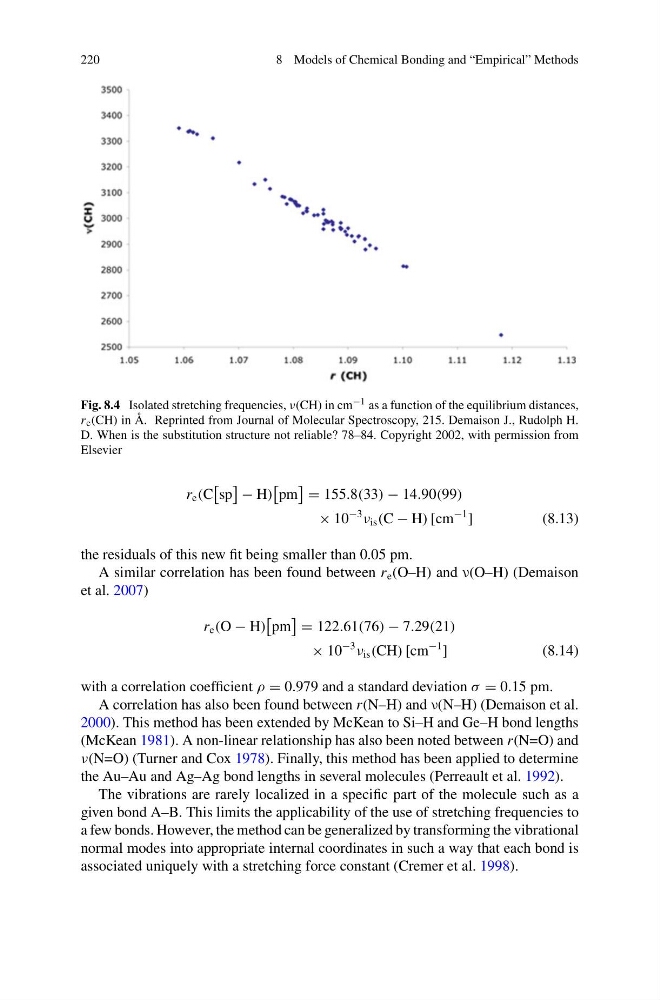
Fig. 8.4 Isolated stretching frequencies, ν(CH) in cm −1 as a function of the equilibrium distances,
r e (CH) in Å. Reprinted from Journal of Molecular Spectroscopy, 215. Demaison J., Rudolph H.
D. When is the substitution structure not reliable? 78–84. Copyright 2002, with permission from
Elsevier
r e (C
sp
− H)
pm
= 155.8(33) − 14.90(99)
× 10
−3
ν is (C − H) [cm
−1
]
(8.13)
the residuals of this new fit being smaller than 0.05 pm.
A similar correlation has been found between r e (O–H) and ν(O–H) (Demaison
et al. 2007)
r e (O − H)
pm
= 122.61(76) − 7.29(21)
× 10
−3
ν is (CH) [cm
−1
]
(8.14)
with a correlation coefficient ρ = 0.979 and a standard deviation σ = 0.15 pm.
A correlation has also been found between r(N–H) and ν(N–H) (Demaison et al.
2000). This method has been extended by McKean to Si–H and Ge–H bond lengths
(McKean 1981). A non-linear relationship has also been noted between r(N=O) and
ν(N=O) (Turner and Cox 1978). Finally, this method has been applied to determine
the Au–Au and Ag–Ag bond lengths in several molecules (Perreault et al. 1992).
The vibrations are rarely localized in a specific part of the molecule such as a
given bond A–B. This limits the applicability of the use of stretching frequencies to
a few bonds. However, the method can be generalized by transforming the vibrational
normal modes into appropriate internal coordinates in such a way that each bond is
associated uniquely with a stretching force constant (Cremer et al. 1998).
8 Models of Chemical Bonding and “Empirical” Methods
Fig. 8.4 Isolated stretching frequencies, ν(CH) in cm −1 as a function of the equilibrium distances,
r e (CH) in Å. Reprinted from Journal of Molecular Spectroscopy, 215. Demaison J., Rudolph H.
D. When is the substitution structure not reliable? 78–84. Copyright 2002, with permission from
Elsevier
r e (C
sp
− H)
pm
= 155.8(33) − 14.90(99)
× 10
−3
ν is (C − H) [cm
−1
]
(8.13)
the residuals of this new fit being smaller than 0.05 pm.
A similar correlation has been found between r e (O–H) and ν(O–H) (Demaison
et al. 2007)
r e (O − H)
pm
= 122.61(76) − 7.29(21)
× 10
−3
ν is (CH) [cm
−1
]
(8.14)
with a correlation coefficient ρ = 0.979 and a standard deviation σ = 0.15 pm.
A correlation has also been found between r(N–H) and ν(N–H) (Demaison et al.
2000). This method has been extended by McKean to Si–H and Ge–H bond lengths
(McKean 1981). A non-linear relationship has also been noted between r(N=O) and
ν(N=O) (Turner and Cox 1978). Finally, this method has been applied to determine
the Au–Au and Ag–Ag bond lengths in several molecules (Perreault et al. 1992).
The vibrations are rarely localized in a specific part of the molecule such as a
given bond A–B. This limits the applicability of the use of stretching frequencies to
a few bonds. However, the method can be generalized by transforming the vibrational
normal modes into appropriate internal coordinates in such a way that each bond is
associated uniquely with a stretching force constant (Cremer et al. 1998).