

218
8 Models of Chemical Bonding and “Empirical” Methods
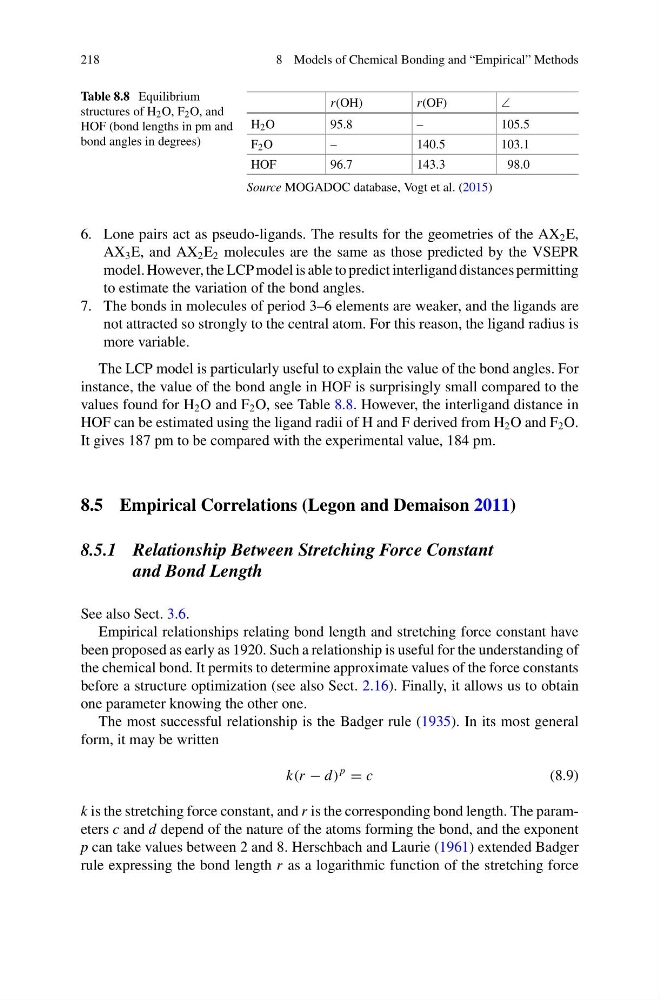
Table 8.8 Equilibrium
structures of H 2 O, F 2 O, and
HOF (bond lengths in pm and
bond angles in degrees)
r(OH)
r(OF)
∠
H 2 O
95.8
–
105.5
F 2 O
–
140.5
103.1
HOF
96.7
143.3
98.0
Source MOGADOC database, Vogt et al. (2015)
6. Lone pairs act as pseudo-ligands. The results for the geometries of the AX 2 E,
AX 3 E, and AX 2 E 2 molecules are the same as those predicted by the VSEPR
model. However, the LCP model is able to predict interligand distances permitting
to estimate the variation of the bond angles.
7. The bonds in molecules of period 3–6 elements are weaker, and the ligands are
not attracted so strongly to the central atom. For this reason, the ligand radius is
more variable.
The LCP model is particularly useful to explain the value of the bond angles. For
instance, the value of the bond angle in HOF is surprisingly small compared to the
values found for H 2 O and F 2 O, see Table 8.8. However, the interligand distance in
HOF can be estimated using the ligand radii of H and F derived from H 2 O and F 2 O.
It gives 187 pm to be compared with the experimental value, 184 pm.
8.5 Empirical Correlations (Legon and Demaison 2011)
8.5.1 Relationship Between Stretching Force Constant
and Bond Length
See also Sect. 3.6.
Empirical relationships relating bond length and stretching force constant have
been proposed as early as 1920. Such a relationship is useful for the understanding of
the chemical bond. It permits to determine approximate values of the force constants
before a structure optimization (see also Sect. 2.16). Finally, it allows us to obtain
one parameter knowing the other one.
The most successful relationship is the Badger rule (1935). In its most general
form, it may be written
k(r − d)
p
= c
(8.9)
k is the stretching force constant, and r is the corresponding bond length. The parameters c and d depend of the nature of the atoms forming the bond, and the exponent
p can take values between 2 and 8. Herschbach and Laurie (1961) extended Badger
rule expressing the bond length r as a logarithmic function of the stretching force
8 Models of Chemical Bonding and “Empirical” Methods
Table 8.8 Equilibrium
structures of H 2 O, F 2 O, and
HOF (bond lengths in pm and
bond angles in degrees)
r(OH)
r(OF)
∠
H 2 O
95.8
–
105.5
F 2 O
–
140.5
103.1
HOF
96.7
143.3
98.0
Source MOGADOC database, Vogt et al. (2015)
6. Lone pairs act as pseudo-ligands. The results for the geometries of the AX 2 E,
AX 3 E, and AX 2 E 2 molecules are the same as those predicted by the VSEPR
model. However, the LCP model is able to predict interligand distances permitting
to estimate the variation of the bond angles.
7. The bonds in molecules of period 3–6 elements are weaker, and the ligands are
not attracted so strongly to the central atom. For this reason, the ligand radius is
more variable.
The LCP model is particularly useful to explain the value of the bond angles. For
instance, the value of the bond angle in HOF is surprisingly small compared to the
values found for H 2 O and F 2 O, see Table 8.8. However, the interligand distance in
HOF can be estimated using the ligand radii of H and F derived from H 2 O and F 2 O.
It gives 187 pm to be compared with the experimental value, 184 pm.
8.5 Empirical Correlations (Legon and Demaison 2011)
8.5.1 Relationship Between Stretching Force Constant
and Bond Length
See also Sect. 3.6.
Empirical relationships relating bond length and stretching force constant have
been proposed as early as 1920. Such a relationship is useful for the understanding of
the chemical bond. It permits to determine approximate values of the force constants
before a structure optimization (see also Sect. 2.16). Finally, it allows us to obtain
one parameter knowing the other one.
The most successful relationship is the Badger rule (1935). In its most general
form, it may be written
k(r − d)
p
= c
(8.9)
k is the stretching force constant, and r is the corresponding bond length. The parameters c and d depend of the nature of the atoms forming the bond, and the exponent
p can take values between 2 and 8. Herschbach and Laurie (1961) extended Badger
rule expressing the bond length r as a logarithmic function of the stretching force