

168
7 Molecular Structures from Gas-Phase Electron Diffraction
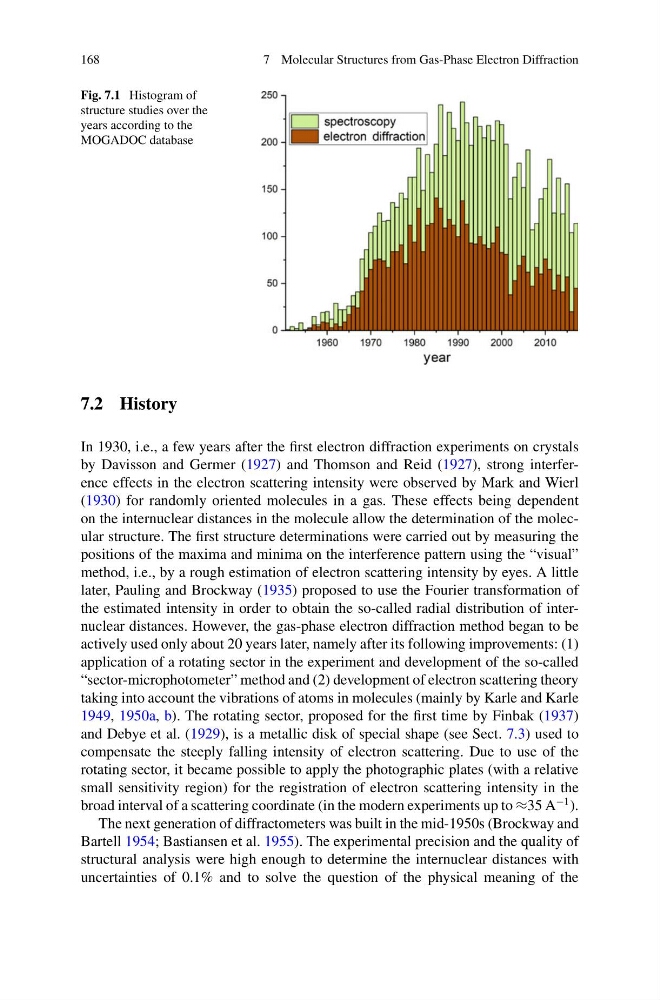
Fig. 7.1 Histogram of
structure studies over the
years according to the
MOGADOC database
7.2 History
In 1930, i.e., a few years after the first electron diffraction experiments on crystals
by Davisson and Germer (1927) and Thomson and Reid (1927), strong interference effects in the electron scattering intensity were observed by Mark and Wierl
(1930) for randomly oriented molecules in a gas. These effects being dependent
on the internuclear distances in the molecule allow the determination of the molecular structure. The first structure determinations were carried out by measuring the
positions of the maxima and minima on the interference pattern using the “visual”
method, i.e., by a rough estimation of electron scattering intensity by eyes. A little
later, Pauling and Brockway (1935) proposed to use the Fourier transformation of
the estimated intensity in order to obtain the so-called radial distribution of internuclear distances. However, the gas-phase electron diffraction method began to be
actively used only about 20 years later, namely after its following improvements: (1)
application of a rotating sector in the experiment and development of the so-called
“sector-microphotometer” method and (2) development of electron scattering theory
taking into account the vibrations of atoms in molecules (mainly by Karle and Karle
1949, 1950a, b). The rotating sector, proposed for the first time by Finbak (1937)
and Debye et al. (1929), is a metallic disk of special shape (see Sect. 7.3) used to
compensate the steeply falling intensity of electron scattering. Due to use of the
rotating sector, it became possible to apply the photographic plates (with a relative
small sensitivity region) for the registration of electron scattering intensity in the
broad interval of a scattering coordinate (in the modern experiments up to ≈35 A
−1 ).
The next generation of diffractometers was built in the mid-1950s (Brockway and
Bartell 1954; Bastiansen et al. 1955). The experimental precision and the quality of
structural analysis were high enough to determine the internuclear distances with
uncertainties of 0.1% and to solve the question of the physical meaning of the
7 Molecular Structures from Gas-Phase Electron Diffraction
Fig. 7.1 Histogram of
structure studies over the
years according to the
MOGADOC database
7.2 History
In 1930, i.e., a few years after the first electron diffraction experiments on crystals
by Davisson and Germer (1927) and Thomson and Reid (1927), strong interference effects in the electron scattering intensity were observed by Mark and Wierl
(1930) for randomly oriented molecules in a gas. These effects being dependent
on the internuclear distances in the molecule allow the determination of the molecular structure. The first structure determinations were carried out by measuring the
positions of the maxima and minima on the interference pattern using the “visual”
method, i.e., by a rough estimation of electron scattering intensity by eyes. A little
later, Pauling and Brockway (1935) proposed to use the Fourier transformation of
the estimated intensity in order to obtain the so-called radial distribution of internuclear distances. However, the gas-phase electron diffraction method began to be
actively used only about 20 years later, namely after its following improvements: (1)
application of a rotating sector in the experiment and development of the so-called
“sector-microphotometer” method and (2) development of electron scattering theory
taking into account the vibrations of atoms in molecules (mainly by Karle and Karle
1949, 1950a, b). The rotating sector, proposed for the first time by Finbak (1937)
and Debye et al. (1929), is a metallic disk of special shape (see Sect. 7.3) used to
compensate the steeply falling intensity of electron scattering. Due to use of the
rotating sector, it became possible to apply the photographic plates (with a relative
small sensitivity region) for the registration of electron scattering intensity in the
broad interval of a scattering coordinate (in the modern experiments up to ≈35 A
−1 ).
The next generation of diffractometers was built in the mid-1950s (Brockway and
Bartell 1954; Bastiansen et al. 1955). The experimental precision and the quality of
structural analysis were high enough to determine the internuclear distances with
uncertainties of 0.1% and to solve the question of the physical meaning of the