

6.13 Appendices
161
P a + μa
2
− P
μab
μac
μab
P b + μb
2
− P
μbc
μac
μbc
P c + μc
2
− P
= 0
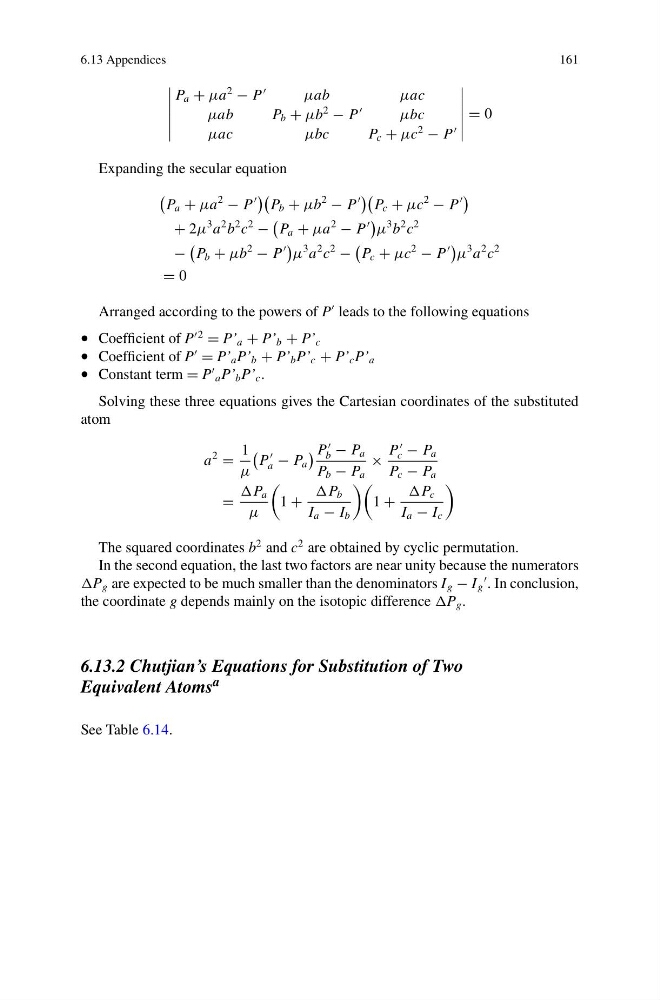
Expanding the secular equation
P a + μa
2
− P
P b + μb
2
− P
P c + μc
2
− P
+ 2μ
3 a
2 b
2 c
2
−
P a + μa
2
− P
μ
3 b
2 c
2
−
P b + μb
2
− P
μ
3 a
2 c
2
−
P c + μc
2
− P
μ
3 a
2 c
2
= 0
Arranged according to the powers of P
leads to the following equations
• Coefficient of P
2
= P’ a + P’ b + P’ c
• Coefficient of P
= P’ a P’ b + P’ b P’ c + P’ c P’ a
• Constant term = P
a P’ b P’ c .
Solving these three equations gives the Cartesian coordinates of the substituted
atom
a
2
=
1
μ
P
a − P a
P
b − P a
P b − P a
×
P
c − P a
P c − P a
=
P a
μ
1 +
P b
I a − I b
1 +
P c
I a − I c
The squared coordinates b
2 and c
2 are obtained by cyclic permutation.
In the second equation, the last two factors are near unity because the numerators
P g are expected to be much smaller than the denominators I g − I g
. In conclusion,
the coordinate g depends mainly on the isotopic difference P g .
6.13.2 Chutjian’s Equations for Substitution of Two
Equivalent Atoms a
See Table 6.14.
161
P a + μa
2
− P
μab
μac
μab
P b + μb
2
− P
μbc
μac
μbc
P c + μc
2
− P
= 0
Expanding the secular equation
P a + μa
2
− P
P b + μb
2
− P
P c + μc
2
− P
+ 2μ
3 a
2 b
2 c
2
−
P a + μa
2
− P
μ
3 b
2 c
2
−
P b + μb
2
− P
μ
3 a
2 c
2
−
P c + μc
2
− P
μ
3 a
2 c
2
= 0
Arranged according to the powers of P
leads to the following equations
• Coefficient of P
2
= P’ a + P’ b + P’ c
• Coefficient of P
= P’ a P’ b + P’ b P’ c + P’ c P’ a
• Constant term = P
a P’ b P’ c .
Solving these three equations gives the Cartesian coordinates of the substituted
atom
a
2
=
1
μ
P
a − P a
P
b − P a
P b − P a
×
P
c − P a
P c − P a
=
P a
μ
1 +
P b
I a − I b
1 +
P c
I a − I c
The squared coordinates b
2 and c
2 are obtained by cyclic permutation.
In the second equation, the last two factors are near unity because the numerators
P g are expected to be much smaller than the denominators I g − I g
. In conclusion,
the coordinate g depends mainly on the isotopic difference P g .
6.13.2 Chutjian’s Equations for Substitution of Two
Equivalent Atoms a
See Table 6.14.