

6.9 Structure of Weakly Bound Complexes
153
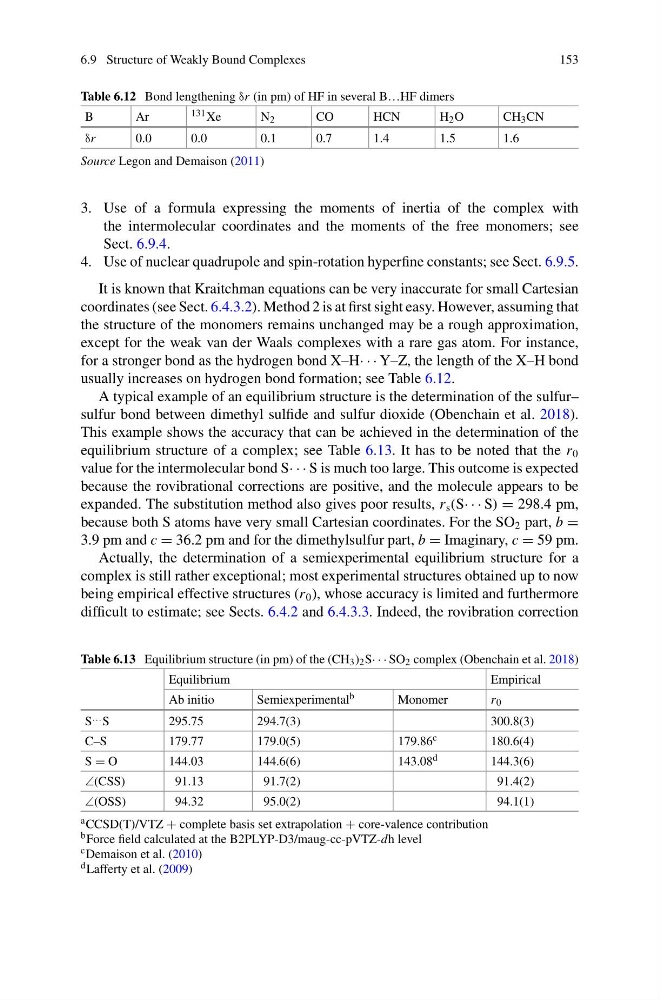
Table 6.12 Bond lengthening δr (in pm) of HF in several B…HF dimers
B
Ar
131 Xe
N 2
CO
HCN
H 2 O
CH 3 CN
δr
0.0
0.0
0.1
0.7
1.4
1.5
1.6
Source Legon and Demaison (2011)
3. Use of a formula expressing the moments of inertia of the complex with
the intermolecular coordinates and the moments of the free monomers; see
Sect. 6.9.4.
4. Use of nuclear quadrupole and spin-rotation hyperfine constants; see Sect. 6.9.5.
It is known that Kraitchman equations can be very inaccurate for small Cartesian
coordinates (see Sect. 6.4.3.2). Method 2 is at first sight easy. However, assuming that
the structure of the monomers remains unchanged may be a rough approximation,
except for the weak van der Waals complexes with a rare gas atom. For instance,
for a stronger bond as the hydrogen bond X–H· · · Y–Z, the length of the X–H bond
usually increases on hydrogen bond formation; see Table 6.12.
A typical example of an equilibrium structure is the determination of the sulfur–
sulfur bond between dimethyl sulfide and sulfur dioxide (Obenchain et al. 2018).
This example shows the accuracy that can be achieved in the determination of the
equilibrium structure of a complex; see Table 6.13. It has to be noted that the r 0
value for the intermolecular bond S· · · S is much too large. This outcome is expected
because the rovibrational corrections are positive, and the molecule appears to be
expanded. The substitution method also gives poor results, r s (S· · · S) = 298.4 pm,
because both S atoms have very small Cartesian coordinates. For the SO 2 part, b =
3.9 pm and c = 36.2 pm and for the dimethylsulfur part, b = Imaginary, c = 59 pm.
Actually, the determination of a semiexperimental equilibrium structure for a
complex is still rather exceptional; most experimental structures obtained up to now
being empirical effective structures (r 0 ), whose accuracy is limited and furthermore
difficult to estimate; see Sects. 6.4.2 and 6.4.3.3. Indeed, the rovibration correction
Table 6.13 Equilibrium structure (in pm) of the (CH 3 ) 2 S· · · SO 2 complex (Obenchain et al. 2018)
Equilibrium
Empirical
Ab initio
Semiexperimental b
Monomer
r 0
S … S
295.75
294.7(3)
300.8(3)
C–S
179.77
179.0(5)
179.86 c
180.6(4)
S = O
144.03
144.6(6)
143.08 d
144.3(6)
∠(CSS)
91.13
91.7(2)
91.4(2)
∠(OSS)
94.32
95.0(2)
94.1(1)
a CCSD(T)/VTZ + complete basis set extrapolation + core-valence contribution
b Force field calculated at the B2PLYP-D3/maug-cc-pVTZ-dh level
c Demaison et al. (2010)
d Lafferty et al. (2009)
153
Table 6.12 Bond lengthening δr (in pm) of HF in several B…HF dimers
B
Ar
131 Xe
N 2
CO
HCN
H 2 O
CH 3 CN
δr
0.0
0.0
0.1
0.7
1.4
1.5
1.6
Source Legon and Demaison (2011)
3. Use of a formula expressing the moments of inertia of the complex with
the intermolecular coordinates and the moments of the free monomers; see
Sect. 6.9.4.
4. Use of nuclear quadrupole and spin-rotation hyperfine constants; see Sect. 6.9.5.
It is known that Kraitchman equations can be very inaccurate for small Cartesian
coordinates (see Sect. 6.4.3.2). Method 2 is at first sight easy. However, assuming that
the structure of the monomers remains unchanged may be a rough approximation,
except for the weak van der Waals complexes with a rare gas atom. For instance,
for a stronger bond as the hydrogen bond X–H· · · Y–Z, the length of the X–H bond
usually increases on hydrogen bond formation; see Table 6.12.
A typical example of an equilibrium structure is the determination of the sulfur–
sulfur bond between dimethyl sulfide and sulfur dioxide (Obenchain et al. 2018).
This example shows the accuracy that can be achieved in the determination of the
equilibrium structure of a complex; see Table 6.13. It has to be noted that the r 0
value for the intermolecular bond S· · · S is much too large. This outcome is expected
because the rovibrational corrections are positive, and the molecule appears to be
expanded. The substitution method also gives poor results, r s (S· · · S) = 298.4 pm,
because both S atoms have very small Cartesian coordinates. For the SO 2 part, b =
3.9 pm and c = 36.2 pm and for the dimethylsulfur part, b = Imaginary, c = 59 pm.
Actually, the determination of a semiexperimental equilibrium structure for a
complex is still rather exceptional; most experimental structures obtained up to now
being empirical effective structures (r 0 ), whose accuracy is limited and furthermore
difficult to estimate; see Sects. 6.4.2 and 6.4.3.3. Indeed, the rovibration correction
Table 6.13 Equilibrium structure (in pm) of the (CH 3 ) 2 S· · · SO 2 complex (Obenchain et al. 2018)
Equilibrium
Empirical
Ab initio
Semiexperimental b
Monomer
r 0
S … S
295.75
294.7(3)
300.8(3)
C–S
179.77
179.0(5)
179.86 c
180.6(4)
S = O
144.03
144.6(6)
143.08 d
144.3(6)
∠(CSS)
91.13
91.7(2)
91.4(2)
∠(OSS)
94.32
95.0(2)
94.1(1)
a CCSD(T)/VTZ + complete basis set extrapolation + core-valence contribution
b Force field calculated at the B2PLYP-D3/maug-cc-pVTZ-dh level
c Demaison et al. (2010)
d Lafferty et al. (2009)