

6.7 Semiexperimental Equilibrium (se) Structure
149
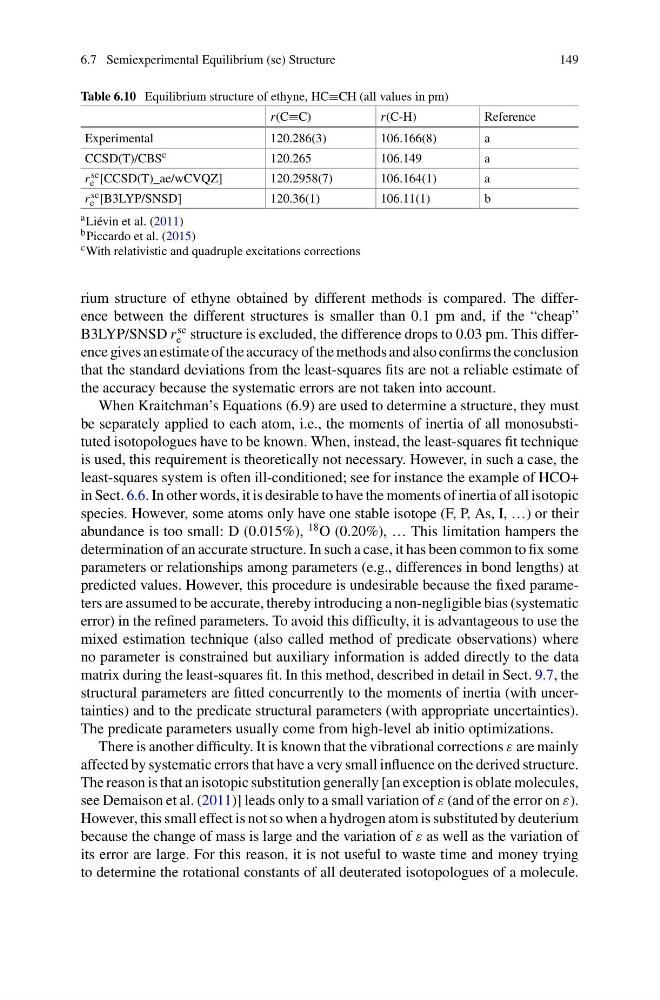
Table 6.10 Equilibrium structure of ethyne, HC≡CH (all values in pm)
r(C≡C)
r(C-H)
Reference
Experimental
120.286(3)
106.166(8)
a
CCSD(T)/CBS c
120.265
106.149
a
r se
e [CCSD(T)_ae/wCVQZ]
120.2958(7)
106.164(1)
a
r se
e [B3LYP/SNSD]
120.36(1)
106.11(1)
b
a Liévin et al. (2011)
b Piccardo et al. (2015)
c With relativistic and quadruple excitations corrections
rium structure of ethyne obtained by different methods is compared. The difference between the different structures is smaller than 0.1 pm and, if the “cheap”
B3LYP/SNSD r
se
e structure is excluded, the difference drops to 0.03 pm. This difference gives an estimate of the accuracy of the methods and also confirms the conclusion
that the standard deviations from the least-squares fits are not a reliable estimate of
the accuracy because the systematic errors are not taken into account.
When Kraitchman’s Equations (6.9) are used to determine a structure, they must
be separately applied to each atom, i.e., the moments of inertia of all monosubstituted isotopologues have to be known. When, instead, the least-squares fit technique
is used, this requirement is theoretically not necessary. However, in such a case, the
least-squares system is often ill-conditioned; see for instance the example of HCO+
in Sect. 6.6. In other words, it is desirable to have the moments of inertia of all isotopic
species. However, some atoms only have one stable isotope (F, P, As, I, …) or their
abundance is too small: D (0.015%),
18 O (0.20%), … This limitation hampers the
determination of an accurate structure. In such a case, it has been common to fix some
parameters or relationships among parameters (e.g., differences in bond lengths) at
predicted values. However, this procedure is undesirable because the fixed parameters are assumed to be accurate, thereby introducing a non-negligible bias (systematic
error) in the refined parameters. To avoid this difficulty, it is advantageous to use the
mixed estimation technique (also called method of predicate observations) where
no parameter is constrained but auxiliary information is added directly to the data
matrix during the least-squares fit. In this method, described in detail in Sect. 9.7, the
structural parameters are fitted concurrently to the moments of inertia (with uncertainties) and to the predicate structural parameters (with appropriate uncertainties).
The predicate parameters usually come from high-level ab initio optimizations.
There is another difficulty. It is known that the vibrational corrections ε are mainly
affected by systematic errors that have a very small influence on the derived structure.
The reason is that an isotopic substitution generally [an exception is oblate molecules,
see Demaison et al. (2011)] leads only to a small variation of ε (and of the error on ε).
However, this small effect is not so when a hydrogen atom is substituted by deuterium
because the change of mass is large and the variation of ε as well as the variation of
its error are large. For this reason, it is not useful to waste time and money trying
to determine the rotational constants of all deuterated isotopologues of a molecule.
149
Table 6.10 Equilibrium structure of ethyne, HC≡CH (all values in pm)
r(C≡C)
r(C-H)
Reference
Experimental
120.286(3)
106.166(8)
a
CCSD(T)/CBS c
120.265
106.149
a
r se
e [CCSD(T)_ae/wCVQZ]
120.2958(7)
106.164(1)
a
r se
e [B3LYP/SNSD]
120.36(1)
106.11(1)
b
a Liévin et al. (2011)
b Piccardo et al. (2015)
c With relativistic and quadruple excitations corrections
rium structure of ethyne obtained by different methods is compared. The difference between the different structures is smaller than 0.1 pm and, if the “cheap”
B3LYP/SNSD r
se
e structure is excluded, the difference drops to 0.03 pm. This difference gives an estimate of the accuracy of the methods and also confirms the conclusion
that the standard deviations from the least-squares fits are not a reliable estimate of
the accuracy because the systematic errors are not taken into account.
When Kraitchman’s Equations (6.9) are used to determine a structure, they must
be separately applied to each atom, i.e., the moments of inertia of all monosubstituted isotopologues have to be known. When, instead, the least-squares fit technique
is used, this requirement is theoretically not necessary. However, in such a case, the
least-squares system is often ill-conditioned; see for instance the example of HCO+
in Sect. 6.6. In other words, it is desirable to have the moments of inertia of all isotopic
species. However, some atoms only have one stable isotope (F, P, As, I, …) or their
abundance is too small: D (0.015%),
18 O (0.20%), … This limitation hampers the
determination of an accurate structure. In such a case, it has been common to fix some
parameters or relationships among parameters (e.g., differences in bond lengths) at
predicted values. However, this procedure is undesirable because the fixed parameters are assumed to be accurate, thereby introducing a non-negligible bias (systematic
error) in the refined parameters. To avoid this difficulty, it is advantageous to use the
mixed estimation technique (also called method of predicate observations) where
no parameter is constrained but auxiliary information is added directly to the data
matrix during the least-squares fit. In this method, described in detail in Sect. 9.7, the
structural parameters are fitted concurrently to the moments of inertia (with uncertainties) and to the predicate structural parameters (with appropriate uncertainties).
The predicate parameters usually come from high-level ab initio optimizations.
There is another difficulty. It is known that the vibrational corrections ε are mainly
affected by systematic errors that have a very small influence on the derived structure.
The reason is that an isotopic substitution generally [an exception is oblate molecules,
see Demaison et al. (2011)] leads only to a small variation of ε (and of the error on ε).
However, this small effect is not so when a hydrogen atom is substituted by deuterium
because the change of mass is large and the variation of ε as well as the variation of
its error are large. For this reason, it is not useful to waste time and money trying
to determine the rotational constants of all deuterated isotopologues of a molecule.