

4.12 Experimental Techniques
95
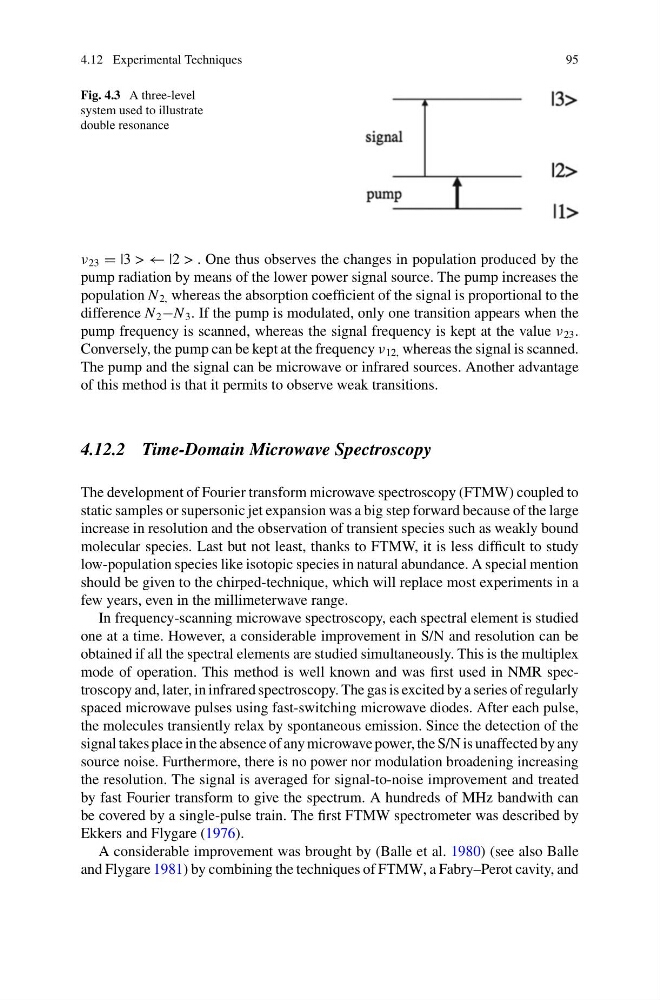
Fig. 4.3 A three-level
system used to illustrate
double resonance
ν 23 = |3 > ← |2 > . One thus observes the changes in population produced by the
pump radiation by means of the lower power signal source. The pump increases the
population N 2, whereas the absorption coefficient of the signal is proportional to the
difference N 2 −N 3 . If the pump is modulated, only one transition appears when the
pump frequency is scanned, whereas the signal frequency is kept at the value ν 23 .
Conversely, the pump can be kept at the frequency ν 12, whereas the signal is scanned.
The pump and the signal can be microwave or infrared sources. Another advantage
of this method is that it permits to observe weak transitions.
4.12.2 Time-Domain Microwave Spectroscopy
The development of Fourier transform microwave spectroscopy (FTMW) coupled to
static samples or supersonic jet expansion was a big step forward because of the large
increase in resolution and the observation of transient species such as weakly bound
molecular species. Last but not least, thanks to FTMW, it is less difficult to study
low-population species like isotopic species in natural abundance. A special mention
should be given to the chirped-technique, which will replace most experiments in a
few years, even in the millimeterwave range.
In frequency-scanning microwave spectroscopy, each spectral element is studied
one at a time. However, a considerable improvement in S/N and resolution can be
obtained if all the spectral elements are studied simultaneously. This is the multiplex
mode of operation. This method is well known and was first used in NMR spectroscopy and, later, in infrared spectroscopy. The gas is excited by a series of regularly
spaced microwave pulses using fast-switching microwave diodes. After each pulse,
the molecules transiently relax by spontaneous emission. Since the detection of the
signal takes place in the absence of any microwave power, the S/N is unaffected by any
source noise. Furthermore, there is no power nor modulation broadening increasing
the resolution. The signal is averaged for signal-to-noise improvement and treated
by fast Fourier transform to give the spectrum. A hundreds of MHz bandwith can
be covered by a single-pulse train. The first FTMW spectrometer was described by
Ekkers and Flygare (1976).
A considerable improvement was brought by (Balle et al. 1980) (see also Balle
and Flygare 1981) by combining the techniques of FTMW, a Fabry–Perot cavity, and
95
Fig. 4.3 A three-level
system used to illustrate
double resonance
ν 23 = |3 > ← |2 > . One thus observes the changes in population produced by the
pump radiation by means of the lower power signal source. The pump increases the
population N 2, whereas the absorption coefficient of the signal is proportional to the
difference N 2 −N 3 . If the pump is modulated, only one transition appears when the
pump frequency is scanned, whereas the signal frequency is kept at the value ν 23 .
Conversely, the pump can be kept at the frequency ν 12, whereas the signal is scanned.
The pump and the signal can be microwave or infrared sources. Another advantage
of this method is that it permits to observe weak transitions.
4.12.2 Time-Domain Microwave Spectroscopy
The development of Fourier transform microwave spectroscopy (FTMW) coupled to
static samples or supersonic jet expansion was a big step forward because of the large
increase in resolution and the observation of transient species such as weakly bound
molecular species. Last but not least, thanks to FTMW, it is less difficult to study
low-population species like isotopic species in natural abundance. A special mention
should be given to the chirped-technique, which will replace most experiments in a
few years, even in the millimeterwave range.
In frequency-scanning microwave spectroscopy, each spectral element is studied
one at a time. However, a considerable improvement in S/N and resolution can be
obtained if all the spectral elements are studied simultaneously. This is the multiplex
mode of operation. This method is well known and was first used in NMR spectroscopy and, later, in infrared spectroscopy. The gas is excited by a series of regularly
spaced microwave pulses using fast-switching microwave diodes. After each pulse,
the molecules transiently relax by spontaneous emission. Since the detection of the
signal takes place in the absence of any microwave power, the S/N is unaffected by any
source noise. Furthermore, there is no power nor modulation broadening increasing
the resolution. The signal is averaged for signal-to-noise improvement and treated
by fast Fourier transform to give the spectrum. A hundreds of MHz bandwith can
be covered by a single-pulse train. The first FTMW spectrometer was described by
Ekkers and Flygare (1976).
A considerable improvement was brought by (Balle et al. 1980) (see also Balle
and Flygare 1981) by combining the techniques of FTMW, a Fabry–Perot cavity, and