

86
4 Rotation of the Polyatomic Molecule
ν = 2B(J + 1) − 4D J (J + 1)
3
−2D J K (J + 1)K
2
(4.32)
4.5.3 Determination of the Axial Rotational Constant
Due to the selection rule K = 0, the axial rotational constant (A for a prolate top, C
for an oblate top) cannot be obtained from the rotational spectrum. However, there
are two powerful methods that permit to determine it from the infrared spectrum.
The first one uses perturbation-allowed transitions. These transitions are normally
forbidden but, thanks to a resonance between two nearby levels, the forbidden transition borrows some intensity to an allowed transition and becomes observable and
is called perturbation allowed transition, see Sect. 21 of Papousek and Aliev (1982).
The frequency difference between allowed transitions and “forbidden” transitions
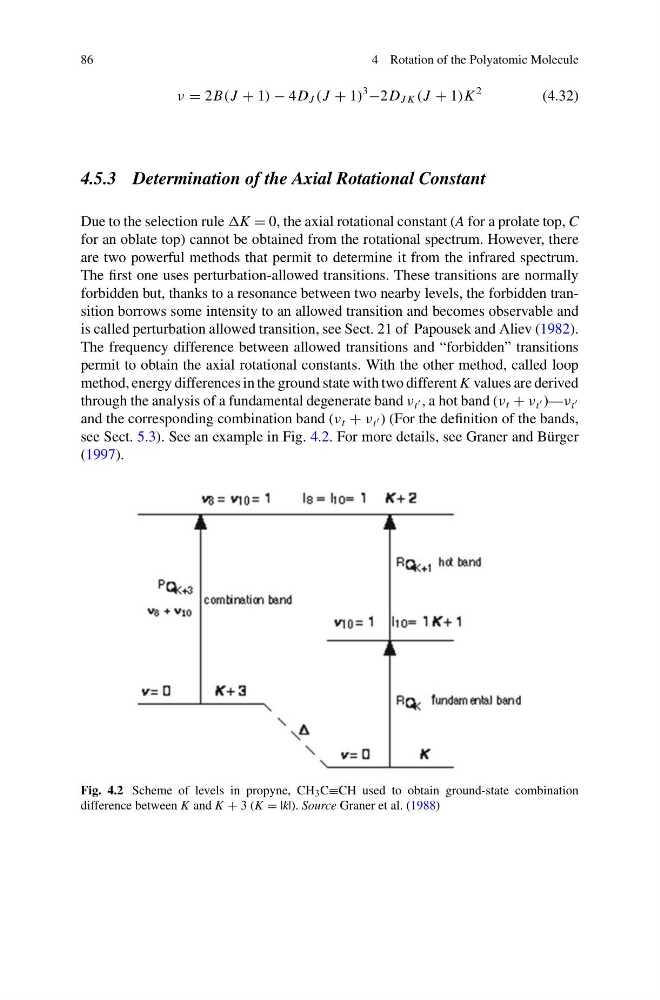
permit to obtain the axial rotational constants. With the other method, called loop
method, energy differences in the ground state with two different K values are derived
through the analysis of a fundamental degenerate band ν t , a hot band (ν t + ν t )—ν t
and the corresponding combination band (ν t + ν t ) (For the definition of the bands,
see Sect. 5.3). See an example in Fig. 4.2. For more details, see Graner and Bürger
(1997).
Fig. 4.2 Scheme of levels in propyne, CH 3 C≡CH used to obtain ground-state combination
difference between K and K + 3 (K = |k|). Source Graner et al. (1988)
4 Rotation of the Polyatomic Molecule
ν = 2B(J + 1) − 4D J (J + 1)
3
−2D J K (J + 1)K
2
(4.32)
4.5.3 Determination of the Axial Rotational Constant
Due to the selection rule K = 0, the axial rotational constant (A for a prolate top, C
for an oblate top) cannot be obtained from the rotational spectrum. However, there
are two powerful methods that permit to determine it from the infrared spectrum.
The first one uses perturbation-allowed transitions. These transitions are normally
forbidden but, thanks to a resonance between two nearby levels, the forbidden transition borrows some intensity to an allowed transition and becomes observable and
is called perturbation allowed transition, see Sect. 21 of Papousek and Aliev (1982).
The frequency difference between allowed transitions and “forbidden” transitions
permit to obtain the axial rotational constants. With the other method, called loop
method, energy differences in the ground state with two different K values are derived
through the analysis of a fundamental degenerate band ν t , a hot band (ν t + ν t )—ν t
and the corresponding combination band (ν t + ν t ) (For the definition of the bands,
see Sect. 5.3). See an example in Fig. 4.2. For more details, see Graner and Bürger
(1997).
Fig. 4.2 Scheme of levels in propyne, CH 3 C≡CH used to obtain ground-state combination
difference between K and K + 3 (K = |k|). Source Graner et al. (1988)