

84
4 Rotation of the Polyatomic Molecule
J K M|P
2
y |J K ± 2M =
2
4
[J (J + 1) − K (K ± 1)]
1/2
[J (J + 1) − (K ± 1)(K ± 2)]
1/2
(4.21b)
J K M|P
2
x |J K ± 2M = −J K M|P
2
y |J K ± 2M
(4.21c)
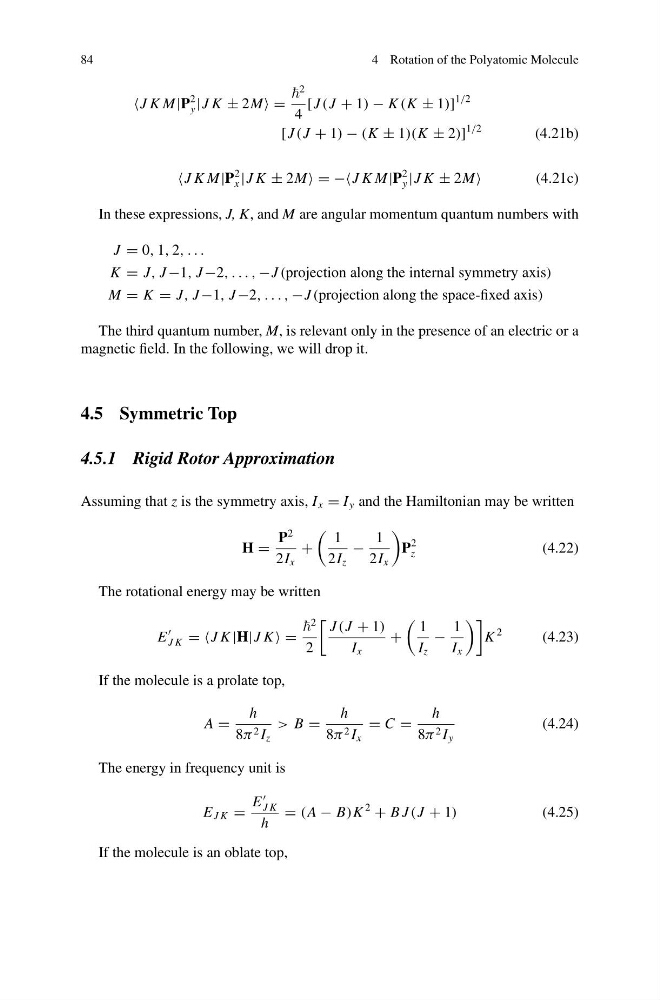
In these expressions, J, K, and M are angular momentum quantum numbers with
J = 0, 1, 2, . . .
K = J, J −1, J −2, . . . , −J (projection along the internal symmetry axis)
M = K = J, J −1, J −2, . . . , −J (projection along the space-fixed axis)
The third quantum number, M, is relevant only in the presence of an electric or a
magnetic field. In the following, we will drop it.
4.5 Symmetric Top
4.5.1 Rigid Rotor Approximation
Assuming that z is the symmetry axis, I x = I y and the Hamiltonian may be written
H =
P
2
2I x
+
1
2I z
−
1
2I x
P
2
z
(4.22)
The rotational energy may be written
E
J K = J K |H|J K =
2
2
J (J + 1)
I x
+
1
I z
−
1
I x
K
2
(4.23)
If the molecule is a prolate top,
A =
h
8π 2 I z
> B =
h
8π 2 I x
= C =
h
8π 2 I y
(4.24)
The energy in frequency unit is
E J K =
E
J K
h
= (A − B)K
2
+ B J (J + 1)
(4.25)
If the molecule is an oblate top,
4 Rotation of the Polyatomic Molecule
J K M|P
2
y |J K ± 2M =
2
4
[J (J + 1) − K (K ± 1)]
1/2
[J (J + 1) − (K ± 1)(K ± 2)]
1/2
(4.21b)
J K M|P
2
x |J K ± 2M = −J K M|P
2
y |J K ± 2M
(4.21c)
In these expressions, J, K, and M are angular momentum quantum numbers with
J = 0, 1, 2, . . .
K = J, J −1, J −2, . . . , −J (projection along the internal symmetry axis)
M = K = J, J −1, J −2, . . . , −J (projection along the space-fixed axis)
The third quantum number, M, is relevant only in the presence of an electric or a
magnetic field. In the following, we will drop it.
4.5 Symmetric Top
4.5.1 Rigid Rotor Approximation
Assuming that z is the symmetry axis, I x = I y and the Hamiltonian may be written
H =
P
2
2I x
+
1
2I z
−
1
2I x
P
2
z
(4.22)
The rotational energy may be written
E
J K = J K |H|J K =
2
2
J (J + 1)
I x
+
1
I z
−
1
I x
K
2
(4.23)
If the molecule is a prolate top,
A =
h
8π 2 I z
> B =
h
8π 2 I x
= C =
h
8π 2 I y
(4.24)
The energy in frequency unit is
E J K =
E
J K
h
= (A − B)K
2
+ B J (J + 1)
(4.25)
If the molecule is an oblate top,