

6 Tricarbocyclic Sesterterpenoids
A greater number of carbocyclic moieties increases the complexity of the structures
of sesterterpenoids. Thus, sesterterpenoids with more than three carbocyclic rings
exhibit considerable complexity. Moreover, the diversity of the basic carbon skeleton is also increased. Especially the type 1 terpene cyclases have great potential to
generate various kinds of structures with more than three carbocyclic rings.
6.1 Tricarbocyclic Sesterterpenoids Constructed by the Type 1
Terpene Cyclases
6.1.1 5/8/5-Membered Ring System
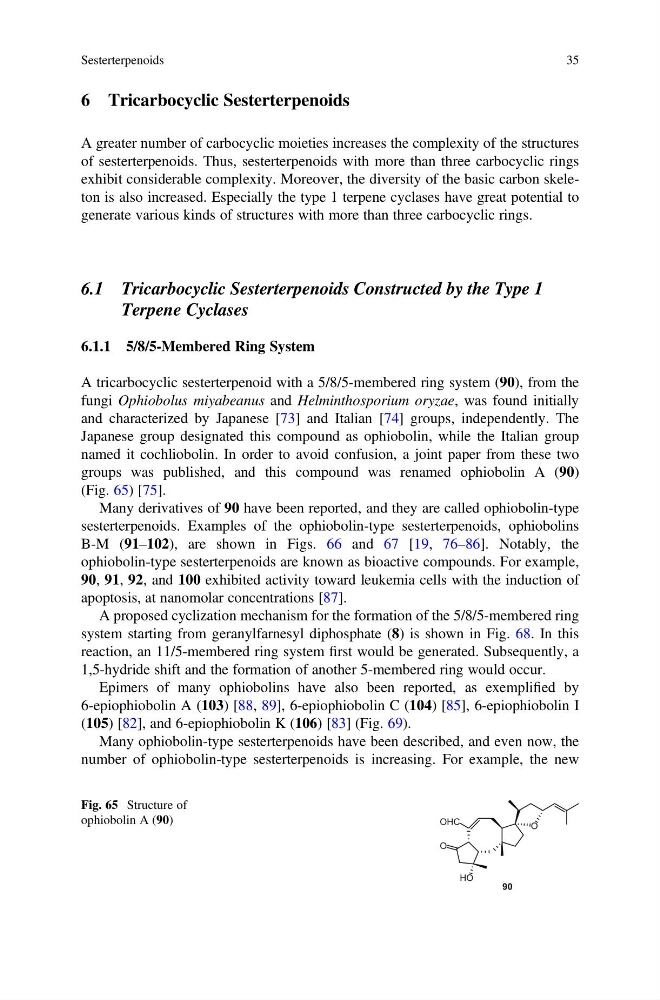
A tricarbocyclic sesterterpenoid with a 5/8/5-membered ring system (90), from the
fungi Ophiobolus miyabeanus and Helminthosporium oryzae, was found initially
and characterized by Japanese [73] and Italian [74] groups, independently. The
Japanese group designated this compound as ophiobolin, while the Italian group
named it cochliobolin. In order to avoid confusion, a joint paper from these two
groups was published, and this compound was renamed ophiobolin A (90)
(Fig. 65) [75].
Many derivatives of 90 have been reported, and they are called ophiobolin-type
sesterterpenoids. Examples of the ophiobolin-type sesterterpenoids, ophiobolins
B-M (91–102), are shown in Figs. 66 and 67 [19, 76–86]. Notably, the
ophiobolin-type sesterterpenoids are known as bioactive compounds. For example,
90, 91, 92, and 100 exhibited activity toward leukemia cells with the induction of
apoptosis, at nanomolar concentrations [87].
A proposed cyclization mechanism for the formation of the 5/8/5-membered ring
system starting from geranylfarnesyl diphosphate (8) is shown in Fig. 68. In this
reaction, an 11/5-membered ring system first would be generated. Subsequently, a
1,5-hydride shift and the formation of another 5-membered ring would occur.
Epimers of many ophiobolins have also been reported, as exemplified by
6-epiophiobolin A (103) [88, 89], 6-epiophiobolin C (104) [85], 6-epiophiobolin I
(105) [82], and 6-epiophiobolin K (106) [83] (Fig. 69).
Many ophiobolin-type sesterterpenoids have been described, and even now, the
number of ophiobolin-type sesterterpenoids is increasing. For example, the new
OHC
HO
O
O
90
Fig. 65 Structure of
ophiobolin A (90)
Sesterterpenoids
35
A greater number of carbocyclic moieties increases the complexity of the structures
of sesterterpenoids. Thus, sesterterpenoids with more than three carbocyclic rings
exhibit considerable complexity. Moreover, the diversity of the basic carbon skeleton is also increased. Especially the type 1 terpene cyclases have great potential to
generate various kinds of structures with more than three carbocyclic rings.
6.1 Tricarbocyclic Sesterterpenoids Constructed by the Type 1
Terpene Cyclases
6.1.1 5/8/5-Membered Ring System
A tricarbocyclic sesterterpenoid with a 5/8/5-membered ring system (90), from the
fungi Ophiobolus miyabeanus and Helminthosporium oryzae, was found initially
and characterized by Japanese [73] and Italian [74] groups, independently. The
Japanese group designated this compound as ophiobolin, while the Italian group
named it cochliobolin. In order to avoid confusion, a joint paper from these two
groups was published, and this compound was renamed ophiobolin A (90)
(Fig. 65) [75].
Many derivatives of 90 have been reported, and they are called ophiobolin-type
sesterterpenoids. Examples of the ophiobolin-type sesterterpenoids, ophiobolins
B-M (91–102), are shown in Figs. 66 and 67 [19, 76–86]. Notably, the
ophiobolin-type sesterterpenoids are known as bioactive compounds. For example,
90, 91, 92, and 100 exhibited activity toward leukemia cells with the induction of
apoptosis, at nanomolar concentrations [87].
A proposed cyclization mechanism for the formation of the 5/8/5-membered ring
system starting from geranylfarnesyl diphosphate (8) is shown in Fig. 68. In this
reaction, an 11/5-membered ring system first would be generated. Subsequently, a
1,5-hydride shift and the formation of another 5-membered ring would occur.
Epimers of many ophiobolins have also been reported, as exemplified by
6-epiophiobolin A (103) [88, 89], 6-epiophiobolin C (104) [85], 6-epiophiobolin I
(105) [82], and 6-epiophiobolin K (106) [83] (Fig. 69).
Many ophiobolin-type sesterterpenoids have been described, and even now, the
number of ophiobolin-type sesterterpenoids is increasing. For example, the new
OHC
HO
O
O
90
Fig. 65 Structure of
ophiobolin A (90)
Sesterterpenoids
35