

4.1.2 6-Membered Ring
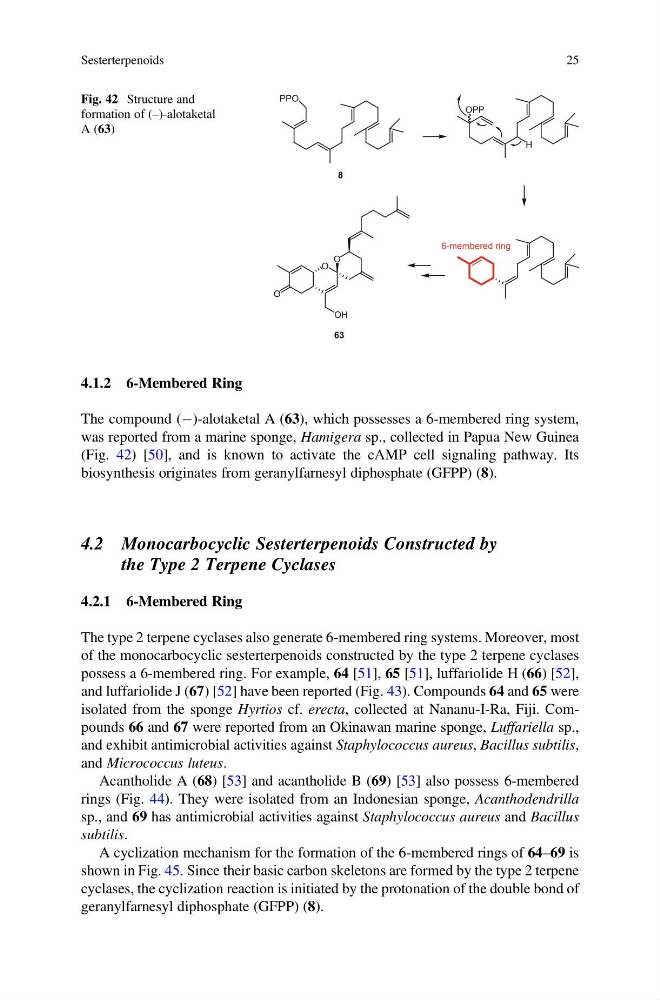
The compound (À)-alotaketal A (63), which possesses a 6-membered ring system,
was reported from a marine sponge, Hamigera sp., collected in Papua New Guinea
(Fig. 42) [50], and is known to activate the cAMP cell signaling pathway. Its
biosynthesis originates from geranylfarnesyl diphosphate (GFPP) (8).
4.2 Monocarbocyclic Sesterterpenoids Constructed by
the Type 2 Terpene Cyclases
4.2.1 6-Membered Ring
The type 2 terpene cyclases also generate 6-membered ring systems. Moreover, most
of the monocarbocyclic sesterterpenoids constructed by the type 2 terpene cyclases
possess a 6-membered ring. For example, 64 [51], 65 [51], luffariolide H (66) [52],
and luffariolide J (67) [52] have been reported (Fig. 43). Compounds 64 and 65 were
isolated from the sponge Hyrtios cf. erecta, collected at Nananu-I-Ra, Fiji. Compounds 66 and 67 were reported from an Okinawan marine sponge, Luffariella sp.,
and exhibit antimicrobial activities against Staphylococcus aureus, Bacillus subtilis,
and Micrococcus luteus.
Acantholide A (68) [53] and acantholide B (69) [53] also possess 6-membered
rings (Fig. 44). They were isolated from an Indonesian sponge, Acanthodendrilla
sp., and 69 has antimicrobial activities against Staphylococcus aureus and Bacillus
subtilis.
A cyclization mechanism for the formation of the 6-membered rings of 64–69 is
shown in Fig. 45. Since their basic carbon skeletons are formed by the type 2 terpene
cyclases, the cyclization reaction is initiated by the protonation of the double bond of
geranylfarnesyl diphosphate (GFPP) (8).
PPO
OPP
8
63
O
O
O
OH
H
6-membered ring
Fig. 42 Structure and
formation of (–)-alotaketal
A (63)
Sesterterpenoids
25
The compound (À)-alotaketal A (63), which possesses a 6-membered ring system,
was reported from a marine sponge, Hamigera sp., collected in Papua New Guinea
(Fig. 42) [50], and is known to activate the cAMP cell signaling pathway. Its
biosynthesis originates from geranylfarnesyl diphosphate (GFPP) (8).
4.2 Monocarbocyclic Sesterterpenoids Constructed by
the Type 2 Terpene Cyclases
4.2.1 6-Membered Ring
The type 2 terpene cyclases also generate 6-membered ring systems. Moreover, most
of the monocarbocyclic sesterterpenoids constructed by the type 2 terpene cyclases
possess a 6-membered ring. For example, 64 [51], 65 [51], luffariolide H (66) [52],
and luffariolide J (67) [52] have been reported (Fig. 43). Compounds 64 and 65 were
isolated from the sponge Hyrtios cf. erecta, collected at Nananu-I-Ra, Fiji. Compounds 66 and 67 were reported from an Okinawan marine sponge, Luffariella sp.,
and exhibit antimicrobial activities against Staphylococcus aureus, Bacillus subtilis,
and Micrococcus luteus.
Acantholide A (68) [53] and acantholide B (69) [53] also possess 6-membered
rings (Fig. 44). They were isolated from an Indonesian sponge, Acanthodendrilla
sp., and 69 has antimicrobial activities against Staphylococcus aureus and Bacillus
subtilis.
A cyclization mechanism for the formation of the 6-membered rings of 64–69 is
shown in Fig. 45. Since their basic carbon skeletons are formed by the type 2 terpene
cyclases, the cyclization reaction is initiated by the protonation of the double bond of
geranylfarnesyl diphosphate (GFPP) (8).
PPO
OPP
8
63
O
O
O
OH
H
6-membered ring
Fig. 42 Structure and
formation of (–)-alotaketal
A (63)
Sesterterpenoids
25