

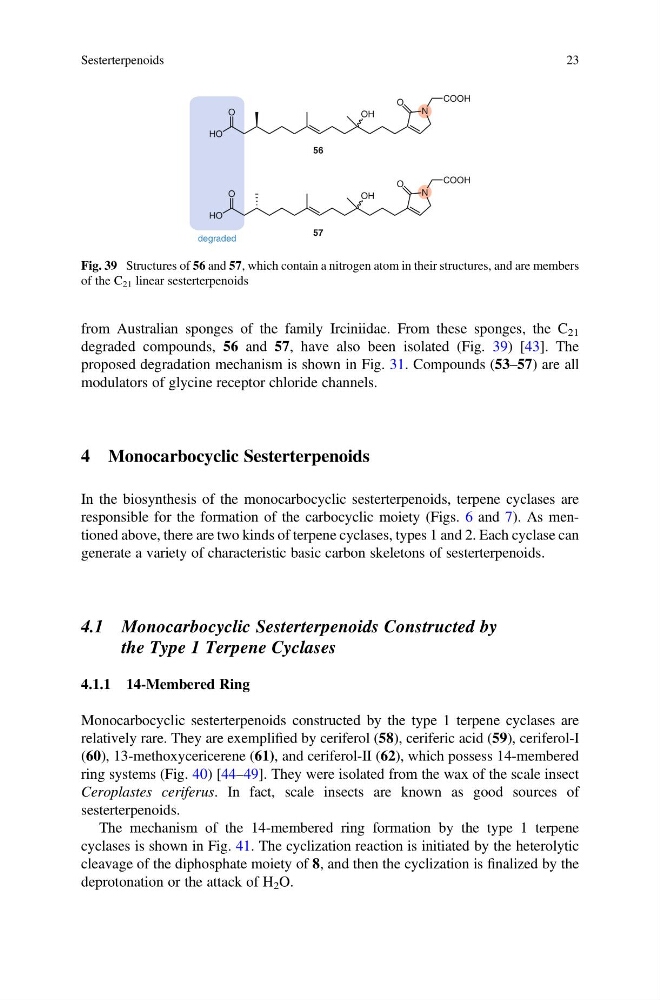
from Australian sponges of the family Irciniidae. From these sponges, the C 21
degraded compounds, 56 and 57, have also been isolated (Fig. 39) [43]. The
proposed degradation mechanism is shown in Fig. 31. Compounds (53–57) are all
modulators of glycine receptor chloride channels.
4 Monocarbocyclic Sesterterpenoids
In the biosynthesis of the monocarbocyclic sesterterpenoids, terpene cyclases are
responsible for the formation of the carbocyclic moiety (Figs. 6 and 7). As mentioned above, there are two kinds of terpene cyclases, types 1 and 2. Each cyclase can
generate a variety of characteristic basic carbon skeletons of sesterterpenoids.
4.1 Monocarbocyclic Sesterterpenoids Constructed by
the Type 1 Terpene Cyclases
4.1.1 14-Membered Ring
Monocarbocyclic sesterterpenoids constructed by the type 1 terpene cyclases are
relatively rare. They are exemplified by ceriferol (58), ceriferic acid (59), ceriferol-I
(60), 13-methoxycericerene (61), and ceriferol-II (62), which possess 14-membered
ring systems (Fig. 40) [44–49]. They were isolated from the wax of the scale insect
Ceroplastes ceriferus. In fact, scale insects are known as good sources of
sesterterpenoids.
The mechanism of the 14-membered ring formation by the type 1 terpene
cyclases is shown in Fig. 41. The cyclization reaction is initiated by the heterolytic
cleavage of the diphosphate moiety of 8, and then the cyclization is finalized by the
deprotonation or the attack of H 2 O.
56
O
OH
HO
O
OH
HO
57
degraded
N
N
O
O
COOH
COOH
Fig. 39 Structures of 56 and 57, which contain a nitrogen atom in their structures, and are members
of the C 21 linear sesterterpenoids
Sesterterpenoids
23
degraded compounds, 56 and 57, have also been isolated (Fig. 39) [43]. The
proposed degradation mechanism is shown in Fig. 31. Compounds (53–57) are all
modulators of glycine receptor chloride channels.
4 Monocarbocyclic Sesterterpenoids
In the biosynthesis of the monocarbocyclic sesterterpenoids, terpene cyclases are
responsible for the formation of the carbocyclic moiety (Figs. 6 and 7). As mentioned above, there are two kinds of terpene cyclases, types 1 and 2. Each cyclase can
generate a variety of characteristic basic carbon skeletons of sesterterpenoids.
4.1 Monocarbocyclic Sesterterpenoids Constructed by
the Type 1 Terpene Cyclases
4.1.1 14-Membered Ring
Monocarbocyclic sesterterpenoids constructed by the type 1 terpene cyclases are
relatively rare. They are exemplified by ceriferol (58), ceriferic acid (59), ceriferol-I
(60), 13-methoxycericerene (61), and ceriferol-II (62), which possess 14-membered
ring systems (Fig. 40) [44–49]. They were isolated from the wax of the scale insect
Ceroplastes ceriferus. In fact, scale insects are known as good sources of
sesterterpenoids.
The mechanism of the 14-membered ring formation by the type 1 terpene
cyclases is shown in Fig. 41. The cyclization reaction is initiated by the heterolytic
cleavage of the diphosphate moiety of 8, and then the cyclization is finalized by the
deprotonation or the attack of H 2 O.
56
O
OH
HO
O
OH
HO
57
degraded
N
N
O
O
COOH
COOH
Fig. 39 Structures of 56 and 57, which contain a nitrogen atom in their structures, and are members
of the C 21 linear sesterterpenoids
Sesterterpenoids
23