

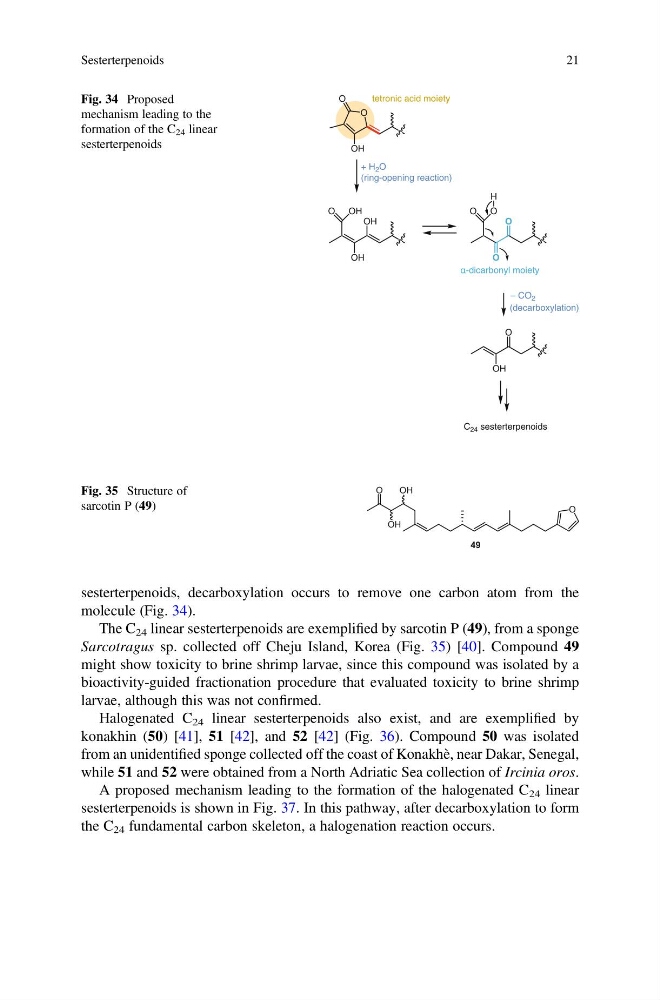
sesterterpenoids, decarboxylation occurs to remove one carbon atom from the
molecule (Fig. 34).
The C 24 linear sesterterpenoids are exemplified by sarcotin P (49), from a sponge
Sarcotragus sp. collected off Cheju Island, Korea (Fig. 35) [40]. Compound 49
might show toxicity to brine shrimp larvae, since this compound was isolated by a
bioactivity-guided fractionation procedure that evaluated toxicity to brine shrimp
larvae, although this was not confirmed.
Halogenated C 24 linear sesterterpenoids also exist, and are exemplified by
konakhin (50) [41], 51 [42], and 52 [42] (Fig. 36). Compound 50 was isolated
from an unidentified sponge collected off the coast of Konakhè, near Dakar, Senegal,
while 51 and 52 were obtained from a North Adriatic Sea collection of Ircinia oros.
A proposed mechanism leading to the formation of the halogenated C 24 linear
sesterterpenoids is shown in Fig. 37. In this pathway, after decarboxylation to form
the C 24 fundamental carbon skeleton, a halogenation reaction occurs.
OH
O
O
O
OH
O
OH
OH
O
+ H 2 O
(ring opening reaction)
tetronic acid moiety
-dicarbonyl moiety
C 24 sesterterpenoids
H
2
(decarboxylation)
O
OH
O
O
Fig. 34 Proposed
mechanism leading to the
formation of the C 24 linear
sesterterpenoids
49
O
OH
OH
O
Fig. 35 Structure of
sarcotin P (49)
Sesterterpenoids
21
molecule (Fig. 34).
The C 24 linear sesterterpenoids are exemplified by sarcotin P (49), from a sponge
Sarcotragus sp. collected off Cheju Island, Korea (Fig. 35) [40]. Compound 49
might show toxicity to brine shrimp larvae, since this compound was isolated by a
bioactivity-guided fractionation procedure that evaluated toxicity to brine shrimp
larvae, although this was not confirmed.
Halogenated C 24 linear sesterterpenoids also exist, and are exemplified by
konakhin (50) [41], 51 [42], and 52 [42] (Fig. 36). Compound 50 was isolated
from an unidentified sponge collected off the coast of Konakhè, near Dakar, Senegal,
while 51 and 52 were obtained from a North Adriatic Sea collection of Ircinia oros.
A proposed mechanism leading to the formation of the halogenated C 24 linear
sesterterpenoids is shown in Fig. 37. In this pathway, after decarboxylation to form
the C 24 fundamental carbon skeleton, a halogenation reaction occurs.
OH
O
O
O
OH
O
OH
OH
O
+ H 2 O
(ring opening reaction)
tetronic acid moiety
-dicarbonyl moiety
C 24 sesterterpenoids
H
2
(decarboxylation)
O
OH
O
O
Fig. 34 Proposed
mechanism leading to the
formation of the C 24 linear
sesterterpenoids
49
O
OH
OH
O
Fig. 35 Structure of
sarcotin P (49)
Sesterterpenoids
21