

“diterpenoids” are from (C 20 ) 7, and “triterpenoids” are from (C 30 ) squalene (17)
(Fig. 12).
In contrast to 5–8, 17 is generated by the condensation of two (C 15 ) 6 units. This
condensation pattern is known as a tail-to-tail (Fig. 13b) linkage. The other
polyprenyl diphosphates 5–8 exhibit only head-to-tail linkages (Fig. 13b).
3
OPP
OPP
OPP
4
8
sesterterpenoids
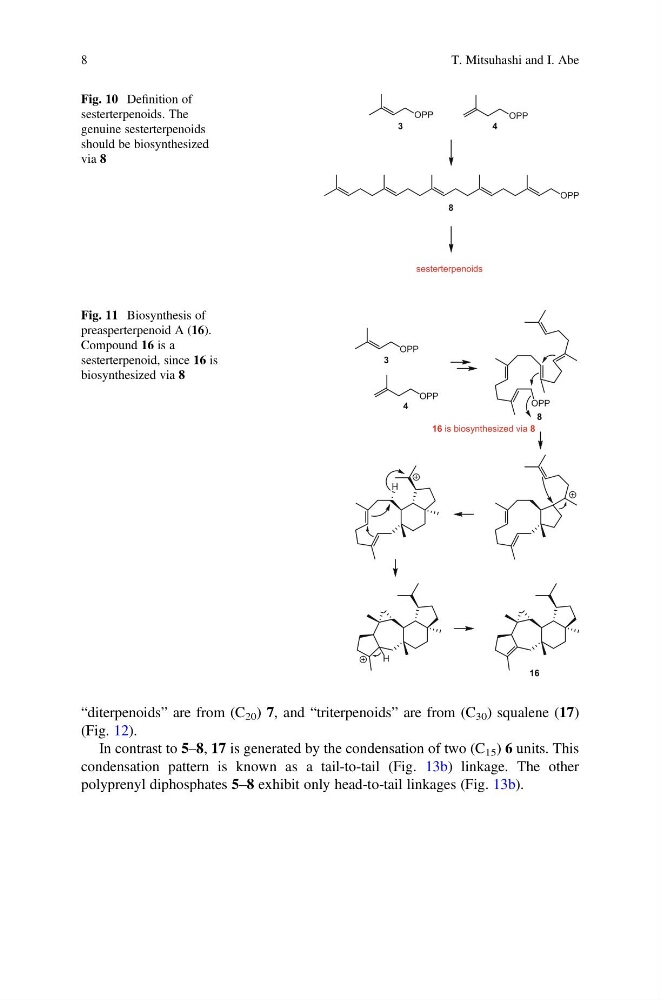
Fig. 10 Definition of
sesterterpenoids. The
genuine sesterterpenoids
should be biosynthesized
via 8
16
H
H
OPP
8
3
OPP
OPP
4
16 is biosynthesized via 8
Fig. 11 Biosynthesis of
preasperterpenoid A (16).
Compound 16 is a
sesterterpenoid, since 16 is
biosynthesized via 8
8
T. Mitsuhashi and I. Abe
(Fig. 12).
In contrast to 5–8, 17 is generated by the condensation of two (C 15 ) 6 units. This
condensation pattern is known as a tail-to-tail (Fig. 13b) linkage. The other
polyprenyl diphosphates 5–8 exhibit only head-to-tail linkages (Fig. 13b).
3
OPP
OPP
OPP
4
8
sesterterpenoids
Fig. 10 Definition of
sesterterpenoids. The
genuine sesterterpenoids
should be biosynthesized
via 8
16
H
H
OPP
8
3
OPP
OPP
4
16 is biosynthesized via 8
Fig. 11 Biosynthesis of
preasperterpenoid A (16).
Compound 16 is a
sesterterpenoid, since 16 is
biosynthesized via 8
8
T. Mitsuhashi and I. Abe