

Chemical examination of the solid rice culture of Stachybotrys chartarum
WGC-25C-6, which was obtained from the sponge Niphates recondita collected
from the inner coral reef near Weizhou Island in Beibuwan Bay, Guangxi Province,
resulted in the isolation of sixteen phenylspirodrimanes, chartarlactams AÀP (195–
210). When tested at a concentration of 10 μM in the HepG2 cell model,
chartarlactams DÀF, K, L, N, and O (198–200, 205, 206, 208, and 209) displayed
potent lipid-lowering activities as assessed by Oil Red O staining. Chartarlactams E,
F, K, and O (199, 200, 205, and 209) resulted in strong inhibition of intracellular
triglyceride levels, while chartarlactams DÀF and N (198–200 and 208) dramatically reduced total cholesterol levels [74]. Stachybotrys chartarum MXH-X73, as
obtained from the sponge Xestospongia testudinaris collected at Xisha Island,
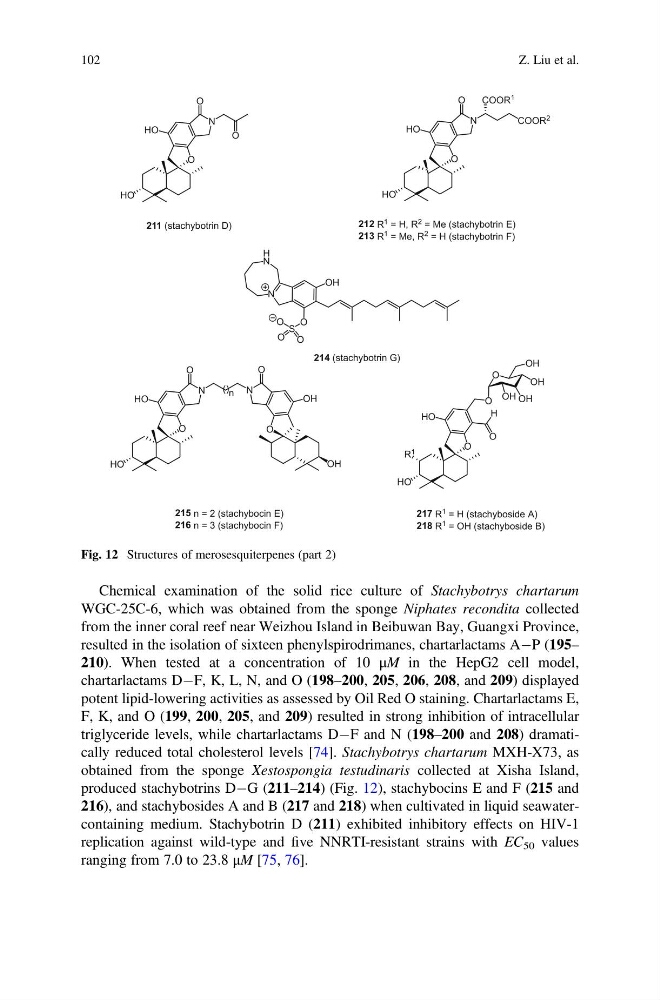
produced stachybotrins DÀG (211–214) (Fig. 12), stachybocins E and F (215 and
216), and stachybosides A and B (217 and 218) when cultivated in liquid seawatercontaining medium. Stachybotrin D (211) exhibited inhibitory effects on HIV-1
replication against wild-type and five NNRTI-resistant strains with EC 50 values
ranging from 7.0 to 23.8 μM [75, 76].
O
N
HO
O
HO
O
211 (stachybotrin D)
O
N
HO
O
HO
212 R 1 = H, R 2 = Me (stachybotrin E)
213 R
1 = Me, R
2 = H (stachybotrin F)
COOR 2
COOR 1
O
N
HO
O
HO
OH
O
OH
N
O
()
215 n = 2 (stachybocin E)
216 n = 3 (stachybocin F)
n
O
HO
HO
H
O
O
R 1
217 R 1 = H (stachyboside A)
218 R
1 = OH (stachyboside B)
O
OH
OH
OH
OH
N
H
N
OH
O S
O
O O
214 (stachybotrin G)
Fig. 12 Structures of merosesquiterpenes (part 2)
102
Z. Liu et al.
WGC-25C-6, which was obtained from the sponge Niphates recondita collected
from the inner coral reef near Weizhou Island in Beibuwan Bay, Guangxi Province,
resulted in the isolation of sixteen phenylspirodrimanes, chartarlactams AÀP (195–
210). When tested at a concentration of 10 μM in the HepG2 cell model,
chartarlactams DÀF, K, L, N, and O (198–200, 205, 206, 208, and 209) displayed
potent lipid-lowering activities as assessed by Oil Red O staining. Chartarlactams E,
F, K, and O (199, 200, 205, and 209) resulted in strong inhibition of intracellular
triglyceride levels, while chartarlactams DÀF and N (198–200 and 208) dramatically reduced total cholesterol levels [74]. Stachybotrys chartarum MXH-X73, as
obtained from the sponge Xestospongia testudinaris collected at Xisha Island,
produced stachybotrins DÀG (211–214) (Fig. 12), stachybocins E and F (215 and
216), and stachybosides A and B (217 and 218) when cultivated in liquid seawatercontaining medium. Stachybotrin D (211) exhibited inhibitory effects on HIV-1
replication against wild-type and five NNRTI-resistant strains with EC 50 values
ranging from 7.0 to 23.8 μM [75, 76].
O
N
HO
O
HO
O
211 (stachybotrin D)
O
N
HO
O
HO
212 R 1 = H, R 2 = Me (stachybotrin E)
213 R
1 = Me, R
2 = H (stachybotrin F)
COOR 2
COOR 1
O
N
HO
O
HO
OH
O
OH
N
O
()
215 n = 2 (stachybocin E)
216 n = 3 (stachybocin F)
n
O
HO
HO
H
O
O
R 1
217 R 1 = H (stachyboside A)
218 R
1 = OH (stachyboside B)
O
OH
OH
OH
OH
N
H
N
OH
O S
O
O O
214 (stachybotrin G)
Fig. 12 Structures of merosesquiterpenes (part 2)
102
Z. Liu et al.