

Each polyprenyl diphosphate is designated as follows: (C 10 ) geranyl diphosphate
(GPP) (5), (C 15 ) farnesyl diphosphate (FPP) (6), (C 20 ) geranylgeranyl diphosphate
(GGPP) (7), and (C 25 ) geranylfarnesyl diphosphate (GFPP) (8). These condensation
reactions are catalyzed by enzymes called “prenyltransferases” (Fig. 5) [6–8].
In many cases, the polyprenyl diphosphates are subjected to cyclization reactions
to form a carbocyclic moiety. These cyclization reactions are catalyzed by “terpene
cyclases.” Generally, the terpene cyclases are divided into two classes, “type 1” and
“type 2,” based on their catalytic mechanisms.
The type 1 terpene cyclases initiate the cyclization by heterolytic cleavage of the
diphosphate moiety of the polyprenyl diphosphates. The heterolytic cleavage leads
to the generation of cation intermediates, and the high energy of the cation intermediate is the driving force of the cyclization reaction. The cyclization reaction is
finalized by either deprotonation or an attack by H 2 O. For example, 1 is formed by a
type 1 terpene cyclase (Fig. 6).
The other class of terpene cyclases is known as the “type 2” terpene cyclases. The
type 2 terpene cyclases also generate cation intermediates to initiate the cyclization
reaction. However, the strategy to generate the cation intermediate is different from
that of the type 1 terpene cyclases. The type 2 terpene cyclases generate the cation
intermediate via the protonation of a double bond of the polyprenyl diphosphates.
For example, 2 is formed by a type 2 terpene cyclase (Fig. 7).
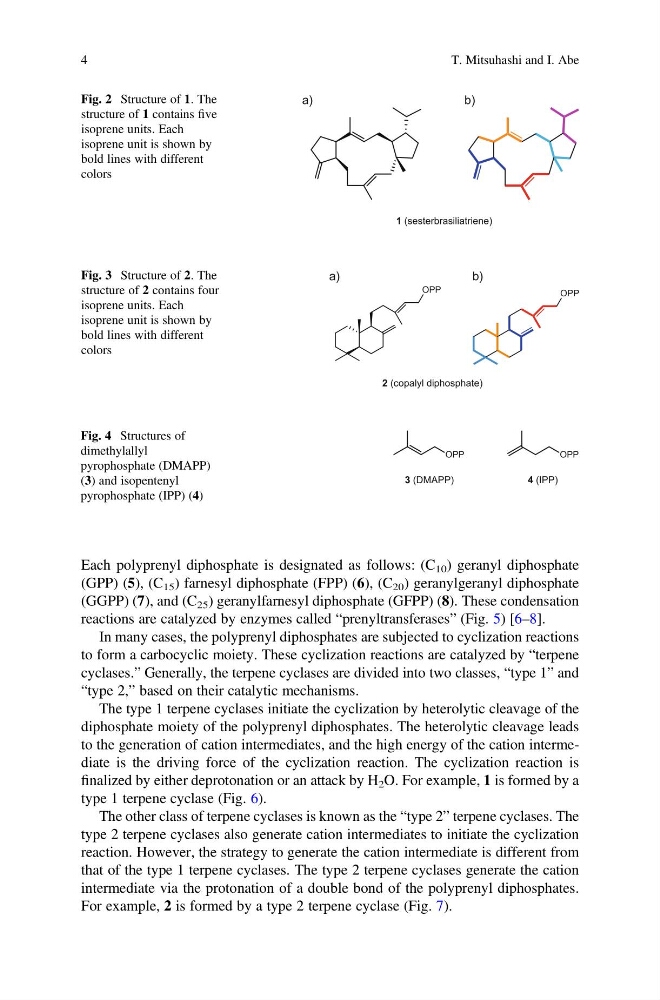
1 (sesterbrasiliatriene)
a)
b)
Fig. 2 Structure of 1. The
structure of 1 contains five
isoprene units. Each
isoprene unit is shown by
bold lines with different
colors
OPP
2 (copalyl diphosphate)
OPP
a)
b)
Fig. 3 Structure of 2. The
structure of 2 contains four
isoprene units. Each
isoprene unit is shown by
bold lines with different
colors
3 (DMAPP)
OPP
OPP
4 (IPP)
Fig. 4 Structures of
dimethylallyl
pyrophosphate (DMAPP)
(3) and isopentenyl
pyrophosphate (IPP) (4)
4
T. Mitsuhashi and I. Abe
(GPP) (5), (C 15 ) farnesyl diphosphate (FPP) (6), (C 20 ) geranylgeranyl diphosphate
(GGPP) (7), and (C 25 ) geranylfarnesyl diphosphate (GFPP) (8). These condensation
reactions are catalyzed by enzymes called “prenyltransferases” (Fig. 5) [6–8].
In many cases, the polyprenyl diphosphates are subjected to cyclization reactions
to form a carbocyclic moiety. These cyclization reactions are catalyzed by “terpene
cyclases.” Generally, the terpene cyclases are divided into two classes, “type 1” and
“type 2,” based on their catalytic mechanisms.
The type 1 terpene cyclases initiate the cyclization by heterolytic cleavage of the
diphosphate moiety of the polyprenyl diphosphates. The heterolytic cleavage leads
to the generation of cation intermediates, and the high energy of the cation intermediate is the driving force of the cyclization reaction. The cyclization reaction is
finalized by either deprotonation or an attack by H 2 O. For example, 1 is formed by a
type 1 terpene cyclase (Fig. 6).
The other class of terpene cyclases is known as the “type 2” terpene cyclases. The
type 2 terpene cyclases also generate cation intermediates to initiate the cyclization
reaction. However, the strategy to generate the cation intermediate is different from
that of the type 1 terpene cyclases. The type 2 terpene cyclases generate the cation
intermediate via the protonation of a double bond of the polyprenyl diphosphates.
For example, 2 is formed by a type 2 terpene cyclase (Fig. 7).
1 (sesterbrasiliatriene)
a)
b)
Fig. 2 Structure of 1. The
structure of 1 contains five
isoprene units. Each
isoprene unit is shown by
bold lines with different
colors
OPP
2 (copalyl diphosphate)
OPP
a)
b)
Fig. 3 Structure of 2. The
structure of 2 contains four
isoprene units. Each
isoprene unit is shown by
bold lines with different
colors
3 (DMAPP)
OPP
OPP
4 (IPP)
Fig. 4 Structures of
dimethylallyl
pyrophosphate (DMAPP)
(3) and isopentenyl
pyrophosphate (IPP) (4)
4
T. Mitsuhashi and I. Abe