

contrasting binding modes of resveratrol and its analogs in different sirtuin complexes are speculated to be evidence of distinct binding conformations of the
peptides and the local environments in the individual sirtuins. For example, in
contrast to SIRT1, SIRT5 does not have an extended N-terminal domain, and thus
when the structure of SIRT5 with resveratrol was examined, it was found that the
compound bound to a location corresponding to the binding site of Res3 in SIRT1
[176]. Resveratrol exposure has been reported to extend the lifespan of numerous
organisms including C. elegans and S. cerevisiae [178–180]. Resveratrol has
displayed also a supportive effect in numerous age-related disease models including
those mimicking cancer, type 1 and 2 diabetes, and cardiovascular disease [181].
Other polyphenols, such as chalcones including butein, and flavones including
quercetin (compound 57 in Fig. 13) were demonstrated to increase SIRT1
deacetylation activity when a fluorescent AMC moiety was attached to the peptide
substrate [168]. Additionally, flavonoids quercetin and luteolin were shown to
stimulate SIRT6 at high concentration [182]. They exhibited SIRT6 activation
with half maximal effective concentration (EC 50 ) values of 990 μM (Quercetin)
and 270 μM (Luteolin). Rahnasto-Rilla et al. [76] observed that other flavonoids
including anthocyanidins could stimulate SIRT6 catalyzed deacetylase reaction.
Cyanidin was the most potent compound in the class of anthocyanidins, achieving
a 55-fold maximal activation.
The terpenylated coumarins (compound 58 in Fig. 13) extracted from the bark of
Ailanthus altissima were reported to increase SIRT1 activity in vitro and in vivo
[167]. Furthermore, some ginsenosides such as ginsenoside Rb2 from Panax ginseng have been identified as SIRT1 activators. These ginsenoides increased the ATP
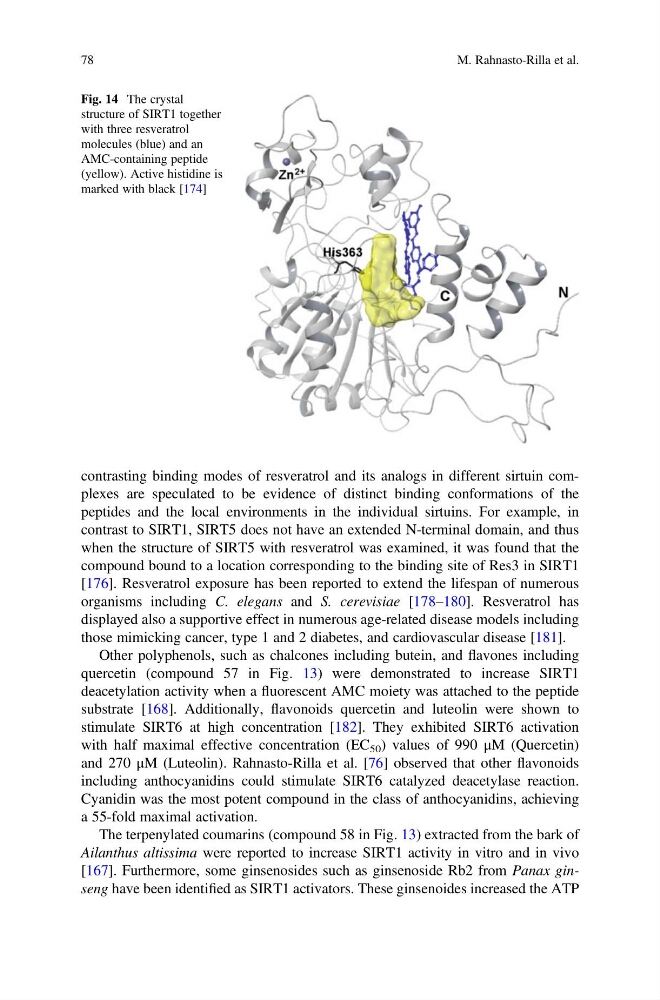
Fig. 14 The crystal
structure of SIRT1 together
with three resveratrol
molecules (blue) and an
AMC-containing peptide
(yellow). Active histidine is
marked with black [174]
78
M. Rahnasto-Rilla et al.
peptides and the local environments in the individual sirtuins. For example, in
contrast to SIRT1, SIRT5 does not have an extended N-terminal domain, and thus
when the structure of SIRT5 with resveratrol was examined, it was found that the
compound bound to a location corresponding to the binding site of Res3 in SIRT1
[176]. Resveratrol exposure has been reported to extend the lifespan of numerous
organisms including C. elegans and S. cerevisiae [178–180]. Resveratrol has
displayed also a supportive effect in numerous age-related disease models including
those mimicking cancer, type 1 and 2 diabetes, and cardiovascular disease [181].
Other polyphenols, such as chalcones including butein, and flavones including
quercetin (compound 57 in Fig. 13) were demonstrated to increase SIRT1
deacetylation activity when a fluorescent AMC moiety was attached to the peptide
substrate [168]. Additionally, flavonoids quercetin and luteolin were shown to
stimulate SIRT6 at high concentration [182]. They exhibited SIRT6 activation
with half maximal effective concentration (EC 50 ) values of 990 μM (Quercetin)
and 270 μM (Luteolin). Rahnasto-Rilla et al. [76] observed that other flavonoids
including anthocyanidins could stimulate SIRT6 catalyzed deacetylase reaction.
Cyanidin was the most potent compound in the class of anthocyanidins, achieving
a 55-fold maximal activation.
The terpenylated coumarins (compound 58 in Fig. 13) extracted from the bark of
Ailanthus altissima were reported to increase SIRT1 activity in vitro and in vivo
[167]. Furthermore, some ginsenosides such as ginsenoside Rb2 from Panax ginseng have been identified as SIRT1 activators. These ginsenoides increased the ATP
Fig. 14 The crystal
structure of SIRT1 together
with three resveratrol
molecules (blue) and an
AMC-containing peptide
(yellow). Active histidine is
marked with black [174]
78
M. Rahnasto-Rilla et al.