

Another series of SirReal2 analogs was developed by Yang and coworkers; the most
potent inhibitor (compound 42 in Fig. 8) exhibited an IC 50 value of 42 nM for SIRT2
and displayed an antiproliferative effect in a breast cancer cell line (MCF7) [125].
2.3.5 AGK2 and Sulfobenzoic Acid Derivatives
Based on screening, AGK2 (compound 43 in Fig. 10) was identified as a selective
SIRT2 inhibitor exhibiting an IC 50 value of 3.5 μM [125]. In this screening program,
other potent SIRT2 inhibitors were also identified: sulfobenzoic acid derivatives,
AK–1 (IC 50 ¼ 12.5 μM) (compound 44 in Fig. 10) [127] and C2–8 [128]. Interestingly, both AGK2 and AK-1 prevented alpha-synuclein toxicity in cell-based and
Drosophila models of Parkinson’s disease (PD) [129]. They also prevented mutant
polyglutamine toxicity in Drosophila and C. elegans PD models [130] and were also
neuroprotective in mouse models [131]. The sulfobenzoic acid derivative C2–8 was
neuroprotective in HD mice [132, 133].
Several analogs of AK-1 were developed and tested for inhibitory properties
against SIRT1–3. Many of these analogs were more potent inhibitors against SIRT2
displaying IC 50 values in a range between 4 μM and 10 μM in comparison with their
effects on the other sirtuins [134]. 3-(1-Azepanylsulfonyl-)-N-(3-bromophenyl)
benzamide, also called AK-7 (compound 45 in Fig. 10), showed a dose-dependent
and selective inhibition for SIRT2 (IC 50 ¼ 15.5 μM) [133]. However, AK-7 was
neuroprotective in vitro, and it reduced polyglutamine inclusions and cholesterol
levels in neurons. AK-7 has also been studied in vivo in both truncated and fulllength HD mouse models where it was able to improve the mice’s motor function,
extend their survival, and reduce the extent of brain atrophy [132]. AK-7 was also
claimed to be neuroprotective in PD [135, 136]. In addition, the novel thiazolecontaining inhibitors of SIRT2 that are derivatives of 8-nitro-5-R-quinoline and
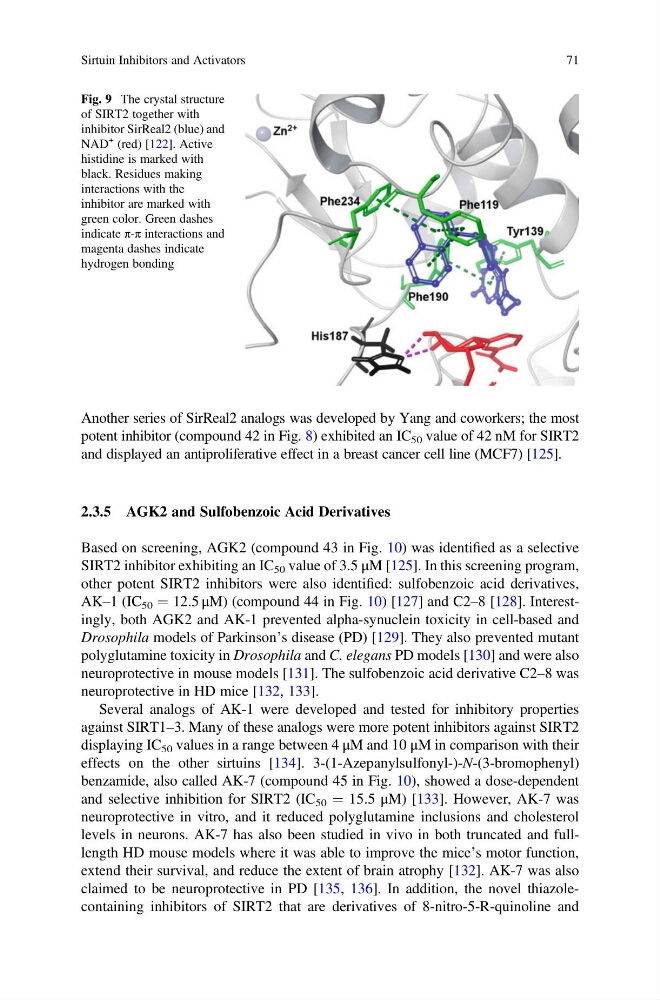
Fig. 9 The crystal structure
of SIRT2 together with
inhibitor SirReal2 (blue) and
NAD
+ (red) [122]. Active
histidine is marked with
black. Residues making
interactions with the
inhibitor are marked with
green color. Green dashes
indicate π-π interactions and
magenta dashes indicate
hydrogen bonding
Sirtuin Inhibitors and Activators
71
potent inhibitor (compound 42 in Fig. 8) exhibited an IC 50 value of 42 nM for SIRT2
and displayed an antiproliferative effect in a breast cancer cell line (MCF7) [125].
2.3.5 AGK2 and Sulfobenzoic Acid Derivatives
Based on screening, AGK2 (compound 43 in Fig. 10) was identified as a selective
SIRT2 inhibitor exhibiting an IC 50 value of 3.5 μM [125]. In this screening program,
other potent SIRT2 inhibitors were also identified: sulfobenzoic acid derivatives,
AK–1 (IC 50 ¼ 12.5 μM) (compound 44 in Fig. 10) [127] and C2–8 [128]. Interestingly, both AGK2 and AK-1 prevented alpha-synuclein toxicity in cell-based and
Drosophila models of Parkinson’s disease (PD) [129]. They also prevented mutant
polyglutamine toxicity in Drosophila and C. elegans PD models [130] and were also
neuroprotective in mouse models [131]. The sulfobenzoic acid derivative C2–8 was
neuroprotective in HD mice [132, 133].
Several analogs of AK-1 were developed and tested for inhibitory properties
against SIRT1–3. Many of these analogs were more potent inhibitors against SIRT2
displaying IC 50 values in a range between 4 μM and 10 μM in comparison with their
effects on the other sirtuins [134]. 3-(1-Azepanylsulfonyl-)-N-(3-bromophenyl)
benzamide, also called AK-7 (compound 45 in Fig. 10), showed a dose-dependent
and selective inhibition for SIRT2 (IC 50 ¼ 15.5 μM) [133]. However, AK-7 was
neuroprotective in vitro, and it reduced polyglutamine inclusions and cholesterol
levels in neurons. AK-7 has also been studied in vivo in both truncated and fulllength HD mouse models where it was able to improve the mice’s motor function,
extend their survival, and reduce the extent of brain atrophy [132]. AK-7 was also
claimed to be neuroprotective in PD [135, 136]. In addition, the novel thiazolecontaining inhibitors of SIRT2 that are derivatives of 8-nitro-5-R-quinoline and
Fig. 9 The crystal structure
of SIRT2 together with
inhibitor SirReal2 (blue) and
NAD
+ (red) [122]. Active
histidine is marked with
black. Residues making
interactions with the
inhibitor are marked with
green color. Green dashes
indicate π-π interactions and
magenta dashes indicate
hydrogen bonding
Sirtuin Inhibitors and Activators
71