

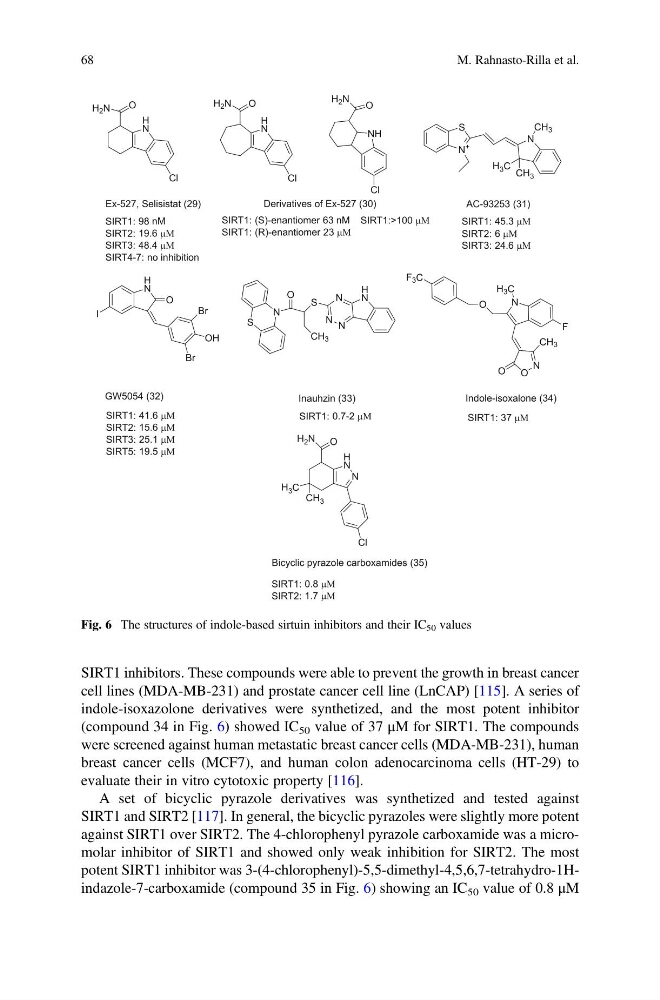
SIRT1 inhibitors. These compounds were able to prevent the growth in breast cancer
cell lines (MDA-MB-231) and prostate cancer cell line (LnCAP) [115]. A series of
indole-isoxazolone derivatives were synthetized, and the most potent inhibitor
(compound 34 in Fig. 6) showed IC 50 value of 37 μM for SIRT1. The compounds
were screened against human metastatic breast cancer cells (MDA-MB-231), human
breast cancer cells (MCF7), and human colon adenocarcinoma cells (HT-29) to
evaluate their in vitro cytotoxic property [116].
A set of bicyclic pyrazole derivatives was synthetized and tested against
SIRT1 and SIRT2 [117]. In general, the bicyclic pyrazoles were slightly more potent
against SIRT1 over SIRT2. The 4-chlorophenyl pyrazole carboxamide was a micromolar inhibitor of SIRT1 and showed only weak inhibition for SIRT2. The most
potent SIRT1 inhibitor was 3-(4-chlorophenyl)-5,5-dimethyl-4,5,6,7-tetrahydro-1Hindazole-7-carboxamide (compound 35 in Fig. 6) showing an IC 50 value of 0.8 μM
H
N
H 2 N
O
Ex-527, Selisistat (29)
SIRT1: 98 nM
SIRT2: 19.6
SIRT3: 48.4
SIRT4-7: no inhibition
Cl
N
+
S
N
H 3 C CH 3
CH 3
AC-93253 (31)
SIRT2: 6
SIRT1: 45.3
SIRT3: 24.6
NH
H
N
Cl
O
H 2 N
Derivatives of Ex-527 (30)
SIRT1: (S)-enantiomer 63 nM
SIRT1: (R)-enantiomer 23
Cl
O
H 2 N
SIRT1:>100
S
N
N N
N
H
N
S
CH 3
O
Inauhzin (33)
SIRT1: 0.7-2
N
O
F 3 C
H 3 C
O
N
O
F
CH 3
Indole-isoxalone (34)
SIRT1: 37
H
N
O
Br
OH
Br
I
GW5054 (32)
SIRT1: 41.6
SIRT2: 15.6
SIRT3: 25.1
SIRT5: 19.5
N
H
N
H 2 N
O
Cl
Bicyclic pyrazole carboxamides (35)
SIRT1: 0.8
SIRT2: 1.7
H 3 C
CH 3
Fig. 6 The structures of indole-based sirtuin inhibitors and their IC 50 values
68
M. Rahnasto-Rilla et al.
cell lines (MDA-MB-231) and prostate cancer cell line (LnCAP) [115]. A series of
indole-isoxazolone derivatives were synthetized, and the most potent inhibitor
(compound 34 in Fig. 6) showed IC 50 value of 37 μM for SIRT1. The compounds
were screened against human metastatic breast cancer cells (MDA-MB-231), human
breast cancer cells (MCF7), and human colon adenocarcinoma cells (HT-29) to
evaluate their in vitro cytotoxic property [116].
A set of bicyclic pyrazole derivatives was synthetized and tested against
SIRT1 and SIRT2 [117]. In general, the bicyclic pyrazoles were slightly more potent
against SIRT1 over SIRT2. The 4-chlorophenyl pyrazole carboxamide was a micromolar inhibitor of SIRT1 and showed only weak inhibition for SIRT2. The most
potent SIRT1 inhibitor was 3-(4-chlorophenyl)-5,5-dimethyl-4,5,6,7-tetrahydro-1Hindazole-7-carboxamide (compound 35 in Fig. 6) showing an IC 50 value of 0.8 μM
H
N
H 2 N
O
Ex-527, Selisistat (29)
SIRT1: 98 nM
SIRT2: 19.6
SIRT3: 48.4
SIRT4-7: no inhibition
Cl
N
+
S
N
H 3 C CH 3
CH 3
AC-93253 (31)
SIRT2: 6
SIRT1: 45.3
SIRT3: 24.6
NH
H
N
Cl
O
H 2 N
Derivatives of Ex-527 (30)
SIRT1: (S)-enantiomer 63 nM
SIRT1: (R)-enantiomer 23
Cl
O
H 2 N
SIRT1:>100
S
N
N N
N
H
N
S
CH 3
O
Inauhzin (33)
SIRT1: 0.7-2
N
O
F 3 C
H 3 C
O
N
O
F
CH 3
Indole-isoxalone (34)
SIRT1: 37
H
N
O
Br
OH
Br
I
GW5054 (32)
SIRT1: 41.6
SIRT2: 15.6
SIRT3: 25.1
SIRT5: 19.5
N
H
N
H 2 N
O
Cl
Bicyclic pyrazole carboxamides (35)
SIRT1: 0.8
SIRT2: 1.7
H 3 C
CH 3
Fig. 6 The structures of indole-based sirtuin inhibitors and their IC 50 values
68
M. Rahnasto-Rilla et al.