

Salermide also exhibited an antiproliferative effect on human leukemia cells
(MOLT4), breast cancer (MDA-MB-231), and colon (RKO) cancer cells. It
displayed potency against colorectal carcinoma and glioblastoma multiforme cancer
stem cells. Some of these analogs evoked massive apoptosis of human leukemia
(U937) cells [87].
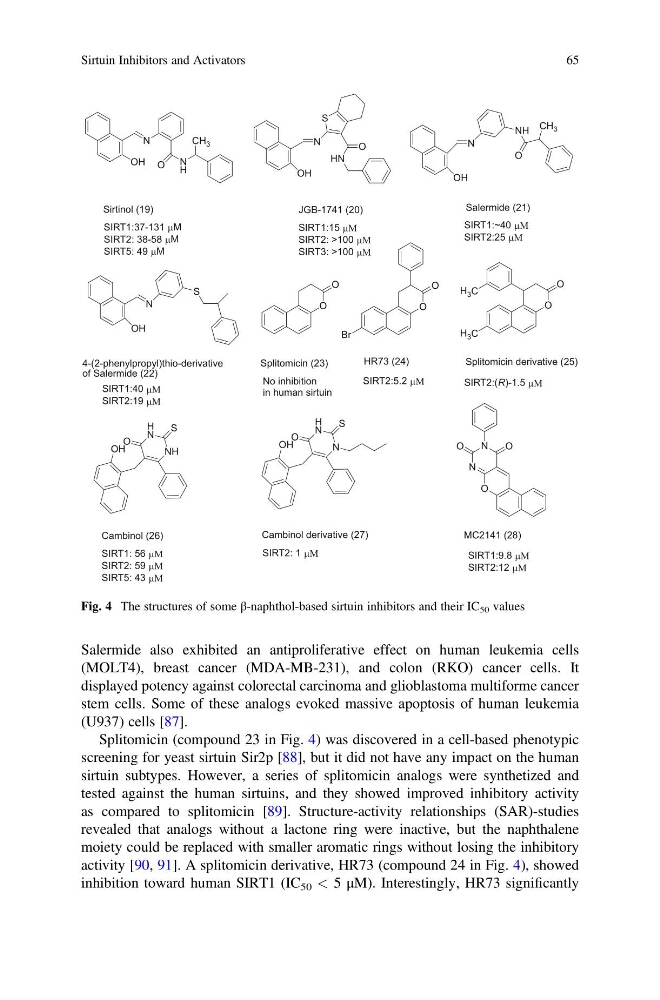
Splitomicin (compound 23 in Fig. 4) was discovered in a cell-based phenotypic
screening for yeast sirtuin Sir2p [88], but it did not have any impact on the human
sirtuin subtypes. However, a series of splitomicin analogs were synthetized and
tested against the human sirtuins, and they showed improved inhibitory activity
as compared to splitomicin [89]. Structure-activity relationships (SAR)-studies
revealed that analogs without a lactone ring were inactive, but the naphthalene
moiety could be replaced with smaller aromatic rings without losing the inhibitory
activity [90, 91]. A splitomicin derivative, HR73 (compound 24 in Fig. 4), showed
inhibition toward human SIRT1 (IC 50 < 5 μM). Interestingly, HR73 significantly
N
O
N
H
CH 3
OH
Sirtinol (19)
SIRT1:37-131 μM
SIRT2: 38-58 μM
SIRT5: 49 μM
N
S
O
HN
OH
JGB-1741 (20)
SIRT1:15 μΜ
SIRT2: >100 μΜ
SIRT3: >100 μΜ
N
NH CH 3
OH
O
Salermide (21)
SIRT1:~40 μΜ
SIRT2:25 μΜ
OH
N
S
4-(2-phenylpropyl)thio-derivative
of Salermide (22)
SIRT1:40 μΜ
SIRT2:19 μΜ
Splitomicin (23)
No inhibition
in human sirtuin
SIRT2:(R)-1.5 μΜ
NH
H
N
O
S
Cambinol (26)
SIRT1: 56 μΜ
SIRT2: 59 μΜ
SIRT5: 43 μΜ
Splitomicin derivative (25)
OH
N
H
N
O
S
OH
Cambinol derivative (27)
SIRT2: 1 μΜ
O
O
H 3 C
H 3 C
O
O
O
O
Br
HR73 (24)
SIRT2:5.2 μΜ
N
N
O
O
MC2141 (28)
SIRT1:9.8 μΜ
SIRT2:12 μΜ
O
Fig. 4 The structures of some β-naphthol-based sirtuin inhibitors and their IC 50 values
Sirtuin Inhibitors and Activators
65
(MOLT4), breast cancer (MDA-MB-231), and colon (RKO) cancer cells. It
displayed potency against colorectal carcinoma and glioblastoma multiforme cancer
stem cells. Some of these analogs evoked massive apoptosis of human leukemia
(U937) cells [87].
Splitomicin (compound 23 in Fig. 4) was discovered in a cell-based phenotypic
screening for yeast sirtuin Sir2p [88], but it did not have any impact on the human
sirtuin subtypes. However, a series of splitomicin analogs were synthetized and
tested against the human sirtuins, and they showed improved inhibitory activity
as compared to splitomicin [89]. Structure-activity relationships (SAR)-studies
revealed that analogs without a lactone ring were inactive, but the naphthalene
moiety could be replaced with smaller aromatic rings without losing the inhibitory
activity [90, 91]. A splitomicin derivative, HR73 (compound 24 in Fig. 4), showed
inhibition toward human SIRT1 (IC 50 < 5 μM). Interestingly, HR73 significantly
N
O
N
H
CH 3
OH
Sirtinol (19)
SIRT1:37-131 μM
SIRT2: 38-58 μM
SIRT5: 49 μM
N
S
O
HN
OH
JGB-1741 (20)
SIRT1:15 μΜ
SIRT2: >100 μΜ
SIRT3: >100 μΜ
N
NH CH 3
OH
O
Salermide (21)
SIRT1:~40 μΜ
SIRT2:25 μΜ
OH
N
S
4-(2-phenylpropyl)thio-derivative
of Salermide (22)
SIRT1:40 μΜ
SIRT2:19 μΜ
Splitomicin (23)
No inhibition
in human sirtuin
SIRT2:(R)-1.5 μΜ
NH
H
N
O
S
Cambinol (26)
SIRT1: 56 μΜ
SIRT2: 59 μΜ
SIRT5: 43 μΜ
Splitomicin derivative (25)
OH
N
H
N
O
S
OH
Cambinol derivative (27)
SIRT2: 1 μΜ
O
O
H 3 C
H 3 C
O
O
O
O
Br
HR73 (24)
SIRT2:5.2 μΜ
N
N
O
O
MC2141 (28)
SIRT1:9.8 μΜ
SIRT2:12 μΜ
O
Fig. 4 The structures of some β-naphthol-based sirtuin inhibitors and their IC 50 values
Sirtuin Inhibitors and Activators
65